From the 7 to the 11 September, I'm going to be Rome for the 37th session of the Committee on Fisheries, working as technical support to the Marshall Islands Marine Resources Authority.
Seventeen years ago I worked in that building as a fisheries officer. I left in 2009 and wrote a blog about why (one of my first ones on another platform). So walking back into the COFI plenary room as a delegate of a member state instead of an officer or a consultant will be interesting and some way of closing the circle.
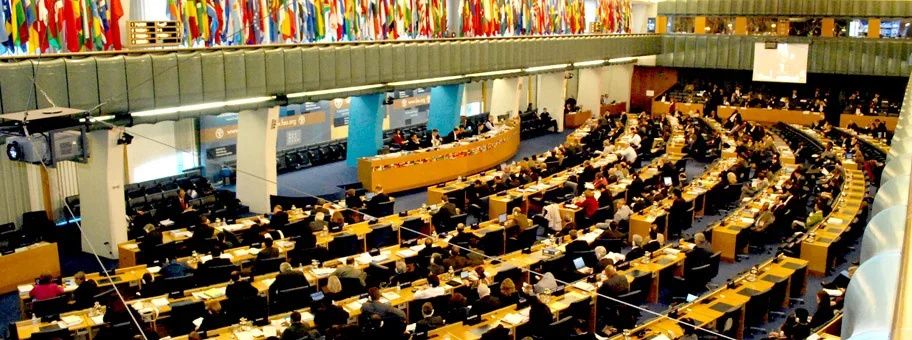
Fisheries fun
So let me use this post to explain what COFI actually is, what the paperwork looks like, and what it feels like to come back from the other side.
What COFI is
The Committee on Fisheries is a subsidiary body of the FAO Council. The FAO Conference set it up in 1965, and it meets every two years. It is the only global intergovernmental forum where countries sit down together to deal with fisheries and aquaculture. That sentence gets repeated a lot in FAO material, and it is easy to skim past, but it is true, and it matters. There is no other room like it.
COFI does two things. It leads negotiations on international agreements on fisheries and aquaculture and issues global recommendations and policy advice to governments, regional fishery bodies, civil society, the private sector, and the wider international community. Over the years, it has produced binding agreements and non-binding instruments that changed how the sector works, mostly in the direction of resource sustainability and biodiversity conservation.
If you work in fisheries, you already live inside things that came out of that room. The Code of Conduct for Responsible Fisheries. The Port State Measures Agreement. The Voluntary Guidelines for Catch Documentation Schemes. The Voluntary Guidelines for Transhipment. The Small-Scale Fisheries Guidelines, and so on… Every one of them started as a draft, that then got discussed by FAO officers, then go trough a expert cosnsultation, then a technical consultation and along the proces a poing in the COFI agenda, where it gets argued over line by line, and finally may end up as something a port inspector in Majuro or a fisheries officer in Honiara now has to apply on a Tuesday morning.
That is the thing about COFI. It looks like a conference. It is actually the upstream end of the work most of us do downstream.
The paperwork, and why it matters
COFI runs on documents, and there are three kinds.
Working Documents are the core official papers, prepared by the Secretariat to guide the Committee's deliberations. Each one is tied to an agenda item. They provide context, an overview of FAO's work in that space, and a summary of the key issues, options, and recommendations for Members to consider. These are the ones intended to support negotiation and formal action. If you only have time to read one category, read these, because these are the ones that turn into decisions.
Information Documents are supplementary. They sit behind the Working Documents and go deeper on a specific topic. They are not up for negotiation, and nobody is going to endorse them. Their job is to inform. Very often they hold the detail that the Working Document had to compress into a paragraph, so if a Working Document says something that will land on your country, the Information Document is where you go to find out how hard.
Session Background Documents are broader context and reference material for the session as a whole. Useful, occasionally very useful, but not the thing you build a position on.
For a small delegation, this hierarchy is a matter of survival. A big delegation reads everything, with a person per agenda item and a capital behind them sending instructions. A Pacific island delegation may be two or three people covering an agenda that runs from aquaculture to fisheries subsidies to climate adaptation. You cannot have the capacity to deal with all of them with the same attention. You triage, identify which lines actually touch your country, and focus your preparation there.
That triage is a lot of what I'm there for. Read the papers, find the parts that land on RMI, work out what they mean in practice for a country with the world's busiest tuna transhipment port and an administration of a dozen people, and turn that into something the delegate can say in two minutes with the microphone on.
Coming back
I first walked into FAO because of FAO. I was trained by a Fisheries Department programme as an 18-year-old fisherman in Argentina. That training gave me knowledge, but more than that, it gave me a start. Years later, I got a job there, replacing one of the people who had trained me, which felt like closing another circle. I still think FAO changes people's lives more reliably than it changes the world, and I have no standing to complain, because it changed mine twice.
Then I quit, after a bit over a year, having been picked from more than 100 candidates for the post. People found that hard to understand at the time (and so did I). It was a well-paid job with diplomatic status, real research freedom, and Rome outside the window. Rome is one of the most beautiful cities in history, and I loved it. But she asks a price, and I was not willing to keep paying it.
The reasons I wrote down in 2009 have not changed much on rereading. Some of it was family. I'm a village boy, and I wanted my kids to grow up somewhere small, walking home along the beach, in a place where, if they got into trouble, almost anyone they ran into would try to help. Some of it was me. I grew up in a society where personal effort alone did not cut the cake, where who you knew mattered more than what you did, and I had spent years in rebellion against exactly that. I did not want to hand it to my children as normal. New Zealand let a 29-year-old with 300 dollars in savings start again without anyone asking which party he belonged to or which school he went to. Those are the values I wanted them to know still exist somewhere, and those values are not the ones that guide Italy… as much as I love the country.
I also wrote at the time that FAO Fisheries was a good old solid boat, the only one of her kind, but one that burns a lot of fuel just to stay afloat, and that the responsibility for that lies with the skipper. Seventeen years later, I would not change the metaphor much. She is still the only boat of her kind, which is precisely why the state of her engines is everyone's problem and not just FAO's.
What I took away was better than what I gave up. I worked alongside some genuine popes of very specific corners of fisheries. I found my tribe: transient, borderless, mixed origins, doing for a living things most people do not know anyone does. And I proved to myself that you can get somewhere on your own terms, without a tie, without diplomatic language, without powerful recommenders, as long as you are consistent and you treat people with respect. That is not a small thing to learn.
Twenty years of paperwork coming back around
The odd part of reading the COFI 37 papers has been how much of the agenda I have already met somewhere, at an earlier stage of its life.
My relationship with the institution is now about twenty years old (2208), and at that time I i evaluated the operational impact on the initial text of what became the Port State Measures Agreement. Then, as a consultant, I drafted the initial text of the Catch Documentation Scheme guidelines and then sat in on the expert consultations that turned it into something Members could adopt. I was in the expert and then technical consultations for the Transhipment guidelines. I drafted the initial text of the guidance on social responsibility in fisheries and aquaculture value chains, which the Sub-Committee on Fish Trade has now consolidated into a single document and is moving towards finalisation. I led the writing of the end-to-end traceability guidelines. And right now I'm working on the draft of the voluntary guidelines for fisheries access agreements, which appears in the COFI 37 papers as work FAO has started and will bring back to a future session. And i wrote a couple of books for them that condiment al lot of the issues being discussed.
So several items on this agenda are, in a very direct sense, drafts I once had in front of me on a screen, now grown up and being discussed by 190-odd countries. Nobody's name is on any of it, which is exactly how it should be. Text that survives that process no longer belongs to whoever typed the first version, and that is the point.
Still. As someone who sees themself as an ex-fisherman who got carried away by education and works independently as a 1-man band…. I’m quite proud of my relationship with FAO
The other side of the table
So the interesting part of September, for me, is the change of seat.
When you sit on the Secretariat side, you write the papers. You choose the framing, decide what goes in the Working Document and what gets pushed to an Information Document, and draft the suggested action the Committee is invited to take. You are trying to be even-handed across 190-odd Members, which in practice means the text ends up general enough that nobody objects.
When you sit behind a country's nameplate, you have to live with the result. General text is not neutral. A recommendation written to suit everyone tends to suit the countries with the administrative capacity to implement it, and quietly burden those without.
A capacity development programme designed in Rome is delivered in Busan, Malta and Vigo, and the numbers show how much of it has ever reached the Pacific. None of that is malice. It is just what happens when nobody in the room says the specific thing out loud.
Which is the job. Not to make noise, but to put the specific thing on the record, in two minutes, with the facts straight. Majuro handles more tuna transhipment than any port on earth. RMI ratified the Port State Measures Agreement in 2024. Tuna biomass is projected to move east out of Pacific island zones as the ocean warms, taking access revenue with it. Those are facts, and facts said plainly into a microphone in that room have a way of turning up in text two years later.
I got a good reference and an open door when I left in 2009. I never went back through it as a staff member. Going back through it as technical support for a Pacific island member country is, I suspect, closing another circle in my sunset years that allows me to see issues from many sides, something I consider a blessing life gives me.