The debate over bottom trawling's impacts on seabed carbon has intensified recently. Policymakers and environmental advocates often paint the issue in stark terms: bottom trawls disturb the seafloor, release carbon, and therefore must be restricted or banned entirely. It's a compelling narrative. It's also incomplete.
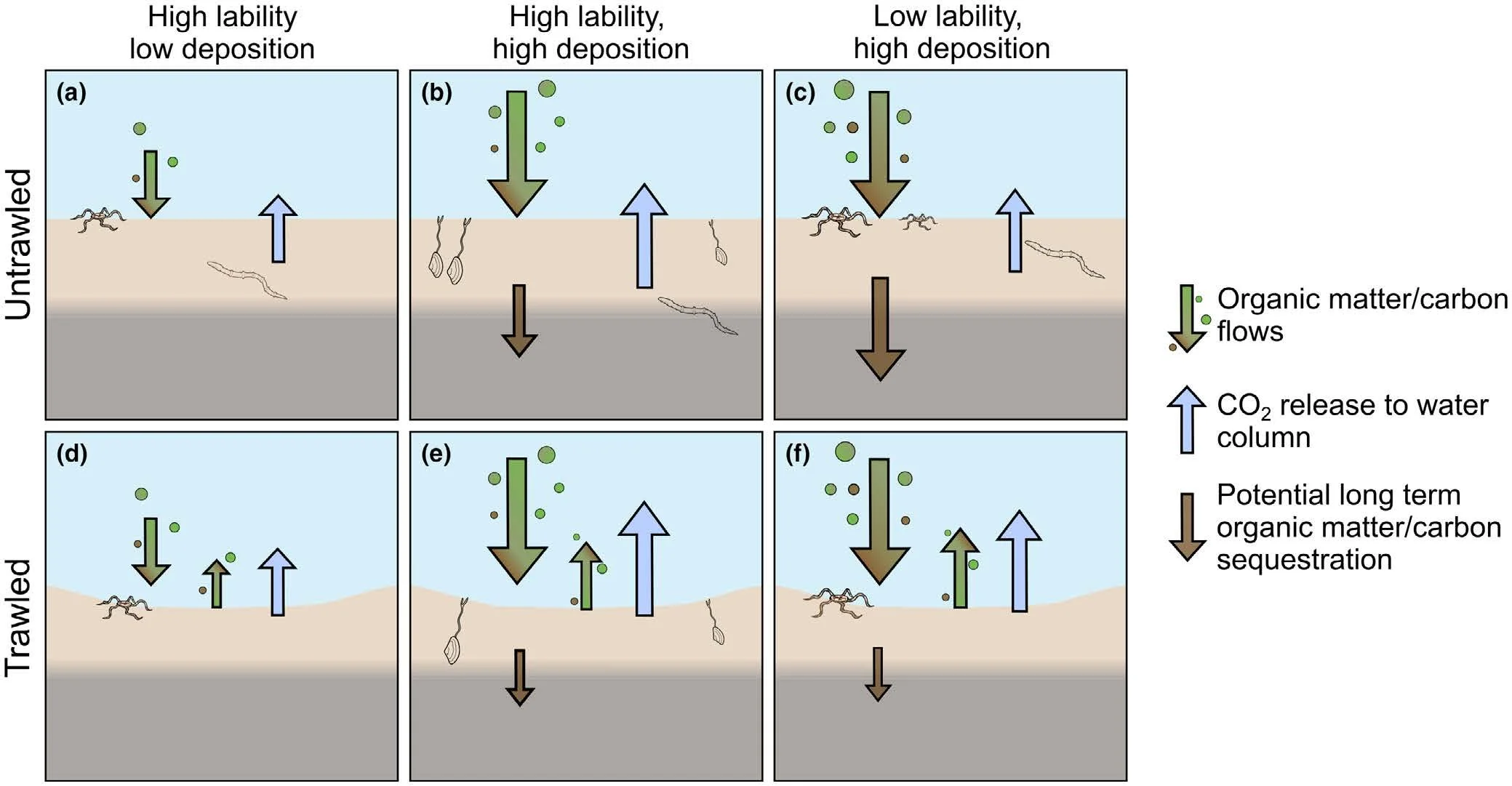
Conceptual examples of marine habitats illustrating potential combinations of organic matter (OM) lability, deposition rate and trawling disturbance.
A recent paper, “Rethinking the impacts of bottom trawling on seabed carbon: Biogeochemical mechanisms, vulnerability and long-term climate consequences” in the Journal of Applied Ecology by Justin Tiano and Emil De Borger cuts through the oversimplification to reveal something far more interesting (and actionable) about how we should approach this problem.
The Real Problem with Simple Solutions
Here's the uncomfortable truth that Tiano and De Borger set out: not all carbon in the seabed is equally vulnerable to trawling, and not all trawling impacts are equally harmful to the climate. Worse, protecting areas solely because they contain labile (easily degradable) carbon might distract us from protecting areas that matter more for long-term climate mitigation. This matters enormously if we're serious about effective marine policy.
The authors synthesise a decade of research showing that bottom disturbance creates what we might call 'competing climate effects.'When trawl gear scrapes across the seafloor, it does several things simultaneously: it resuspends organic matter into the water column, mechanically mixes sediments, and redistributes material. Each process has opposing effects on carbon cycling across different parts of the water-sediment system.
Take resuspension. When reactive organic carbon is stirred up from the seafloor into the oxygenated water column, it mineralises more rapidly, releasing CO₂. That's real. But here's the wrinkle: much of this carbon would have been degraded relatively quickly anyway, even without disturbance. In other words, trawling may be accelerating a process that was already going to happen. Distinguishing between carbon genuinely diverted from long-term burial and carbon simply undergoing mineralisation on a slightly faster timescale is crucial—and context-dependent.
The Mechanism Question: Exactly What is Trawling Doing?
What I find most valuable about this paper is its careful dissection of the mechanism. The authors identify three primary physical disturbance pathways: erosion and resuspension, mechanical mixing, and redeposition. Each operates differently and depends heavily on context.
Erosion and resuspension increase mineralisation in the water column but typically reduce it in the sediment itself, because you've removed the reactive organic matter and the benthic fauna that would otherwise degrade it.
Mechanical mixing creates a temporary oxygenation spike, and field experiments show it returns to baseline within hours. Redeposition can either enhance mineralisation or promote burial, depending on local hydrodynamics and sediment characteristics.
The crucial insight: these effects operate on different timescales and depend on sediment type, hydrodynamic regime, and benthic community composition. A process that's inconsequential in a naturally dynamic sandy system may be significant in a stable, muddy depositional environment. As usual, one size absolutely does not fit all.
The Management Challenge: High Reactivity vs. High Burial Potential
Here's where Tiano and De Borger identify a genuine management problem. Recent vulnerability assessments have highlighted areas rich in labile (highly reactive) carbon as priorities for protection because they're at higher immediate risk of CO₂ release. That sounds logical, but from a climate mitigation perspective over decadal timescales, it may be misguided.
The authors argue that depositional zones—often characterised by lower organic carbon reactivity—may be more important for long-term sequestration. A low-energy, muddy fjord sediment receiving terrestrial material might show lower organic matter lability than a productive coastal area, yet provide far greater climate benefit if protected, because its burial efficiency is higher. You're protecting carbon that will genuinely remain sequestered for centuries, not carbon that would have degraded anyway within a few years.
This creates a genuine tension in management strategy. Efforts to reduce near-term CO₂ emissions by protecting areas rich in reactive organic carbon may not align with efforts to protect the habitats that offer the most durable climate benefits. In some contexts, a depositional area receiving substantial labile organic inputs, for instance, the objectives might align. In others, they diverge sharply, forcing a choice.
Why Context Specificity Isn't a Cop-Out—It's Essential
The paper's central recommendation will frustrate those seeking simple policy solutions: effective seabed carbon protection requires region-specific assessments that identify and prioritise habitats with high burial potential, alongside ecological and fisheries factors, rather than blanket trawling bans or uniform effort reductions.
I understand the frustration. Blanket bans are simpler to implement and communicate, but they're also blunt instruments. A ban that protects low-value sandy systems while allowing continued disturbance of high-burial-potential muddy habitats is worse than useless; it's actively counterproductive.
The paper makes it clear: coarse-grained, sandy environments are typically dynamic, carbon-poor, and characterised by low long-term burial potential. Trawl-induced resuspension in these settings enhances mineralisation in the water column but has minimal impact on climate-relevant burial. Fine-grained, muddy, low-energy depositional environments have higher organic carbon densities and are far more important for long-term burial. These habitats genuinely matter for climate mitigation, and they're also often the ones experiencing deeper gear penetration and slower benthic recovery.
This distinction should inform policy. Protecting the muddy depositional zones makes climate sense. Banning trawling in sandy areas makes significantly less sense from a carbon perspective, though it might make ecological sense for other reasons.
The Perspective Question: Keep First Things First
The paper concludes with something I think is genuinely important: seabed carbon protection can support climate mitigation, but it must remain secondary to the urgent need to reduce fossil-fuel emissions. This isn't hedging or political calculation. It's a matter of scale.
Even if we implemented the most ambitious seabed carbon protection strategy globally, its climate impact would be dwarfed by the consequences of continuing to burn coal, oil, and gas at current rates. Seabed carbon protection should be pursued, but as part of a coherent ocean governance strategy that includes fisheries management, ecosystem conservation, and related measures. It should never become a substitute for decarbonisation.
Moreover, the paper flags legitimate scientific uncertainties that persist regarding long-term carbon burial disruptions on centennial timescales, the relative importance of disturbance-induced versus natural remineralisation, and the role of benthic fauna in mediating recovery. These uncertainties call for caution, but they also call for caution against carbon credit schemes linked to trawling restrictions until the scientific basis is more robust.
Moving Forward: Science-Based, Context-Specific Management
What does this mean for policy? It means moving beyond simple narratives and investing in region- and habitat-specific assessments. We need to identify which areas are most important for long-term carbon burial and protect them accordingly, not only as part of carbon policy but also as part of a broader ecosystem-based management approach. We need to consider the livelihoods of fishing communities, the state of benthic ecosystems, and climate objectives together, rather than in isolation.
It means acknowledging that a high-burial-potential, muddy area receiving low-lability terrestrial organic matter deserves protection, even if its surface carbon isn't obviously 'labile'. It also recognises that blanket trawling bans in sandy systems may deliver negligible climate benefits while imposing real costs.
And it means insisting that seabed carbon protection, important as it is, cannot and must not become an excuse for avoiding the primary climate imperative: ceasing to emit fossil carbon into the atmosphere.
The Tiano and De Borger paper calls for intellectual honesty about complexity. In fisheries governance, as in climate policy, that honesty often costs us the comfort of simple solutions. But it's the only path to effective management.