In February 2025, I wrote a couple of blogs on tuna diplomacy, and much of the feedback I got focused on the “scare” the fisheries agreements with the Soviet Union produced at the time, how that changed US tuna policy in the region and how little is known about this “seismic” event at the time, but also how overrated the "Soviet" scare was.
Also, as I reported recently, I'm working on a study of fisheries access agreements, so as the archive rat and nurd for obscure historical facts, I reviewed that agreement to see what the view time was.
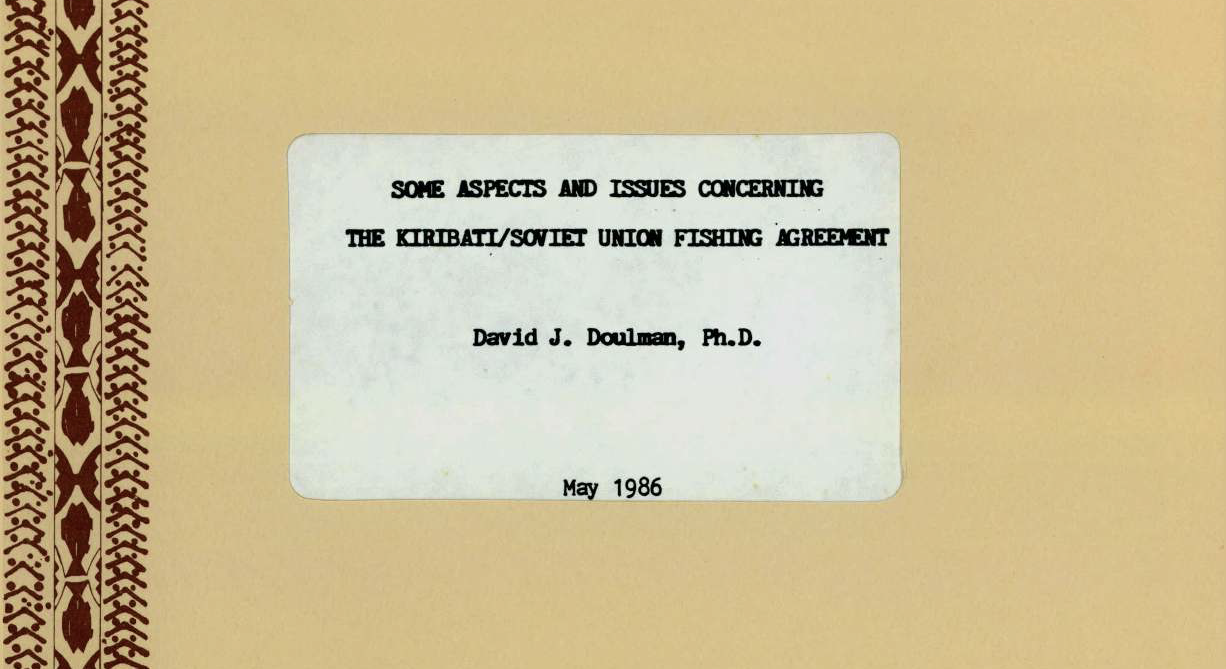
And among the papers reviewed was David Doulman’s paper on it for Pacific Viewpoint (Vol. 28, No. 1, May 1987). Doulman was then at the East-West Center in Honolulu before his long FAO career, during which he became one of the people behind a lot of the FAO work I am still involved in today, such as the Code of Conduct for Responsible Fisheries, the IPOA-IUU and the Port State Measures Agreement. Reading it almost 40 years later reminds me that much of what we now take as the regional default in tuna access was won, not given.
In 1985, Kiribati, a country spread over 33 atolls with about 56,000 people at the time, signed a one-year tuna-access deal with Sovrybflot, the Soviet state fishing company. It was worth US$1.5 million (over 10% of the national budget at the time), covered at most a few dozen boats, and ran for twelve months. By fisheries standards, it was a modest licence. By Cold War standards, it was a small earthquake, and I think it shifted Washington's Pacific tuna policy more than years of patient island diplomacy had.
The American problem
The background was the US juridical position on tuna. The Magnuson Act of 1976 excluded highly migratory species from coastal state jurisdiction, so, as far as Washington was concerned, an American seiner fishing tuna within a Pacific island EEZ without a licence was not poaching. When island countries arrested US boats, the US responded with embargoes under its own law. The Solomons found this out after seizing the Jeanette Diana in 1984.
Doulman lists the better-known cases: the Danica in PNG (1982), the Jeanette Diana in the Solomons (1984), and the Ocean Pearl and Priscilla M in FSM (1984 and 1986). Kiribati had its own. In January 1985, the US seiner Carol Lindaran ran aground in Kiribati's territorial waters while allegedly fishing illegally. Kiribati protested but got nowhere. Unlike Japan, the US government accepted no responsibility for what its fishermen did overseas.
The one thing that had worked, sort of, was the 1983-84 American Tunaboat Association (ATA) agreement with Kiribati, FSM and Palau, administered by the Micronesian Maritime Authority. Fees were US$55 per net registered tonne in year one and US$60 in year two, so a typical 600 NRT seiner paid US$33,000 and then US$36,000. Japanese seiners were paying US$48,000 to 60,000 a year for PNG alone. In effect, the islands were subsidising the US fleet, and other distant-water fleets had noticed and wanted the same deal.
When the parties met in Honolulu in December 1984 to extend it, the islands asked for US$65-70 per NRT to align the ATA with everyone else. The ATA, pleading a depressed market, asked for US$30. The talks collapsed. The ATA lost legal access to some of the best grounds in the WCPO, and the islands lost the roughly US$1.5 million the deal had brought in over two years.
Kiribati's arithmetic
The numbers explain the decision better than any ideology. Phosphate from Banaba (Ocean Island) accounted for 89% of export income in 1979, and mining ended that year (just before the British gave them independence, which was surely a coincidence). By the mid-1980s, copra and tuna each brought in around US$2 million. The 1985 budget was US$12 million. Aid covered about two-thirds of it, and the British grant had just been cut by 46%, with nothing promised after 1986. Access fees were worth about US$1.5 million a year, some 13-15% of the budget. Losing the ATA money hurt. The Soviets, meanwhile, had already been turned away by Fiji, PNG, the Solomons, Tuvalu and Western Samoa. Talks with Kiribati opened in Australia in February 1985, moved to Singapore in May and closed in Manila in August.
The Kiribati president at the time Ieremia Tabai gave three reasons, and I still favour the first. It was economic necessity, for much the same reasons the United States sold grain to Russia. The second was persistent illegal fishing by US seiners that Kiribati could not police. The third was the collapse of the ATA deal.
It is hard to argue with any of them.
What was actually in it
This is the part that gets lost in the Cold War noise. As an access agreement, it was conventional, and from an MCS point of view, quite tidy:
It acknowledged Kiribati's sovereign rights over the resources in its EEZ, its fisheries law and UNCLOS.
Sovrybflot took full responsibility for its vessels' conduct.
It applied the Nauru Group harmonised terms on catch reporting, communications, vessel marking, observers, closed areas and enforcement.
It was capped at 17 named purse seiners and longliners plus one mothership, each licensed individually and in good standing on the FFA Regional Register.
Supply vessels were allowed, and every vessel had to report by telex on entering and leaving the zone.
No fishing was allowed within 12 miles, and no port access was permitted, except in an emergency at Tarawa.
It ran for one year from 15 October 1985, with fees paid in three instalments in advance and no automatic extension.
Kiribati also turned down a Soviet request for port access to refuel and take on food and water and, reportedly, another to base personnel in Tarawa. So, the supposed Trojan horse came without the horse.
Doulman highlights the irony that the Soviets signed up for the very standard provisions, sovereign rights, and flag-state responsibility the ATA had refused for years. The Nauru Agreement was only three years old, yet a superpower accepted its minimum terms.
That is the lineage of what the PNA does today.
Reactions at home and away
At home, it split the country. An opposition MP moved for a referendum, citing Afghanistan and Poland, and the government amended it to commit to discussing the deal first (21 to 14). A later vote of no confidence failed 19 to 15. Demonstrations in Tarawa, and requests from the Protestant and Catholic churches, asked the president to delay signing.
The fault line ran roughly from Protestant south against Catholic north, and the 15 opposition members went on to form the Christian Democratic Party. Doulman suggests that popular opinion had been polarised for perhaps the first time, which says something about what a fishing licence can do.
Abroad, PNG and Vanuatu backed Kiribati after Tabai briefed the Forum in Rarotonga. Fiji had reservations. Australia, New Zealand, and the US objected, and the Australian Defence Minister and the US Secretary of Defence discussed the deal at length. Washington's formal response called it "unfortunate". Australia's concern, expressed in writing by its Prime Minister, was that fishing and port facilities might one day become a base.
New Zealand's Prime Minister was the most outspoken, arguing that the Pacific had been spared superpower rivalry and should remain so. Doulman reads this, fairly, I think, as Wellington trying to mend fences with Washington in the middle of the nuclear ships' row.
As an adoptive New Zealander, I find the next bit hard to read with a straight face. New Zealand had its own joint ventures with Sovrybflot within its EEZ, and the US had been granting Soviet fleets foreign fishing allocations since 1977, with the Soviets and Poles sharing 58,200 tonnes in 1985.
NZ defended itself by arguing that it properly supervised its ventures, implying Kiribati could not supervise its own (white saviour is not a new thing). Wellington then offered RNZAF surveillance flights to help, which still go on today.
Doulman also notes that Soviet seiners were known to trail US boats to learn their purse-seining technique. Some of the Soviet intelligence gathering, in other words, was about catching more fish.
Suddenly everyone had money, and Washington had a treaty
Once the deal was signed, aid offers started arriving. USAID offered help with the domestic tuna industry, the US routed US$453,000 through Save the Children, Australia increased its programme, New Zealand offered to double its aid, and China offered US$350,000 plus interest-free loans.
Tabai said that was never the point. Washington, for its part, avoided cash grants for fear of teaching other island states that a Soviet negotiation was the quickest way into the US aid budget. Which, of course, it just had.
The bigger change concerned tuna. The Secretary of State directed that the multilateral fisheries treaty with the island countries, which had dragged on through negotiating rounds, be concluded as quickly as possible, and a senior counsellor was put in charge. At the tenth round in Tonga in October 1986, the US and 16 island countries agreed to a five-year deal worth US$60 million, granting access to 35 US purse seiners. The US Treaty on Fisheries was signed in Port Moresby in April 1987 and entered into force in 1988. Under it, the US government accepted responsibility for its vessels much as Japan did, exactly what it had refused to do over the Carol Linda.
As for the Soviets, the renewal collapsed in 1986. They wanted to halve the number of vessels and cut the fee accordingly, but Kiribati said no. Vanuatu, which Doulman flagged as the one to watch because of its underused Palikula shore base, went on to sign its own Soviet deal in 1987.
A couple of caveats and why it still matters
To be fair to the historical record, Kiribati did not act alone. Treaty talks were already underway, the Jeanette Diana embargo had made the US deeply unpopular across the region, and reports for the State Department and the Heritage Foundation already urged Washington to end its neglect.
The Soviet deal catalysed a shift from slow negotiation to a priority. The legal climbdown came after the practical one: the US brought tuna under the Magnuson Act only with the 1990 amendments. The treaty was Washington's practical concession to what it was not yet ready to concede in law.
Still, Doulman's conclusion holds up. Kiribati sold its fishing rights to the highest bidder; the ATA had been given first option, and the Soviets simply paid. A country with a lot of tuna and very little land showed that the interests of the ANZUS allies and those of the island states were not the same thing and that the islands knew it.
The lessons are not new, but they bear repeating. Small states have leverage when larger ones compete; regional minimum terms stop that leverage from being traded away boat by boat, and flag-state responsibility is the price of access, not a favour.
I also find it VERY interesting that in 1987 China was moving into the region with hardly a Western objection, because nobody saw it as a threat the way they saw the Soviets.
I will leave that one there.
Source: David J. Doulman (1987), The Kiribati-Soviet Union Fishing Agreement, Pacific Viewpoint 28(1): 20-39.