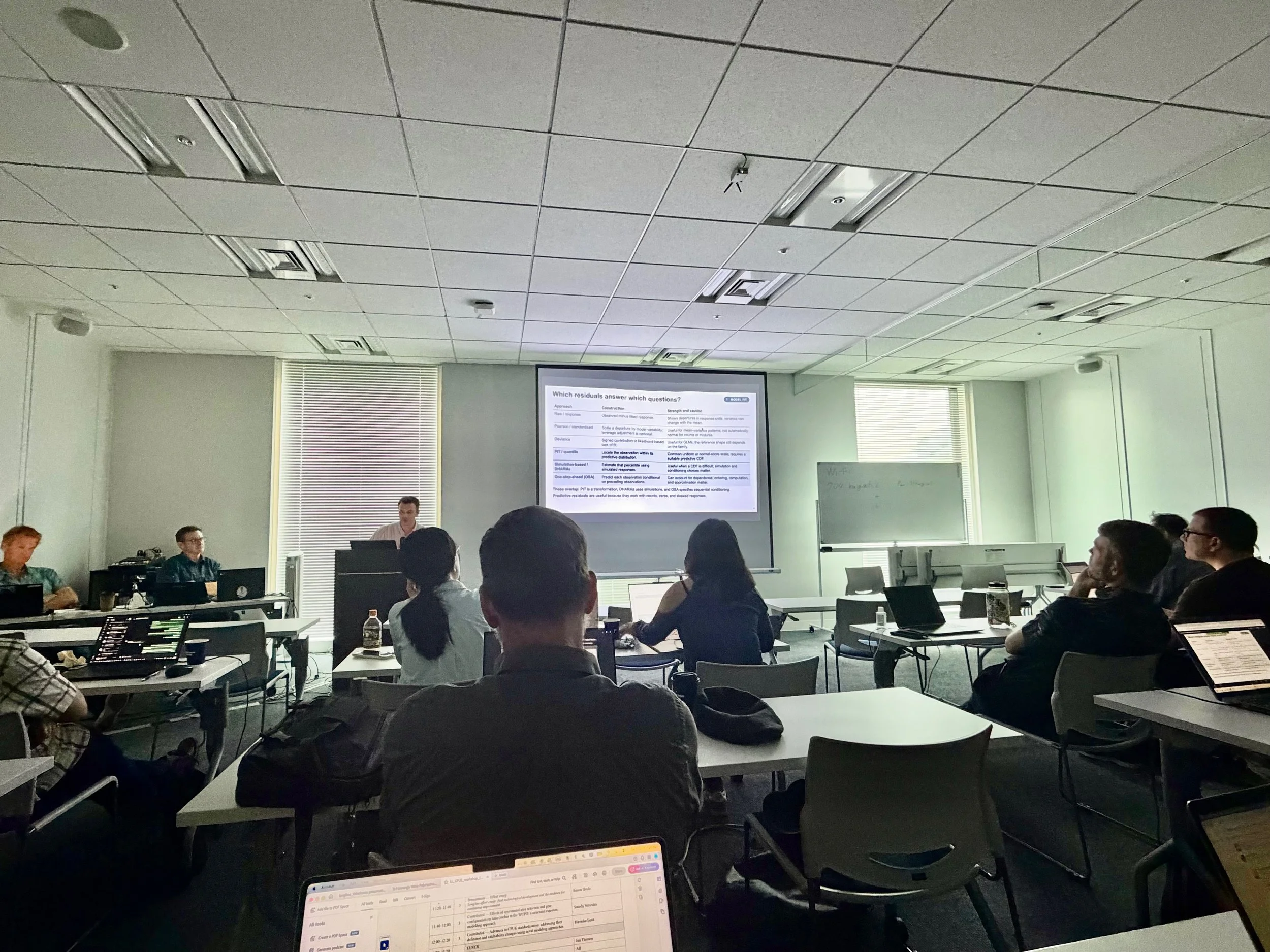
As you read this, I'm in Yokohama (Japan), at the first Global Joint Tuna RFMO Longline CPUE Technical Workshop (12 to 16 October). WCPFC Project 122a supports it, and Japan's Fisheries Research and Education Agency hosts it; it brings together the people who build the longline abundance indices for bigeye, yellowfin, albacore, and bluefin across all the tuna RFMOs. Serious stock assessment modellers: this is serious maths and programming.
I was asked to open Session 3 on operational information and industry insights, which I take with honour and trepidation… I’m a proud fisheries scientist, but I'm definitely not a modeller/ stock assessment specialist
Some of you will remember that back in June I asked for help understanding a new longline manoeuvring pattern showing up in tracking data. Between some replies and a long dive into one vessel's observer report, I now have a much clearer picture, and it became the backbone of my presentation. So consider this a report back.
When the line never comes out of the water
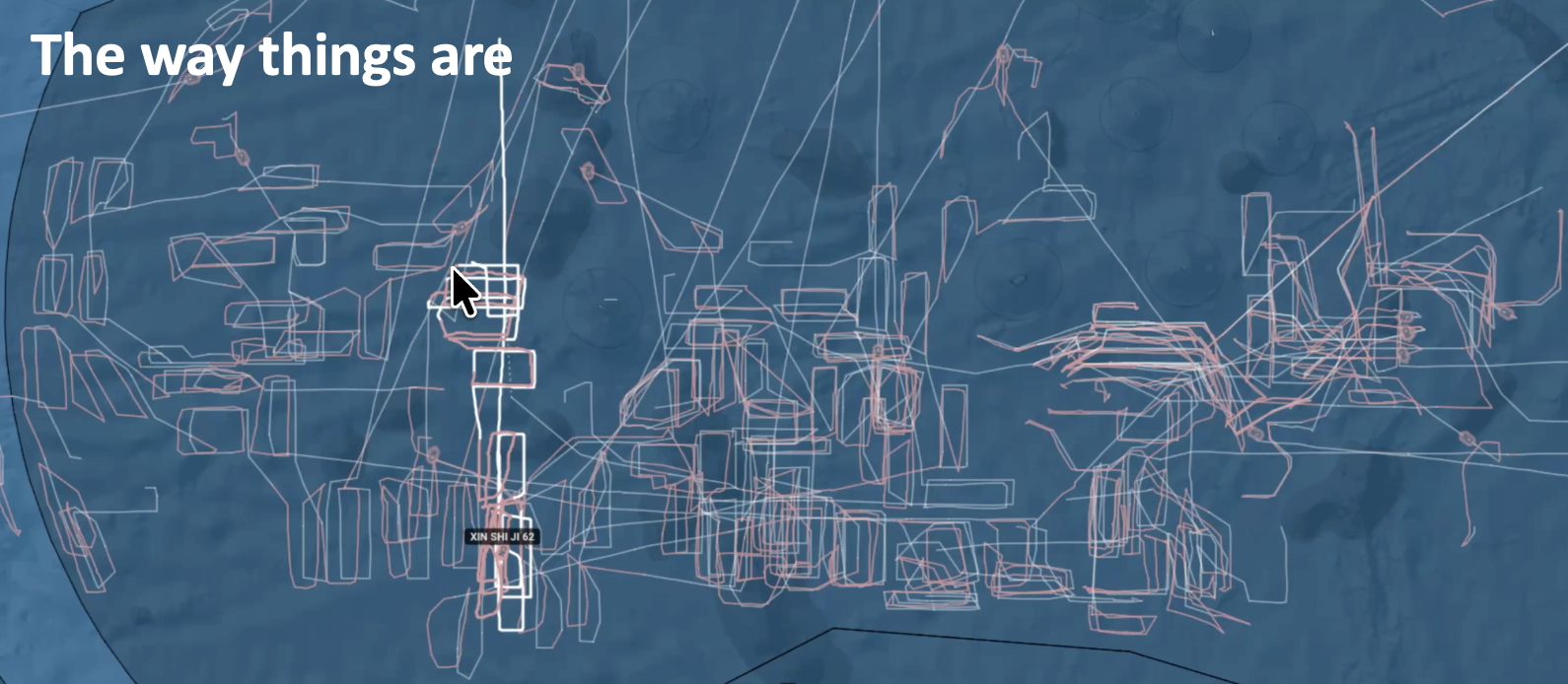
Everything in CPUE rests on the logsheet: who the vessel is, its licence, its operations, its gear and its catch, one column per set. The historic Japanese series that underpins every longline index was built on a simple unit: one straight set, one soak, one haul. On a tracking map that looks like tidy parallel lines.
What we increasingly see today looks more like someone scribbled boxes all over the chart. In the observer report I studied, the mechanics were clear. Set #xxx put out 320 baskets. The captain stopped hauling at basket 170, the mainline was cut, an AIS buoy was left on the unhauled 150, and Set #xxx+1 was spliced onto that free end. The set never fully comes out of the water. The observer journal even records the setting type: the big sets that get split are "horseshoe"; the routine 160-basket sets are "straight line".
Why do it? Nobody confirmed to me that it is about fuel, and anyone who has fished knows that when you are on fish, fuel is not what keeps the skipper awake. My reading is simpler. The straight set is also a search tool: it covers ground, soaks, and tells you where the fish are. Once you know, you stop searching and start working the patch, folding the line back on itself so the hooks stay where the fish are. On these vessels, it wasn't satellite wizardry either, just fishing where they last caught fish plus the odd radio tip. Gear de-confliction on crowded grounds probably plays a part too, and the mix will differ between fleets.
And it is not one flag. I showed tracks from different Asian fleets, sometimes the same company running both patterns side by side, and Spanish swordfish boats in the eastern Pacific doing their own version.
What fisheries biologist actually do!
Why a stock assessment scientist should care
The effort isn't missing; it's mis-partitioned. Hooks set under one set get hauled inside the next set's hauling operation, so their catch lands on another set's logsheet page. The recorded start and end positions don't bracket the gear actually fished. And the carried-over baskets aren't rebaited, so by the time they come aboard, they have soaked 24 to 48 hours on their original bait. The trip total is fine; the "set" is no longer a coherent fishing unit, and a single soak time per set misstates both the effort and the soak covariate.
Then there is hyperstability. A vessel that reliably finds and saturates a hotspot can hold its catch rate steady while the stock declines. Above all there is continuity: if the meaning of "a set" shifts underneath a 70-year index, that is a change in the data, not in the fishing
None of this needs exotic fixes. Recording set type (straight scouting set or reset cycle), deriving effective hooks and per-segment soak time, rebuilding the geometry from high-resolution tracks and haul timing, and putting targeting and vessel or operator effects into the models would all help.
The water you can't see
Hooks between floats (HBF) is the standard proxy for hook depth. In still water, a deep set at HBF 15 puts the mid-basket hooks around 220 m. Add a 1.5-knot current and drag flattens the catenary; the hooks can rise 50 to 100 m, lifting them out of the depth band they were meant to fish. HBF tells you the depth the skipper intended, not the depth he fished.
Current also shapes the bait plume. Fish can't tell where the bait is from smell alone; they swim upstream into the odour. Slack water means no plume and few fish find the bait. Strong current means a narrow plume and gear gets lifted. Moderate current is where the money is. Even a rough estimate of current at setting depth would help the models.
Then bait, where there are as many truths as fishermen. Squid for yellowfin, saury, sardine or mackerel for bigeye, and for albacore size matters more than species: much over 120 g and it gets stripped rather than swallowed. The vessel I studied ran 7 milkfish, 4 chub mackerel and 4 mackerel scad per basket, with live milkfish near the floats. That is a lot of catchability hiding behind one number on a logsheet.
And then the crew
SPC's 2024 overview has a number I can't stop looking at. In 1991 to 1994, about 5,130 longliners in the WCPO soaked some 420 million hooks. In 2024, about 2,158 vessels soaked roughly 666 million. That is about 82,000 hooks per vessel then and 309,000 now, nearly four times as many.
Monofilament and Lindgren-Pitman spools, which came through Hawaii in the late 80s and 90s, explain the climb into the 2000s. I don't think they explain the second climb, which lines up with the growing use of foreign crew. If the deck technology has plateaued and you want more hooks in the water, you work the people longer.
For the trip I studied, I pulled every first- and last-radio-buoy timestamp for setting and hauling out of the observer journal (with Claude doing the tedious bits). On fishing days, the crew averaged 21 hours of setting and hauling, with a median of 22.5, and 90% of days between 20 and 24 hours.
That counts only buoy-to-buoy windows, not the gaps in between. A crew member's handwritten account says the same: hauling from mid-afternoon through the night and straight into the next set, at a fixed day rate, sometimes with only four hours of sleep, then again. The target mattered more than their health.
The effort creep literature talks about gear, technology and skipper skill. I haven't found it talking about crew hours, yet labour is an input, probably the cheapest one to stretch. Whether that belongs in a CPUE model I'll leave to the clever people in the room. I'm just an ex-fisherman who got carried away by university.
Many thanks to Paul Hammer and Simon Hoyle for inviting me to the workshop, and to Russell Dunham, Robert Lee, HoTu Chiang, Malo Hosken, and Bill Holden for sharing their opinions.
And if you have seen this on deck and have a different opinion, my inbox is open because learning when one is wrong is the way science advances.