I get notifications when papers I published get quoted, and only sometimes do I really get to read them, yet this one caught my eye as it supported a private certification, which is one of my nemesis initiatives; I never liked them, and I never will
The paper is Elegbede et al. (2026), "Voluntary sustainability standards and industrial fisheries: Roles of Friend of the Sea certification on occupational safety and working conditions in Nigeria, Gulf of Guinea" (Marine Policy 195, 107289). I
ts headline is that crew in the one FOS-certified trawling company in Nigeria are much better off than crew in two uncertified companies. They have more safety gear (98% vs 75%), access to health personnel (100% vs 17%) and training (98.5% vs 47%). The authors conclude that FOS "functions as a complementary governance tool" and argue for "hybrid governance approaches that combine statutory frameworks with sustainability standards".
Regular readers know where I stand. for example I wrote in 2021 that private labour certification of fishing vessels is ineffective, conflicted and undermines the institutions that should be doing the job. In 2023 I went further and called ecolabels and labour certification agents of neo-colonialism.
So I am not a neutral reader here, but I want to be fair to the authors, as they are local researchers who went out and talked to more than 400 industrial fishers and 17 key informants. That is real fieldwork in a sector where almost nobody collects data on crew conditions, and it deserves respect.
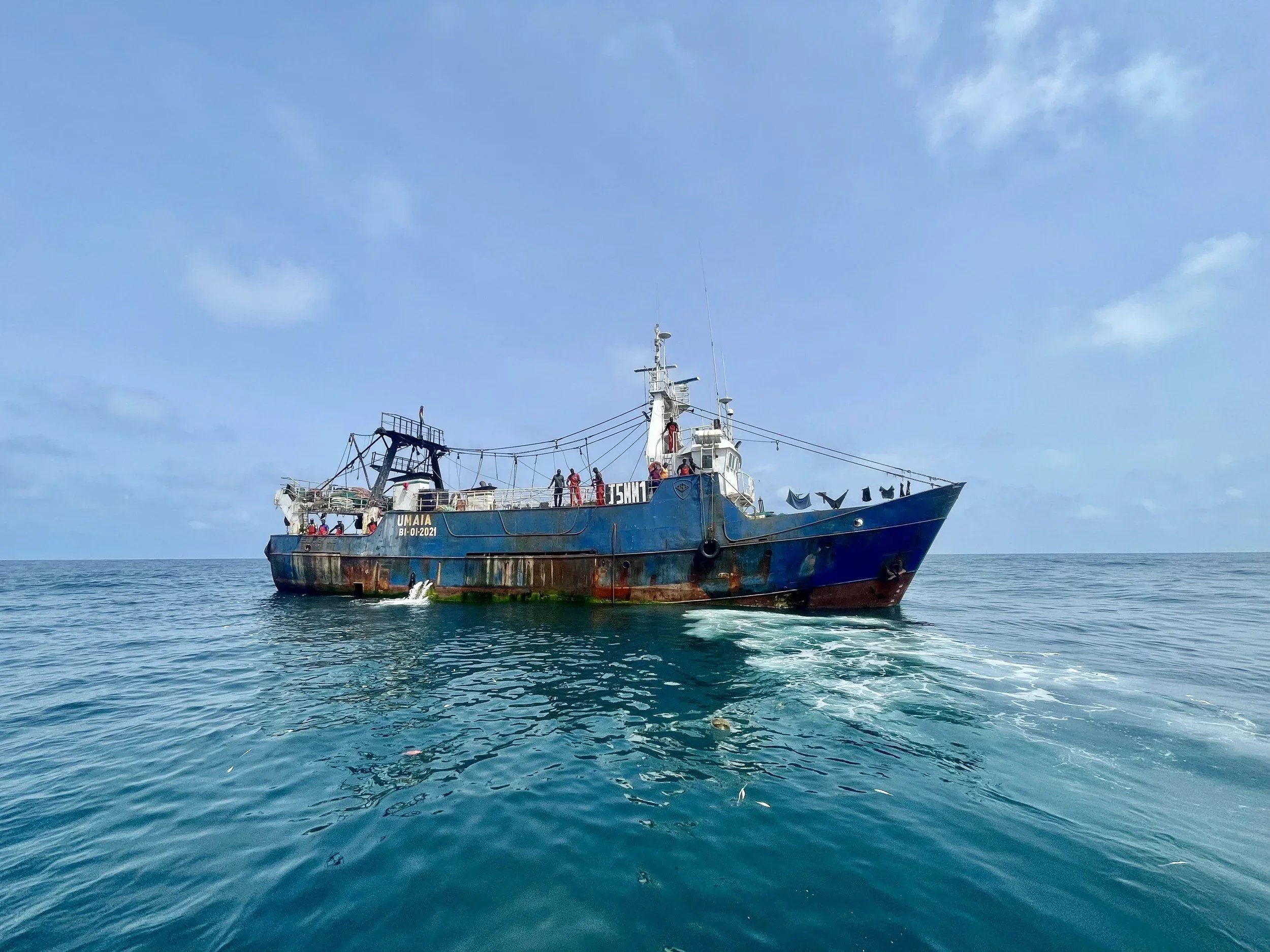
My home in the waters of the Gulf of Guinea
My problem is not the effort. It is what the evidence can support, and more importantly what the policy conclusion does to the one thing that would actually help all Nigerian fishers: laws that are applied.
What FOS actually asks for
Start with Table 2 of the paper, the FOS social accountability criteria. There are four essential requirements: comply with national law and ILO standards on child labour; pay at least the legal minimum wage; give workers access to healthcare and emergency services; and apply the safety measures "required by law". SA8000 or equivalent are only recommended.
So FOS's labour standard is, almost word for word, "obey the law of the country". It adds nothing beyond Nigerian law. It simply sends a private auditor to check whether a company complies with legislation the Nigerian state already has. Table 1 of the same paper lists that legislation: the Labour Act, the Factories Act, the Employees Compensation Act, the Merchant Shipping Act, the NIMASA Act, STCW-F, and the FAO/ILO/IMO Code of Practice for fishing vessels. The authors are honest that the laws exist and that the problem is enforcement.
That is exactly my point. If the finding is that a company follows the law when someone checks, the lesson is not that we need more private checkers. The lesson is that we need the state to check more thorougly.
And the paper shows the state can: in the certified company, the paper says, checks are carried out "by designated onboard safety officers in collaboration with FDF inspectors and third-party FOS auditors", and FDF officers brief crews before trips. The Federal Department of Fisheries shows up when a big exporter with an EU market to protect wants it there. It does not show up for the small operators, where one of the uncertified companies recently had a capsizing with 12 crew rescued by the navy.
What the paper describes is a two-tier system. One large export company, with more than 70 trawlers and the resources to pay for certification, gets gold-plated compliance checking. Everyone else gets nothing. Certification did not create that inequality, but it formalises it and makes it look like a solution.
What the data can and cannot say
I would not normally go through the methods of a paper in a blog post, but here the conclusion depends so heavily on the numbers that it is worth doing.
One company is not a treatment effect. The comparison is one FOS-certified company (the largest in Nigeria and West Africa, 70+ vessels) against two much smaller ones: one with five vessels and one whose main business is packaging, storage and export. There is no before-and-after data and no comparison with uncertified companies of similar size or market. The company was certified because it is large, capitalised and exporting. Those are the same reasons it can afford EPIRBs, a clinic partnership and nurses on standby. The authors acknowledge this as a limitation on generalisability, but it is more than that: you cannot separate the effect of certification from the effect of being that company.
Zero is not a believable number on trawlers. Of the 198 certified crew surveyed, zero reported an injury from inadequate safety measures, zero reported ever being exposed to unsafe conditions, and 100% reported access to health personnel. I have spent a lot of my life on and around fishing boats and trawlers specially, in fact recentloy I spend time on a trwler in Guinea Bisseau.
On a fleet of 70 tropical shrimp trawlers, "never exposed to an unsafe condition" is not a safety outcome, it is an answer. Surveys like this ran with company approval (the ethics section says the companies approved the research) and were administered in the workplace. Crew know who their employer is and who pays for the certificate. That does not mean anyone lied on purpose, but results of 0% and 100% should have made the authors much more cautious, not less.
The regression is upside down. The multivariate model uses certification status as the dependent variable and safety conditions as the predictors. So the paper reports that "lack of training access" is associated with a lower "probability of being FOS-certified". But certification is not something a fisher has a probability of. It is a property of the company they work for, and every respondent in the certified group works for the same company. The model basically predicts which company someone works for. It says nothing about whether certification causes better conditions, which is the question the paper asks. The model is also described as ordinal when the outcome is binary.
The conclusions don't match the results. In the regression, access to health facilities is not significant (p = 0.755), yet the conclusion attributes lower injury rates to "guaranteed access to medical facilities and emergency services". The conclusion also says both groups "reported access to basic safety equipment", which sits awkwardly with Finding 1 on safety equipment being "the most fundamental divergence". And small things matter: the text gives the uncertified sample as n = 206, while the table and response rates imply 218.
The data comparacion over over long timeframe. The fieldwork was done between June and December 2019, and the demographic figure is marked as previously published in a 2025 One Health paper by the same group. Seven years is a long time in a sector that the paper itself says went from about 40 companies to 12.
None of this means the certified company isn't a better employer. It probably is. It means the paper shows that a well-resourced exporter treats its crew better than two small operators. It does not show that FOS certification is why.
Why this matters: certification as a substitute for legislation
My main concern is not the statistics. It is what happens to the policy conversation when papers like this conclude that voluntary standards "operationalise" safety that the law requires but the state does not enforce.
Look at the gaps the paper itself lists. The Sea Fisheries Act of 1992 is "widely regarded as outdated". ILO C188 is "pending ratification". Inspection capacity is limited and coordination between NIMASA and the Federal Department of Fisheries is fragmented. Every one of those is a job for government: update the fisheries law, ratify C188, give labour and fisheries inspectors the mandate and resources to go on board, and make labour conditions part of the licence.
The authors' own recommendations go this way too: mandatory safety audits for all vessels and occupational health services "mandated for all industrial fishing operations, in line with ILO C188". Those are good recommendations. But the paper's framing ties them to certification, and the conclusion people will take from the abstract is "certification works where the state doesn't".
This paper's message is useful to three groups, and none of them is fishers. The certifier gets evidence for its value. The certified company gets a reason to say "we are already audited" when a new law or licence condition is proposed. And the government can point to a certified flagship exporter and say the sector is moving in the right direction, while pressure for ratification and reform eases.
This is what I mean when I say private certification delays the legislation that is needed: not because anyone plans it, but because it takes the urgency away. The 70-plus certified vessels have a private safety net. The rest of the fleet, and the artisanal sector that is much bigger than the industrial one, still has only a law nobody enforces.
We have seen what works instead. In the Pacific, FFA members put labour standards based on C188 into the Harmonised Minimum Terms and Conditions for foreign fishing vessel access, so they apply to every licensed vessel, not only to the ones whose buyers care.
New Zealand dealt with the foreign charter vessel scandal by making its own labour law apply on board, not by asking a certifier to look. And the market lever the paper credits for bringing FOS to Nigeria, access to the EU, is shifting from private labels to public rules: the EU Forced Labour Regulation, the corporate sustainability due diligence framework, and in the US, withhold release orders under Section 307.
If market access is what motivates a Nigerian exporter to treat crew properly, that motivation can be written into import conditions and supported by state-to-state capacity building, without a private intermediary charging fees to verify compliance with Nigerian law.
The money is also worth thinking about. What does one company pay each year for FOS audits? I don't know the figure for this case, but I do know what a fisheries or labour inspector earns in the region. Money spent on private verification of public law is money that did not go into the institution that should be doing the verifying, and that institution is the only one that can reach the whole fleet.
Bottom line
I welcome more research on crew conditions in West African fisheries, and I hope this team keeps working on it. But the honest reading of this paper is not that voluntary standards improve safety. It is that Nigerian law already requires everything FOS checks, that the state can enforce it when it chooses to, and that it currently chooses to only where an export certificate is at stake.
The policy answer to that is not "hybrid governance". It is ratifying C188, updating the 1992 Act, funding inspection, and making labour standards a condition of every fishing licence. Certification that makes those steps feel less urgent is part of the problem, however good the intentions behind it.