I have said this many times in person and in presentations: for me, the key challenge in our region's fisheries is not IUU fishing. It is building capacity, attracting and retaining capable people, bringing in a diversity of backgrounds and ways of thinking, and making room for new ways of working things out… IUU fishing is downstream of that. It is a symptom we have chosen to treat as the disease, mostly because it is much easier to fund a patrol boat, an app or a "workshop" than it is to fund a career.
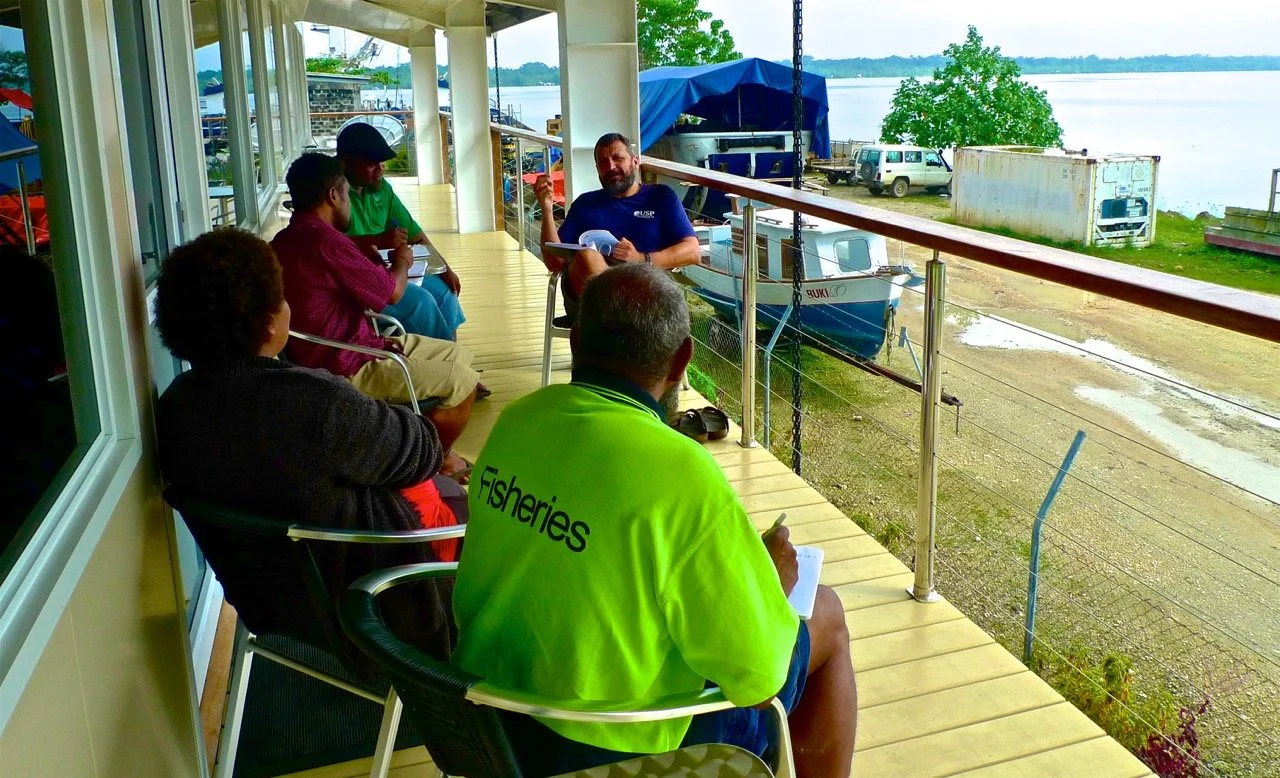
Planning the day and doing the job alongside, not from a workshop room
So I was happy to see a new paper come out in Fish and Fisheries that says this properly, with references, in a journal that the people who write funding strategies actually read. "Lack of Capacity: The Not-So-Hidden Factor Undermining Fisheries Governance" is by Bianca Haas at ANCORS in Wollongong, Transform Aqorau at Solomon Islands National University, and Mitchell Lennan at Aberdeen. It is open access, which matters because a paper on the capacity of developing coastal states that sits behind a USD 40 paywall would be a bad joke.
Full disclosure, I know Bianca and Transform well, and I respect them both a lot. Transform's contribution to the region over the last three decades needs no introduction from me (yet I still enjoy reading this blog), and Bianca has been doing careful, unglamorous work on RFMO performance for years. That said, I would be saying the same things about this paper if I had never met either of them, or if the work I did wasn’t referenced by them.
The central claim
Their argument, boiled down, is that capacity is not a peripheral implementation issue that you tack onto the end of a management measure. It is a core determinant of whether that measure is effective, and whether it is equitable. Unless coastal developing states have sustained scientific, legal, technical, institutional and financial capacity to participate meaningfully in RFMOs, adopting conservation and management measures and international agreements does not translate into outcomes. You get compliance ratings instead of compliance.
I like that they split the problem into technical and structural. The technical side is the one everyone talks about: weak data collection and reporting, thin scientific expertise, limited stock assessment capability, MCS gaps, difficulty meeting reporting requirements. That is the side that workshops aim at.
The structural side is the one nobody funds: high staff turnover, small domestic budgets, weak institutional memory, legal frameworks that cannot domesticate an RFMO measure, and no ability to sustain participation across five or six international processes at once. As they put it, training individuals produces limited long-term impact unless you also invest in institutions, career pathways, domestic legal implementation and stable financing.
That distinction explains many failed projects I have watched over the years. You can train someone brilliantly and still get nothing because the system they return to cannot retain what they learned.
Capacity is power
The example they use to make this concrete is the IOTC allocation negotiation, and it is a good one. Historically, catch has been attributed to the flag state regardless of the waters from which it came. Some coastal members are challenging that, arguing that fish taken inside their EEZ should be attributed to them. The current approach favours well-developed fishing nations and undermines the rights of the state whose fish they are.
Now, here is the point. To challenge that allocation approach, you need technical, legal, economic, and negotiation capacity, all at once, sustained over the years it takes. Since 2011, in this case. If you do not have that, the rule stands and continues to take value from your waters every year it remains in effect.
So capacity is not a nice development add-on for a report's annexes. It is the thing that determines who gets the fish. Arvid Pardo (the “father of UNCLOS ") said in 1984 that international law reflects the beliefs, needs and perceived interests of the most powerful states of the time, and the paper is right to quote him. RFMOs were designed by people who had lawyers. That is not an accident, and it is not ancient history; it is being renegotiated right now.
The bit I want to shout about
They write about the balance between staff turnover, knowledge retention and career development. Junior staff are rotated through departments; they get trained and then leave. The reasons given for high turnover are job dissatisfaction, poor compensation, and a lack of career path. As I said many times, “we expect excellence, yet we pay mediocrity”
Let us be honest about what that means in practice. We, as an industry, expect excellence from our regulators. We want the analyst who can read a stock assessment properly, the officer who can run a boarding by the book, the lawyer who can hold their own against a delegation with three counsel behind them, the person who can tell whether a transhipment declaration is nonsense. We want them incorruptible, available at 3 am when a vessel comes in, and up to date on a legal framework that changes every year.
And then we, collectively, create the conditions in which those people are paid a fraction of what their skills are worth. Less than a coordinator at the cannery. Much less than a manager at the company they're inspecting, or what a consultant like me gets paid to fly in and work with them.
The best-trained fisheries officer in the room is also the most poachable person in the room. Industry hires them, because industry can. A donor project or an international organisation hires them at three times the government rate to do work about their own country. Or they simply leave the sector, because their partner would like to see them and they would like to own a house. Then we run another training for the replacement, and we call that capacity building.
You cannot pay someone poorly, rotate them out of the job just as they get good at it, and then complain in a compliance committee that the country has a capacity problem. That is not a capacity problem; it is a design choice, and we are all part of the design.
What actually works
The paper is not just complaining, which I appreciate. It points at what works, and the pattern is consistent: long-term, relationship-based, country-driven.
At the individual level, it is not only postgraduate scholarships, useful as those are. It is practical skills: negotiation, chairing and facilitating meetings, scientific writing, fisheries economics, and mentoring.
Shadowing an experienced negotiator, taking the rapporteur role, leading a side event. Confidence and strategic thinking, so a delegate speaks in plenary rather than sitting quietly with the right answer in their folder. The FFA negotiation training, with built-in mentoring, is cited as being in the right shape.
At the national level, they highlight long-term embedded advisors rather than short technical missions, because an advisor who is there for years builds trust, understands the institutional constraints, and provides continuity when staff turnover occurs.
The example they use is the offshore fisheries advisor position that New Zealand funded at MIMRA in the Marshall Islands for six and a half years (with 3 more running now), with Majuro port cited by FAO as a best-practice example, and MIMRA taking the global Stop IUU Fishing award in 2023.
Of course I have a personal interest to declare there, since this was (and still is) my job. And I will say what the paper is too polite to say: nothing I did in those years would have worked without the MIMRA leadership and the people who were already there, the ones who stayed there, and the new ones who came. My contribution was continuity: a lot of the MCS work is about routines, and given those routines time to produce results, creating trust in what is done, and trust takes time… hence six and a half years is the point. Nobody funds six-and-a-half-year projects anymore; they fund 12-month projects with a 24-month logframe.
At the regional level, their comparison table across the five tuna RFMOs is worth the download on its own. Support exists everywhere, but it is uneven, mostly short-term, and mostly aimed at narrow technical functions: one workshop, one project. Almost nothing addresses domestic implementation, inter-agency coordination, legal drafting, staff retention, or sustained engagement in negotiations.
And now, more homework
Then there is the load coming. Climate change is going to shift tuna eastwards out of Pacific EEZs and into the high seas, which turns every allocation and access question into a harder one, and BBNJ arrives with a whole new set of processes to attend. The paper treats both as complementary sources of capacity support, and Part V of BBNJ is genuinely promising, particularly because Article 42.3 says capacity building should be country-driven, participatory, and gender-responsive, which is the correct instruction.
But be realistic. We are adding two more agreements to fisheries departments that already cannot cover the meetings they have, with the same five people. If the capacity support does not arrive faster than the obligations do, we have made things worse while feeling good about ourselves.
The authors also make the point, quoting Harden-Davies, that the term "capacity building" itself assumes an unequal relationship and can be read as patronising. They are right. And I've written about the colonial nature of my job and my problems with “Aid” myself, which could lead to another series of blog posts… I remind people very often of Francis Hezel's words, in his seminal book “Making sense of Micronesia” (2013): “Changes may have to be made, as they must in any culture, but we outsiders should at least understand some of the broader contexts of Island culture before we begin leading the charge for change according to our own formulas”
Read the paper. It is short, it is open access, and it says out loud what a lot of us have been talking about among ourselves, normally behind a beer. Capacity is not the soft part of fisheries governance. It is the whole game, and the people who do it deserve to be paid like it.
Haas, B., Aqorau, T. and Lennan, M. (2026) Lack of Capacity: The Not-So-Hidden Factor Undermining Fisheries Governance. Fish and Fisheries. https://doi.org/10.1111/faf.70114