When I talk about high-seas transhipment, I usually mean the fish side… but carriers carry another cargo that hardly anyone notices: people.
Some distant-water longliners stay out for years without going home. They can do that because carriers bring them fuel, food, bait, spare parts... and crew. In practice, carriers are the labour conduits of the distant-water fleets.
Ideally, 4 new crew board the transshipping fishing vessels, and the same number comes off. Reality is, we don’t know, as we are much more advanced in our discussion of the mass balance of “fish in and fish out” than of the mass balance of “crew in and crew out”… which is pathetic.
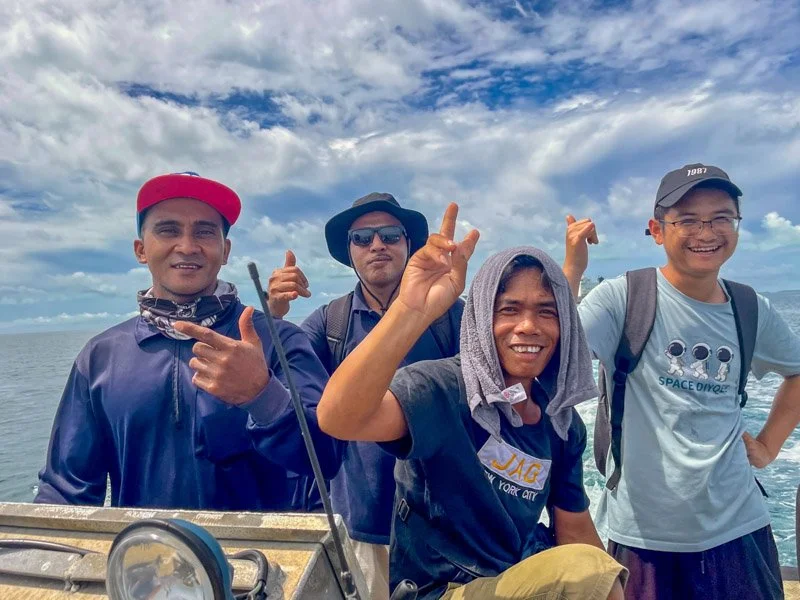
And here is the question that has bothered me for a while. Who is responsible for them while they are on that carrier?
The "supernumerary" limbo
On the carrier's manifest, these fishers are usually listed as "supernumeraries". Not crew, not passengers. They only become crew when they physically step onto the fishing vessel at sea.
The term comes from maritime practice. It describes people on board who are not part of the minimum crew needed to run the ship safely, and who are usually there for a short time. The ILO Maritime Labour Convention (MLC) 2006 doesn't define it in its main articles. That is left to national guidance on how each country applies the Convention.
In practice, the label works like a trapdoor. The MLC protects seafarers, and passenger rules protect passengers. Supernumeraries are neither. So the carrier, and its flag State, can sidestep responsibility for contracts, welfare, safety, medical care and freedom from coercion during transit. And transit can mean weeks or months at sea with no enforceable labour protection at all.
It gets worse. Even once on the fishing vessel, fishers are second-class workers under international law. The MLC explicitly excludes fishers from its definition of "seafarer". The fishing-specific instrument, the ILO Work in Fishing Convention, 2007 (C188), is weaker, less detailed, less prescriptive, and has nowhere near the MLC's ratification count.
What I find remarkable is how broad "seafarer" otherwise is. The bartender on a cruise ship is a seafarer. The guy hauling a longline 1,500 miles from land is not (as Guelker pointed out in 2023). Fishers start outside the main framework, and on carriers they slip even further out.
The flag State is still on the hook
Now, a label on a manifest does not erase the flag State's obligations. Even if supernumeraries are neither seafarers nor passengers, the carrier's flag State still owes them the basics under international law: safety of life at sea, humane treatment, access to medical care and protection from violence or coercion. The problem is that without clear labour due diligence requirements, those protections are thin, poorly enforced or simply theoretical.
The law of the sea is actually quite clear on who they belong to while they are on board. Since the M/V Saiga (No. 2) case in 1999, the International Tribunal for the Law of the Sea (ITLOS) has applied the doctrine of the "ship as a unit". In the Tribunal's words, "the ship, everything on it, and every person involved or interested in its operations are treated as an entity linked to the flag State".
Every person. Not every crew member, not every passenger. So whatever the manifest says, a fisher sitting on a carrier is linked to that carrier's flag State, and is that State's responsibility.
This is where due diligence comes in. Most longline distant-water fishing nations don't set any contract conditions for crew while they are in transit to their vessels. As far as I know, the only exception is Chinese Taipei, whose legislation makes the fishing vessel owner responsible for the migrant fisher's contractual rights during transit. Credit where credit is due.
Everyone else? A flag State that lets its carriers move fishers without checking recruitment conditions, contracts, or destination vessels enables abuse without accountability. If a fisher later ends up in debt bondage or coerced on that longliner, the lack of oversight in transit badly weakens any claim that the flag State exercised reasonable care. At some point, looking the other way stops being negligence and starts looking like collusion.
Exploitation by design
I don't see this as a technical gap that a bit of drafting will fix. It is a structural failure. Calling fishers "supernumeraries" turns them into a logistics item, a bit like cargo or spare parts, instead of people with rights. It makes them invisible, and it lets States feel they have less to answer for.
When a system is set up like that, exploitation is not an accident. It is by design.
The starting point is accepting something obvious to anyone who has worked in this industry. Moving labour at sea is not a side issue in distant-water fishing. And to an extent is pushed by the rich countries themselves… try to get even a transit visa through Australia or the US (as the gates for Micronesia) if you are from a poor background in SE asian country.
So carrier flag States need to own it. At a minimum, they should know who their carriers are moving, under what contracts and to which vessels, before the carrier leaves port. RFMOs could ask for the same in transhipment declarations. We already do it for the fish.
These men are at one of the most vulnerable points of their journey. They are far from home, often already in debt to a recruiter, heading to a vessel they have never seen. The least we can expect is that the flag State carrying them treats them as people under its protection, not as people who are legally absent.