I write about fisheries because that's what I know, and I only occasionally touch on fisheries labour and UNCLOS-related issues I find interesting. My interest in UNCLOS stems from my participation in the Rhodes Academy, where I not only learned about many of the cases cited below, but also got to know some of the people who make the decisions.
Furthermore, the Malvinas/Falkland War in 1982 did mark my life and the one of most of my age peers, and while I don’t dwell on it and have consciously moved on… I’m naturally drawn to read about the situation down there, not only from the fisheries side.
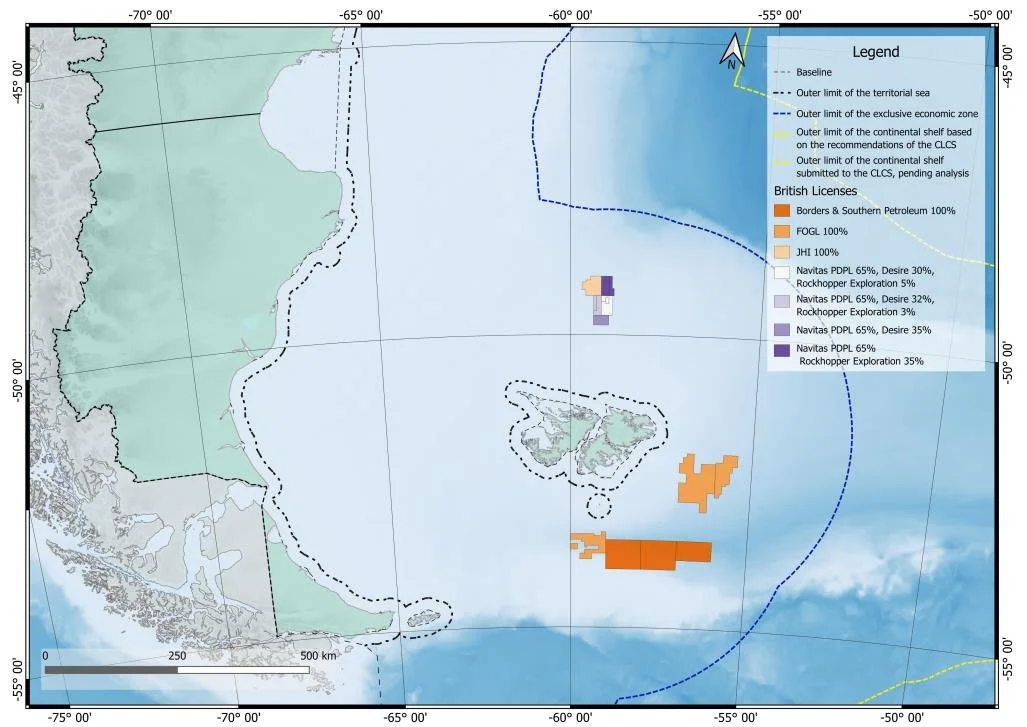
The way Argentina sees it…
A couple of days ago, on 13 October 2026, Argentina filed a request with the International Tribunal for the Law of the Sea (ITLOS) asking it to stop the United Kingdom from starting oil production in the North Falklands (Malvinas) Basin. The case is titled Dispute Dispute concerning Hydrocarbon Exploitation in the South-West Atlantic Ocean (Argentina v. United Kingdom) Hydrocarbon Exploitation in the South-West Atlantic Ocean (Argentina v. United Kingdom). It sits on the ITLOS docket as case 37.
I read the request to see what Argentina is asking for, how it gets there, and where I think the hard questions are. Of course, I am not a lawyer, but “provisional measures cases” under Article 290(5) of UNCLOS are a niche corner of the law of the sea that fisheries people (particularly we in NZ) have had reason to follow since the Southern Bluefin Tuna case. Unsurprisingly, that case appears several times in this filing.
The background in brief
The Sea Lion field lies about 107 nautical miles north of the islands and covers roughly 540 km². The Falkland Islands Government (which Argentina calls the “de facto British authorities”) has issued production licences over it. In December 2025, it approved the Final Investment Decision of the operators, Navitas Petroleum and Rockhopper Exploration, and the project moved into a 35-year production phase. Phases 1 and 2 involve 23 completed wells, a mobile drilling unit and an FPSO anchored to the seabed. The companies say shore works are underway, and drilling will start in early 2027. A drilling rig is reportedly scheduled to begin work in “South America” in January 2027. In September 2026, the Falklands authorities extended all production licences by five years.
Argentina has protested every licensing step since the 1990s and wrote to the companies directly in September 2026. On 28 September it instituted Annex VII arbitration against the UK. That notice asked the UK to suspend the project itself, as a provisional step. The UK refused on 11 October, said it would “vigorously” contest jurisdiction, and Argentina went to Hamburg two days later.
The procedure is worth a sentence. Argentina chose ITLOS under Article 287 and the UK chose the ICJ, so the default forum for the merits is an Annex VII arbitral tribunal. Until that tribunal is constituted, Article 290(5) lets ITLOS prescribe provisional measures. Argentina may apply once two weeks have passed after its request without the parties agreeing on a forum. It filed fifteen days after instituting the arbitration, so nobody can accuse Argentina of dawdling.
What Argentina is asking for
Four measures, pending constitution of the arbitral tribunal:
The UK should prevent the start or continuation of hydrocarbon exploitation in the North Basin through the Sea Lion project.
The UK should refrain from using exploration data from the disputed area to Argentina’s detriment. This seems aimed at the companies passing seismic and well data to third parties.
The UK should stop preventing Argentina from complying with its duties under Articles 192 and 194 to protect the disputed area's marine environment.
The UK should refrain from any other aggravating step, notably granting new licences.
The jurisdictional pitch
This is the part I find most interesting, because Argentina is plainly aware of the obvious objection. An UNCLOS tribunal cannot decide who owns the islands. The Chagos MPA arbitration made that clear, finding it had no jurisdiction over Mauritius’s claim to be the coastal State. Argentina says explicitly that it is not asking the tribunal to settle sovereignty. It asks the tribunal to protect rights that exist because sovereignty is disputed and unsettled. The request builds this on four legs:
Continental shelf rights (Articles 56, 77 and 81). Coastal State rights over the shelf are exclusive, and no one may drill without the coastal State’s consent. Argentina’s claim to be that coastal State is, it argues, at least plausible. It supports that with a long list of regional declarations, from CELAC and MERCOSUR to the Africa-South America Summit. It adds that no State has recognised UK sovereignty over the islands.
Restraint pending settlement (Articles 279 and 300). Articles 74(3) and 83(3) require States with a pending delimitation not to “jeopardise or hamper” a final agreement. Argentina argues that duty is not confined to delimitation but follows from the general obligation to settle disputes peacefully and in good faith. It reinforces this point with Resolution III of the Third Conference, which addresses territories under colonial domination where a sovereignty dispute exists. It also points to UNGA Resolution 31/49 (1976), which asked both parties not to introduce unilateral changes while the decolonisation process was under way.
Part XII. Argentina says the UK’s control of the area stops it from discharging its own preventive obligations under Articles 192 and 194. It is a clever inversion: the request frames Argentina as the State being prevented from doing its environmental duty, not merely as the State complaining. It also notes that Sea Lion falls within Argentina’s IMO search-and-rescue region.
Exchange of views (Article 283). Argentina argues the UK has refused for decades to discuss sovereignty unless the islanders wish it. That, it says, means further exchanges were pointless, an argument ITLOS has accepted before (MOX Plant, ARA Libertad).
Argentina also tackles the Article 298(1)(a) declarations both States have made excluding delimitation disputes. It says this is not a delimitation dispute, which is true in a narrow sense. Whether that narrow sense survives a UK objection is another matter.
Irreparable harm and urgency
On harm, the request is on firmer and more familiar ground. Drilling and production permanently change the seabed and subsoil. The resources are non-renewable, and money cannot restore the status quo. Argentina leans on case law that frames this kind of harm: Aegean Sea (where the ICJ refused measures because the seismic work was transitory and involved no installations), Guyana/Suriname (unilateral acts causing physical change generally require agreement), Somalia v. Kenya, and, above all, Ghana/Côte d’Ivoire. In that case, the ITLOS Special Chamber found a risk of irreparable prejudice from drilling in a disputed area and ordered that no new drilling take place.
The environmental section is detailed. It cites the 2015 blowout preventer failure at the Isobel Deep well about 30 km from Sea Lion. It quotes the operator’s own oil spill modelling from that period, which estimated a 30% probability of waxy Sea Lion crude reaching uncontested Argentine waters within 30 days of a blowout, and 100% within 14 days for a lighter crude. It describes the harsh metocean conditions and the long distances to support ports. It also points out that neither Navitas nor Rockhopper has ever operated a producing offshore field. That last point will sting in some boardrooms, but it is a fair question to ask of a first-of-its-kind project in the South Atlantic.
On urgency, Argentina applies the MOX Plant test: whether prejudicial action is likely before the Annex VII tribunal is constituted. It adds the Land Reclamation point, arguing that ITLOS-prescribed measures may continue beyond that period. With drilling announced for early 2027 and Annex VII tribunals typically taking months to constitute, the timeline does much of the work.
The self-determination section
The request ends with a section rejecting the UK’s position that the activity is a matter for the Falkland Islands Government, exercising the islanders’ right to self-determination and pursuing economic development. Argentina argues the General Assembly has treated this as a sovereignty dispute between two States, not a self-determination case. It notes the Assembly rejected UK amendments on self-determination in 1985. It also dismisses the 2013 referendum because the UN did not organise or supervise it.
The UK, of course, sees this very differently, and the islanders’ 2013 vote (overwhelmingly to remain a British Overseas Territory) is central to its position. Whatever one thinks of the merits, this is the part of the filing least likely to be resolved in Hamburg, and arguably the part Argentina most wants on the record.
My reading of where this goes
First, the prima facie threshold under Article 290(5) is low, and ITLOS has historically been willing to clear it. Southern Bluefin Tuna is the cautionary tale, though. ITLOS prescribed measures in 1999, and the Annex VII tribunal later found it had no jurisdiction and revoked them. A bridge that turns out not to have a solid end on the other side is still a bridge for a while, and it costs companies money to wait to drill while it exists.
Second, the real fight will be over whether this is a law-of-the-sea dispute or a land-sovereignty dispute dressed up as one. Argentina’s framing, that it is only protecting rights arising from the unsettled dispute, is careful. But almost every right it invokes depends on Argentina being, at least plausibly, the coastal State. That is the question Chagos said an UNCLOS tribunal cannot answer. Expect the UK to press this hard.
Third, if ITLOS does find prima facie jurisdiction, Ghana/Côte d’Ivoire is the obvious template, and it cuts both ways. The Chamber stopped new drilling there. It also declined to suspend ongoing activities, citing the cost to the party already operating and the environmental risk of interrupting them. Argentina’s timing is deliberate. It filed before the first well is spudded, exactly when a “no new drilling” order costs least and is easiest to justify. Measure (a) is the one to watch. Measures (b) and (c) look more ambitious and less likely to be granted as drafted.
Fourth, and from my own corner: for an area this rich in fisheries, the request is almost entirely about oil and minerals. Fish appear only as history, in the 1976 Shackleton mission that triggered Resolution 31/49. I suspect this is a deliberate choice to keep the dispute focused on non-renewable resources and irreversibility, where the case law is strongest.
The hearing will presumably be scheduled within weeks. I will write again when the UK’s response and the order come out.