A couple of days ago, the PNA ministers announced what many of us in Majuro have been expecting for some time. Glen Joseph, our director at MIMRA, will become the next CEO of the Parties to the Nauru Agreement (PNA) Office on 1 January 2027, when he takes over from Dr Sangaa Clark, who is finishing her second term.
I have worked with MIMRA since late 2017, and Glen has been my boss throughout. He’s also become a friend and a mentor (even if I’m a bit older than him), so please forgive me if this post isn't as objective as my usual.
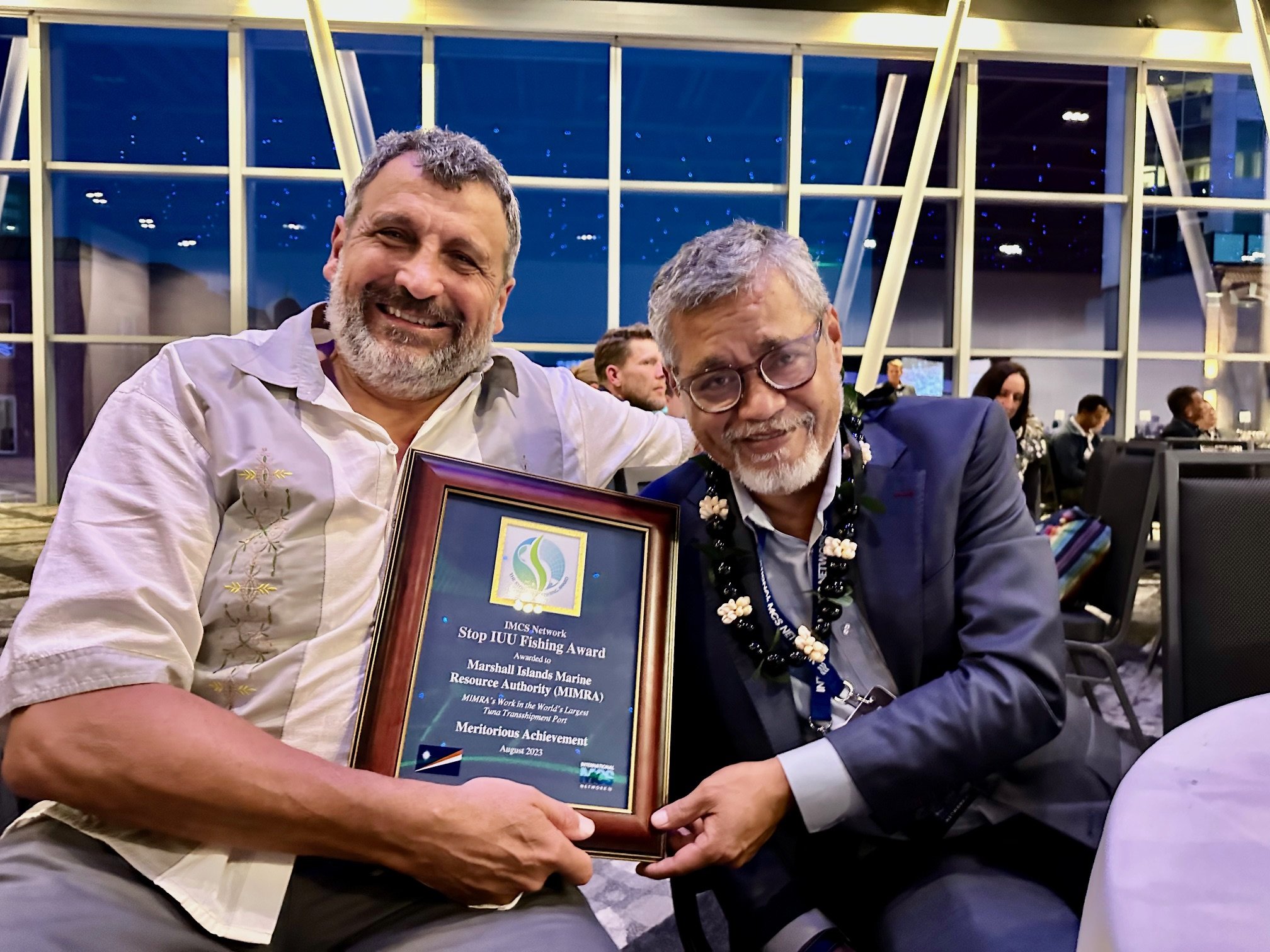
Happy chaps in Halifax!
If you search my blogs for his name, you will find him in many posts, always in the background of something good happening at MIMRA. It feels right to put him in the foreground for once.
A career that started on the water
Glen did not start at a ministry desk. While studying at the University of the South Pacific in Suva in the mid-1990s, he interned at MIMRA during school breaks. After graduating, he stayed on and took on hands-on roles: fisheries observer, enforcement officer, and vessel licensing. He became deputy director in the early 2000s, and in 2005 the board named him to head the authority. That makes 30 years at MIMRA, 21 of them as its director.
I think that coming from an operational background matters more than people realise. Someone who has spent time on a longliner as an observer knows the sector in ways that even reading the best report never will. He knows what the officers at the port are dealing with and why good policy analysis matters, because he has done both jobs himself. You can feel that in how MIMRA is run.
What I see from the inside
When I applied for this job as an Offshore Fisheries Advisor, funded by NZ MFAT, here in Majuro, the obvious choice was someone else… I wasn't the conventional one: an ex-fisherman with an operational focus, not a native English speaker. Glen (and Sam Lanwi, the DD at the time) never made any of that an issue… in fact, the opposite: that was what they found interesting.
When I wrote about the opening of the new MIMRA headquarters in 2019, I said he had fully supported my work and had asked NZ MFAT to extend my contract for another term. I didn't take that for granted then, and I don’t today. By the time my present contract ends in 2028, I will have spent 11 years working with MIMRA, which is quite unique in this world, and I have him and NZ MFAT to thank for that.
In 2018, Majuro hosted the WCPFC TTC, and the town was completely full. Glen invited me to join the RMI delegation on the topics I worked on: FADs, port state measures, and the compliance scheme. I had never been inside a WCPFC meeting, as those rooms are mostly for senior staff and approved observers; it was a real gesture of trust. I spent the rest of the time helping with the organisation and picking people up from the airport, as any other staff member.
Glen also trusted me when my ideas were a bit unusual, and sometimes when they went against more traditional advice… particularly when I thought we should do first and write and sign later, commit only to what we can deliver, and do the best we can while knowing one’s limitations. That honesty and trust are a rare quality in a boss, and it’s why my work here at MIMRA has been the most rewarding part of my consulting career… both professionally and personally
He is also one of the people who made me feel part of the team, not a foreign consultant. That culture comes from the top. And yes, he has an espresso machine in his office, which I will admit played a part in many of my visits.
The building, the award and the way MIMRA works
The new headquarters opened in 2019, and I wrote then that it was more than a building. It was a statement of independence. Most fisheries buildings in the Pacific are donated by funders, who don't shy away from reminding people of this when access negotiations start. MIMRA decided to build its own, funded by its own fisheries revenue, with an operations room that connects to the FFA regional picture, VMS and port operations. I called it the best of its kind in the Pacific, and I still think so.
In 2023, we won the Stop IUU Fishing Meritorious Award from the International MCS Network for our port state measures work in Majuro, the world’s busiest transhipment port. I was with him in Halifax when the award was announced, and I was very happy for everyone, especially my friend Beau Bigler, who carried much of that work. The award recognised the systems, transparency, and collaboration that stemmed from Glen's decisions on how MIMRA should operate.
Among many other achievements, MIMRA started a joint venture with The Nature Conservancy, which became Pacific Island Tuna, which negotiated a supply deal with Walmart and opened a door to the US market that the region had been knocking on for decades. We have been working to meet EU requirements, and the EU audited us last December after six years of preparation. If everything goes as expected, we hope to be authorised to export to the EU next year. MIMRA was also the first government entity in the country to complete its fiscal year 2025 audit, and the World Bank has just upgraded the MIMRA PROPER project's rating to Highly Satisfactory.
We were the first in the region to sign an MoU with Starboard.nz, which revolutionised how we use satellite data for PSM and for dark vessels; we were the first to use remote reading scales for transhipment estimates; we designed and bought the best boarding boats in the region; the PSM system we developed was the basis for the now ubiquitous FFA ePSM; the fines from prosecutions we detected under our PSM/MCS system would have paid already for over half the costs ou our building, our published studies and policy drive to reform the HS transhipment situation in the WCPFC are creating real momentum, last week we did the 1st training in the region even inm indicators of force labour for boarding officer… and so on and on…
These aren't the kind of results that make headlines, but they say a lot about the people who built the organisation.
Why the PNA makes sense
The PNA Office is based in Majuro and opened in 2010. Glen was one of the three people who developed the idea in 2008 and 2009, alongside Sylvester Pokajam from PNG and Transform Aqorau, who became its first CEO. The Vessel Day Scheme, which limits effort rather than the number of vessels, increased PNA members' revenue from around $60 million a year to around $800 million. It is the basis for managing the purse seine fishery in waters that produce more than half of the world's skipjack. So, Glen is not arriving at the PNA as an outsider. He helped put it in place and has been on the member side of the table for years, including as chair of the officials’ meeting.
He also understands what the PNA still needs to do. The Vessel Day Scheme is a platform for more than revenue. The tuna value chain, market access, strong monitoring, and transparency in the fishery are all part of what comes next, and these are exactly the areas where MIMRA has been pushing under his leadership. I cannot think of a better fit for the job right now.
The selfish part
I will miss him at MIMRA. There is no way around it, and while “where is Glen?” is a real thing among the staff… He leaves a functioning organisation with good people, and I have no doubt it will keep running well.
I am also aware that the office will be in the same town, so I expect to keep coming for coffee at his office, and I will keep asking for his opinion, whether he likes it or not.
In any case, congratulations, Glen. Komol Tata, thank you for the trust, support, and friendship over all these years. I look forward to seeing where you take PNA as it continues to evolve.
Kia kaha, boss.