I first met Shirlene Anthonysamy when she was at INFOFISH in Kuala Lumpur in 2007. I was asked to train on post-harvest handling of tuna in India, and INFOFISH was one of those organisations that everyone in the fish trade world knew about, but few outside it had ever heard of. That is a pattern in this business. The institutions that actually make international fish trade work are almost never the ones that get written about. As a matter of fact, everyone knows about the Tuna Conferences in Bangkok every two years, but not everyone knows they would not exist without INFOFISH and Shirlene’s incredible work ethic. I was very, very lucky to be an invited speaker there for over a decade.
Shirlene is now the Fishery Officer coordinating FAO GLOBEFISH in Rome, which is the logical next step in a career that has been spent on the same question from different chairs: how do you get accurate information about fish markets into the hands of the people who need it, particularly when those people are not the ones who can afford to buy it?
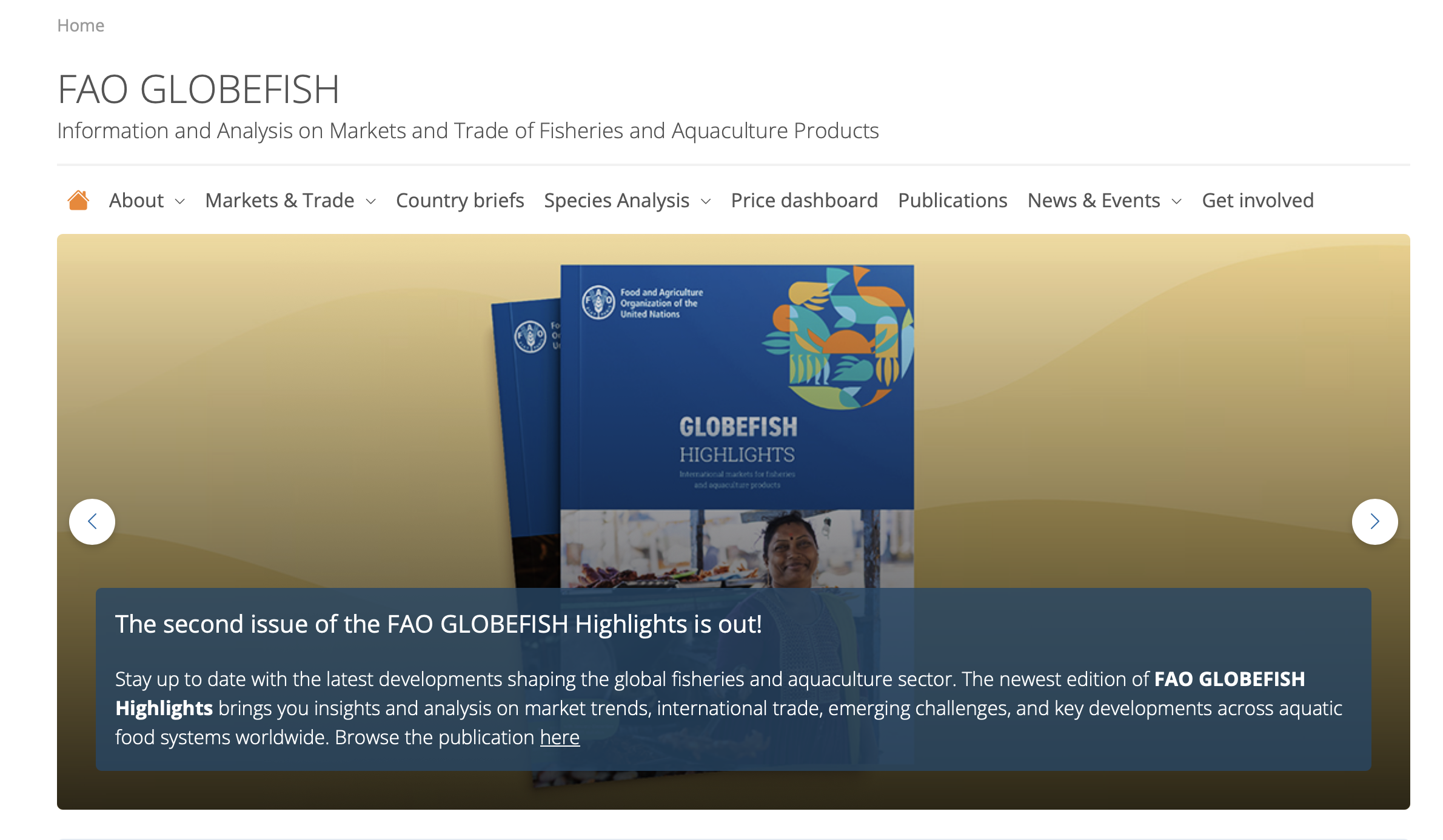
We have stayed friends across 19 years, and I have watched her do this work long enough to feel comfortable saying it matters. So when the GLOBEFISH team put out their contributor brief and their youth initiative concept note, I read them properly.
What GLOBEFISH actually is
GLOBEFISH was established in 1984, which makes it older than most of the regulatory architecture it now reports on. It sits inside FAO’s Fisheries and Aquaculture Division and plays a central role in COFI’s Sub-Committee on Fish Trade. It is a multi-donor funded project, not a core-funded programme, which is an important distinction I will come back to.
What it does is unglamorous and essential. It compiles, analyses and publishes information on prices, trade flows, markets and regulatory developments in fisheries and aquaculture. Price monitoring. Supply and demand analysis. Import notification tracking. Food safety regulation overviews. Trade agreement summaries. Country briefs. Tools that help an exporter work out which Harmonised System code actually applies to their product, which sounds trivial until you have watched a consignment sit in a port because someone guessed wrong.
All of it is free. Every publication, every dashboard, every tool. That is the entire point.
The asymmetry problem
Here are three numbers from the GLOBEFISH one-pager that are worth sitting with.
Thirty-six per cent of global aquatic animal production was traded internationally in 2024. That is a sector with extraordinary exposure to market shocks, because more than a third of what gets produced has to cross a border and satisfy someone else’s rules before it becomes income.
Two hundred and thirty countries and territories traded aquatic products in 2024. Every one of them has its own import requirements, its own documentation, its own interpretation of what constitutes acceptable evidence of legality and safety.
Per capita aquatic food availability in Africa in 2023 was 9.1 kilograms, compared with a global figure of 21.3. Africa exports a great deal of fish. Africa eats comparatively little of it.
Put those together, and you get the structural problem that GLOBEFISH exists to address. Market knowledge is not distributed anything like as evenly as fish is. A large European importer has analysts, legal advisers and consultants on retainer, and knows exactly what a new EU non-tariff measure means for its supply chain within days. A processing cooperative in a coastal town somewhere in the Pacific or West Africa finds out when its container is rejected.
I spend a lot of my working life in the space between those two realities. Most of the compliance failures I see don't result from anyone deciding to cheat. They are the result of someone not knowing, because nobody told them, because the information existed but sat behind a paywall or in a language they do not read or in a regulatory database designed for lawyers. Information asymmetry is not a market inefficiency in this sector. It is a trade barrier, and it hits hardest the operators everyone claims to want to support.
The four areas
GLOBEFISH organises its work around four thematic areas, and they map fairly neatly onto the problem above.
Market intelligence for equitable trade covers price monitoring and supply and demand analysis, the material that lets a small exporter know whether the price they are being offered is reasonable. Regulatory intelligence covers food safety rules, non-tariff measures, trade agreements and import notification systems across the major markets. Capacity development covers training and technical assistance for governments and small-scale actors. Data and knowledge for policy covers the statistical and methodological contributions that feed into the intergovernmental processes where the rules are made.
The 2026 to 2027 work plan adds a centralised Market Hub for practical regulatory compliance information, and expands the price monitoring dashboard to cover North America, Africa, Latin America and Asia. If you have ever tried to reconstruct a regional price series from scratch, you will understand why this is more significant than it sounds.
The partnership model is also worth noting, because it is the reason I have a personal stake in this. GLOBEFISH works with the regional market information network, INFOFISH, INFOPESCA, INFOYU, INFOPÊCHE, INFOSAMAK and EUROFISH, alongside Codex, WTO, WCO and UN ESCAP. That network turns a Rome-based analysis into something usable in Kuala Lumpur, Montevideo, Abidjan or Casablanca. Shirlene came up through that network, and it shows in how the project is run.
The youth question
The other document GLOBEFISH has put out is a concept note for a youth-focused initiative, and I want to take it more seriously than the usual youth-engagement boilerplate deserves.
The underlying problem is real, and I see it everywhere I work. The fisheries and aquaculture workforce is ageing. The pipeline of people coming into the technical and regulatory side of the sector is thin. Rural-to-urban migration pulls young people away from coastal communities, and the careers that do exist in the sector are largely invisible to anyone who hasn't grown up in it. Ask a twenty-year-old what jobs exist in the fish trade, and they will say fisher or maybe processor. They will not say traceability analyst, market intelligence officer, certification auditor, cold chain logistics specialist, food safety regulator or fisheries economist. All of those are real jobs. Most of them are short of people.
The proposed activities are sensible rather than flashy: youth-friendly publications that simplify GLOBEFISH analysis without dumbing it down, a webinar series covering market transparency, aquatic food fraud, traceability and certification, storytelling and interviews with fishers, young entrepreneurs and women leaders in the sector, national surveys to establish where young people actually sit in the value chain, and outreach through World Ocean Day, FAO Open Days, the World Food Forum and university programmes. They have already run a capacity development programme in Thailand on post-harvest fisheries that included a half-day session with around 200 university students on non-obvious career paths, plus a Discovery Station at the World Food Forum and activities at the 2026 FAO Open Day.
The target range is 14 to 35, in and out of formal education. I like that it isn't restricted to students, because many of the people who need this most are already working somewhere in the chain and have no idea there is a route upward.
Why this needs money
Here is the part that made me want to write this.
GLOBEFISH runs on voluntary contributions, at an indicative level of USD 1 to 5 million. For a project that has been operating since 1984, serves over 200 countries and territories, and gives everything away free, that is a remarkably small number. I have seen single consultancies cost a meaningful fraction of it.
The economics of a global public good are awkward. Because the output is free, no user has an incentive to pay for it, and because it is analytical rather than visible, it does not photograph well for an annual report. Nobody cuts a ribbon on a price dashboard. But the counterfactual is worse than it looks. If GLOBEFISH stops, the information does not disappear. It goes private, and it gets sold to whoever can pay, which means the asymmetry I described above widens rather than narrows. The people who lose access are precisely the small-scale operators and developing country agencies that the rest of the development architecture spends far more money trying to help.
So this is my modest pitch. If you work for a donor agency, a ministry, a research institution or a company that benefits from independent market intelligence, GLOBEFISH is one of the better value propositions in this sector.
The contact is Shirlene (ShirleneM.Anthonysamy@fao.org). Work with her, and you may stay friends for 19 years, as we have.
Disclosure, as always: Shirlene is a long-standing friend, and I have no financial interest in GLOBEFISH. I am writing about it because good people support good people. I
Sources: FAO GLOBEFISH one-pager (CE1259EN/1/08.26), the Contributor Information Brief, and the youth-focused initiative concept note.