In my last post on the SC22 outcomes, I wrote about tagging and about SC asking SPC to convene a technical workshop in 2027 on the use of tagging data in regional assessments. Tagging is a vital tool in the stock assessment toolbox. The results always matter, even when they do not go the way scientists would like. Continuity is fundamental.
Yet every few years, the same conversation comes back around, dressed up in the language of efficiency, with the Scientific Services Provider asked to explore options to improve cost efficiency in the tagging programme. The answer tabled at SC22 (WCPFC-SC22-2026-SA-WP04) is polite, thorough, and, if you read it properly, quite blunt. There is nothing left to trim. The only cost that scales is charter days, and cutting charter days is cutting the science.
I want to talk about why that matters, because tagging is one of those things everyone agrees is important, though few can say exactly why. And then about the part everyone silently agrees we need, but nobody wants to pay for: a dedicated research vessel.
What tagging actually is
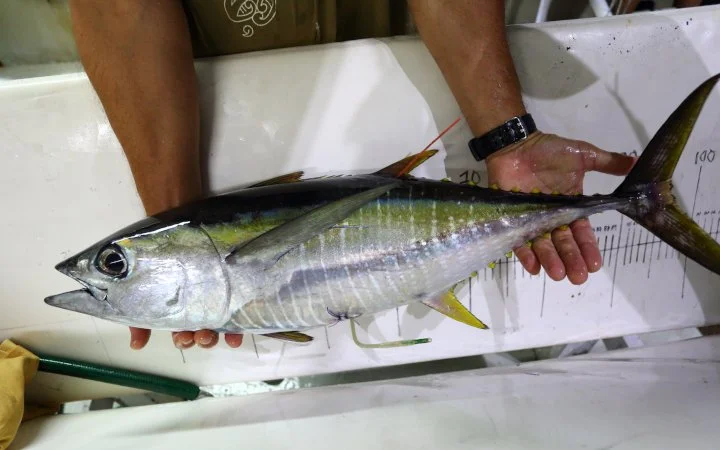
A tag is a small piece of numbered plastic pushed into the back of a skipjack that has been caught, brought aboard, measured, marked and returned to the water in a matter of seconds.
On its own, it is worth nothing. What makes it worth something is that months or years later that fish turns up in a purse seine set, goes into a well, gets landed, goes through a cannery, and somebody on the line notices the tag, reports it and gets a reward. That is the whole trick. A release event, a recapture event, and the distance and time between them.
From that pair of dots you get things you cannot get any other way. How fast fish move between areas. How many die of natural causes rather than fishing. How quickly they grow. How big the population is. Catch data cannot tell you any of that; it only tells you what was caught. Tagging is the one method that measures these things directly instead of inferring them.
It also gives you an estimate of fishing pressure that does not depend on the catch-and-effort data the industry reports about itself, and an estimate of abundance from sources other than CPUE. That matters enormously in a fishery where FAD use has quietly rewritten what a unit of effort even means.
Since 2006, the Pacific Tuna Tagging Project has been the primary source of data on skipjack, yellowfin and bigeye in the WCPO. It feeds MULTIFAN-CL. It feeds SEAPODYM, which is how the region generates its climate projections of where the tuna will be in 2050. It underpins the skipjack management procedure, the harvest strategy that took the Commission the better part of a decade to agree.
Take the tagging away and, as Table 3 of the paper spells out, the skipjack management procedure needs redeveloping, the monitoring strategies for all three species need redeveloping, and the skipjack assessment starts to lean on historical tagging data from a climate regime that no longer exists.
That last point is the one that should worry people. Old tagging data does not just get less precise. Under a shifting ocean, it gets wrong, and it gets wrong in a direction we cannot see.
The numbers, since we are talking about efficiency
WCPFC puts in roughly USD 790,000 a year. That is not what the programme costs. Between 2022 and 2025, non-WCPFC sources covered about 63% of core activity, so every Commission dollar pulled in another USD 1.70 of work aimed at Commission priorities. Over the life of the project, WCPFC has contributed just under USD 6 million since 2006. SPC's own non-WCPFC projects total USD 16.8 million, Korea USD 2.7 million, and PNG USD 1 million. Seventy-seven per cent of the lifetime cash has come from someone other than the Commission.
And that co-finance is not free-floating. It is attached to WCPFC being in the room. Donors and cooperating members fund this because it is the regional tagging programme bearing the Commission's name. Reduce the Commission's share, and you do not save your share. You lose a multiple of it.
The activities are interlocking:
You need the cruises to plant the tags and release the tagged fish.
You need the recovery network, rewards, and training for observers and port staff to get tags back.
You need tag-seeding experiments, in which known tags are introduced into the system without the finders knowing, to determine what proportion of recaptures are actually reported. Without a reporting rate, the recapture numbers mean nothing.
You need the data curation and analysis to turn any of it into something an assessment can use.
Drop one and the others stop producing useful information.
Then there is what it would cost not to have it:
USD 1.3 million a year to replace the tagging data with alternative sources for harvest strategies, assessments and climate projections
USD 100,000 a year for the specimen bank samples
USD 250,000 to redevelop the skipjack management procedure
Roughly USD 1.6 million a year of knock-on cost to at least nine other WCPFC projects
The only genuinely scalable cost is charter days, currently around 60 a year. Fewer days mean fewer tags, which lead to noisier estimates of movement, mortality, and abundance, feeding into weaker assessments and less reliable climate projections. How much weaker it would be would require a large simulation exercise to quantify, which would itself be costly.
And those cruises are not just tagging cruises any more. They are the only regular at-sea sampling platform in the region. Otoliths for ageing, growth and microchemistry. DNA biopsies for close-kin mark-recapture and epigenetic ageing clocks. Blood for reproductive biology and heavy metals. Stomach contents for the microbiome work. Fat content for condition time series. All of it rides on a platform already paid for, at marginal cost. Kill the charter, and every one of those projects has to go and find its own boat.
So the efficiency question has already been answered, several times over, by the accounts. This is one of the cheapest things the Commission does, and one of the few where the money visibly multiplies.
A fisherman always talks about boats
The proposed terms of reference state that tagging cruises are anticipated on either the NFD pole-and-line vessel Solomon Searcher or the multipurpose vessel Gutsy Lady 4, with alternates as availability allows. That sentence is doing an enormous amount of load-bearing work.
There is a reason it has to be pole-and-line. You cannot tag out of a purse seine brail. You need fish coming aboard one at a time, hooked, barbless, landed on a mat, handled for seconds and put back over the side alive and in good condition. Pole and line is the only commercial method that delivers that at scale, along with the live-bait operation that brings the school up and holds it there. The entire mark-recapture dataset that the WCPO assessments rest on exists because a couple of pole-and-line boats in the Solomons and elsewhere are still fishing.
And that fleet is not in good health. Pole-and-line has been shrinking across the Pacific for forty years, squeezed out by purse-seine economics, bait supply problems, crew costs, and the simple fact that it is labour-intensive in a world that keeps trying to be less so. What is left is a small number of ageing hulls kept going by operators whose business case has nothing to do with science. Nobody is building new pole-and-line vessels for the WCPO. Nobody is maintaining them to a research standard, because why would they? They are maintained to keep fishing, for as long as fishing pays, and no longer.
So the regional tagging programme, and through it the skipjack management procedure, and through that a fishery worth billions a year and a large share of government revenue in several PNA members, is underwritten by charter availability on a dwindling fleet of old commercial boats in a fishery that is on its way out. When a charter falls over, the science schedule bends around it. And the paper is clear that sporadic field operations make the whole supporting apparatus, the technicians, the recovery officers, the seeding programme, harder and more expensive to keep alive.
We have built a lifeline out of someone else's spare capacity.
Which brings me to “the boat”
SPC has a proposal on the table for a purpose-built Pacific fisheries science vessel. It is 48.6 metres long, has more than 6,000 nautical miles of range, and draws under 3.5 metres, so it can actually work in the region's shallow ports. It is diesel-electric, with room for whatever comes next: laboratories, acoustics, a hydraulic crane, mid-water trawl capacity, small boats for coastal work, and 26 people on board. The rationale is stark. The vessels previously used for this work are being decommissioned due to their age; here is a solution.
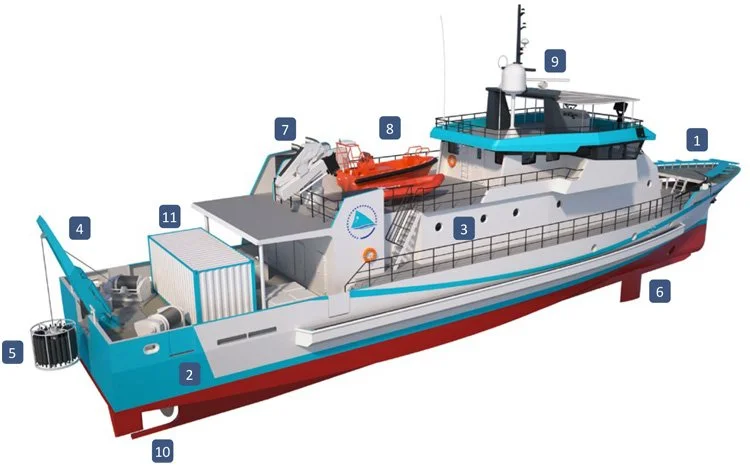
source and details: https://fame.spc.int/ecosystems-and-marine-biology/pacificsciencevessel
I should declare an interest. I began as a fisherman, and when I went to university to study fisheries, I paid for it by spending years crewing on research vessels. I collected data for my thesis and for other scientists while standing watch. I was a scientist and a deck officer at the same time, so I know what a research vessel is worth from both ends.
Which means I also know the arguments against capital investment. A vessel is a capital item, and capital items are politically harder than recurrent line items. Somebody has to crew it, dry-dock it, insure it and fill it with fuel. Regional bodies have owned ships before, and it has not always ended well.
But investment in science is long-term, and you do not see gains in the short term. Look at what countries in the region actually spend. New Zealand, a small agricultural country currently run by a government that invests minimally in science, still puts NZ$250-300 million of public money a year into agri-food science. Australia, a much bigger economy, invests around A$1.2 billion.
On fisheries specifically:
New Zealand: NZ$22.3 million a year on fisheries science, roughly half Crown-funded and half recovered from industry, with two offshore research vessels and small inshore craft
Australia: A$33 million a year through FRDC, plus A$49 million a year to run the Marine National Facility, with 15 to 20 vessels across the Commonwealth and the states
Japan: 7 fisheries research vessels plus 2 training vessels, the largest being Koyo-maru at 2,352 tonnes, run by an agency with 10 institutes and 968 staff, including 541 researchers
Korea: 13 research vessels operated by NIFS alone
These are only the countries I could find figures for. The point is that every serious fishing nation in this region owns fisheries research vessels and has the institutional experience to run them. The Pacific does not.
Furthermore, I would argue that a research vessel for SPC is a better investment than the Guardian-class patrol boats that Australia has already deployed in the region. Those cost around A$16 million per hull, with 22 delivered to 13 recipients, 30-year sustainment behind them, and they appear to go to sea for about 40 to 60 days a year. Over a 30-year life, that is roughly 1,200 to 1,800 sea days per vessel. For comparison, Australia's own RV Investigator costs about A$163,000 a sea day and is considered underused at 200 days a year.
A research vessel that actually goes to sea 200 days or more a year delivers more time on the water per dollar than a patrol boat managing 40 to 60. And it produces the stock assessment data that the enforcement effort is supposed to be protecting. The patrol boat programme bought the platform that ensures presence. Nobody wants to buy the platform that ensures the science.
The options are simple. Either we keep renting time on boats we do not control, from a sector we know is contracting, at a price that only goes one way as the fleet thins, with no ability to schedule the science around what the science needs. Or we build a dedicated vessel that does more than tag: acoustic biomass work, coastal surveys, seafloor mapping, ecosystem sampling, and the training of Pacific Island scientists at sea, which is the part nobody costs and everybody needs. It shows up after a cyclone. It carries the flag of a region that owns two-thirds of the world's tuna and currently cannot independently go and look at it.
Tagging continuity is not a nice-to-have in the science budget. It is the sensor on the most valuable renewable resource in the Pacific, and the entire signal chain currently depends on whether an old pole-and-line boat is free next April.
Fixing the charter line item was never the real question. The real question is whether the region's fishing powers and donors are willing to pay for and own the platform on which their own future depends, or whether we keep renting it from a fishery that is quietly closing down around us.