In my last post, I went through David Doulman's paper on the Kiribati-Soviet fishing agreement. Near the end, Doulman flagged Vanuatu as the next one to watch. It had an underused shore base at Palikula on Espiritu Santo, he reasoned, and if Soviet longliners could fill it, a fishing and port deal would make economic sense for both sides.
He was half right. Vanuatu did sign with the Soviets in January 1987. But by then the base was dying, and its story says as much about Pacific tuna in the 1980s as the Cold War theatre around it. So, this is the sequel: a Japanese transhipment based on an old American naval site, a second Soviet deal, and a group of ni-Vanuatu fishermen still waiting to be paid.
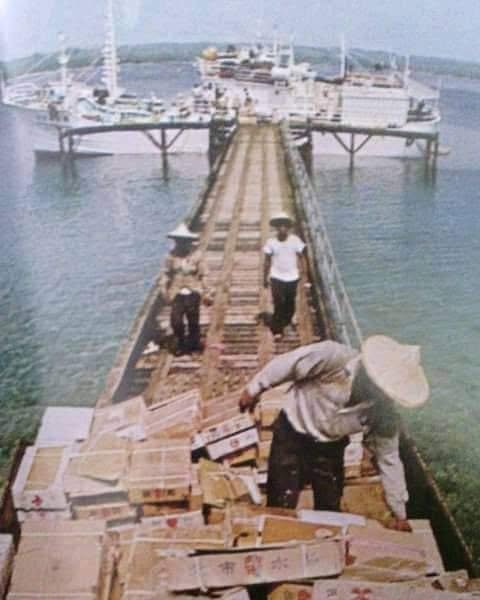
Palekula Fishing Port, in Luganville Santo. Origing of pict unknown
Mitsui's base on the Navy's land
Vanuatu's tuna history began in 1957, when Mitsui & Company established the South Pacific Fishing Company (SPFC) at Palikula (also spelt Palekula or Pallicolo). The site was about 24 hectares of flat land the US Navy had cleared during the war, when Santo was one of the great rear bases. The Navy left in 1946, and a decade later a Japanese trading house moved in. There is a certain symmetry to that.
SPFC was a transhipment and cold storage operation, not a fishing company in the usual sense. Longliners landed, the fish went into freezers, and carriers took it on to canneries. In 1974, the base was upgraded with a new T section on the main wharf for larger carriers, a fuelling wharf, and two large fuel tanks. In good years, up to 100 different longliners called there.
The boats were not Japanese, and most of the fish was not Vanuatu's. An Office de la Recherche Scientifique et Technique Outre-Mer (ORSTOM) fish-sampling study in 1979-81 found that about 90% of the longliners were Taiwanese, chartered under contract. They fished albacore across the Coral and Tasman Seas, roughly 8°S to 35°S, on trips of two to four months. A later catch reconstruction suggests less than 10% of what was landed at Palikula between 1958 and 1986 was caught in the waters immediately around Vanuatu. Palikula was a regional hub that happened to sit in New Hebrides (Vanuatu’s name at the colonial time) under a condominium (British/French) that had little reason to care where the fish came from.
A slow death by EEZ
The best snapshot of how the base worked is a 1982 ORSTOM report by Bour, Kulbicki and Marsac, built on landings data SPFC shared from August 1979. It reads like a fishery going under.
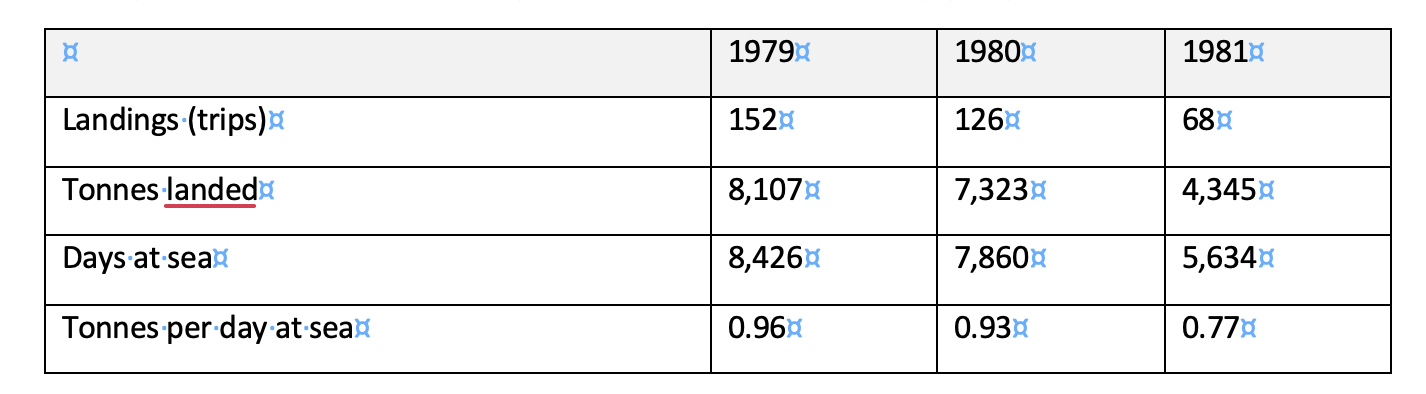
The fleet was 60 boats in 1979 and was expected to be half that in 1982. Catch per trip held at around 54 tonnes, but only because trips averaged about ten more days. At under one tonne a day, the Taiwanese were already well below the roughly 1.5 tonnes Japanese longliners got in the same waters.
ORSTOM put it down to the new EEZs and fuel prices. Their map shows almost no high seas left in the Coral and Tasman Seas, so owners now paid access fees on barely profitable fish, with old boats and old gear. Doulman's figure of 4,000 tonnes through a freezer built in 1984 for 10,000 is the next chapter. The 1984 closure of the Hawaii cannery didn't help, and Vanuatu's albacore ended up being shipped to Puerto Rico.
Anyone who has worked on longline economics will recognise the pattern. Coastal states finally got jurisdiction over their zones, and a business model built on fishing everyone's waters for free stopped adding up.
Lini's turn
Father Walter Lini, (Vanuatu’s 1st Prime Minister) was openly non-aligned. It joined the Non-Aligned Movement in 1983 and established diplomatic relations with Moscow on 30 June 1986, exactly three months before it did with Washington. That order of events was no accident, and nobody in Washington missed it… he was a key proponent of Melanesian socialism.
The fisheries agreement was signed on 27 January 1987. It was government-to-government, not with Sovrybflot as in Kiribati's case. The headline terms were these:
one year, for US$1.5 million
eight purse seiners plus small support vessels in the EEZ
port access for supplies and crew changes
So it cost the same as Kiribati's deal, covered fewer boats, and gave away the one thing Kiribati refused: port access.
Foreign Minister Sela Molisa reportedly described it as a way to help with a US$6.5 million budget deficit, about as much of a justification as you can get. In February 87, a cyclone killed more than 60 people and caused about US$200 million in damage, making the money look even more necessary.
The reaction was louder than in Kiribati, and port access was the reason, tied to the region's geopolitics at the time: Vanuatu's developing "nonaligned" and increasingly “anti-Western” stance and the alleged Libyan intrusions in the region.
After being isolated and ostracised in the Arab world and Africa, Libya's Colonel Muammar Qadhafi was paying increasing attention to Australia and the South Pacific region. In the early months of 1987, Libya established diplomatic relations with Vanuatu and improved ties with a militant faction of the independence movement in New Caledonia, FRETTLIN in East Timor, and the Free Papua Movement (OPM), the independence movement operating along the Papua New Guinea/Indonesia border. In April 1987 Libya hosted the second conference of its World Center Against Imperialism, Zionism and Racism (MATHABA), in Tripoli, and, freaking out of the settler governments of Australia, NZ, Britain and the USA, a good number of Pacific and Southeast Asians attended, including Vanuatuans, New Caledonian Kanaks, OPM representatives from Irian Jaya, New Zealand Maori, and Aboriginal Australians.
A 1988 Heritage Foundation (an absolute right-wing think tank) lecture by Colin Rubenstein (a former politics specialist in the Middle East and public policy at Monash University and now Australia/Israel & Jewish Affairs Council) as expected warned of a Soviet bid for a "Grenada-like strategic toe-hold" in Vanuatu, with talk of acoustic monitoring and submarine sanctuaries. A USA Congressional Record entry the same year contrasted full Soviet port access under a one-year deal with what US boats got under the five-year treaty.
Tsamenyi and Blay answered this in 1989, and their answer still holds up. The Soviets had fished the region since the 1970s; innocent passage gave warships more freedom than any fishing licence; New Zealand had a Soviet fisheries agreement since 1978, renewed three times; and the US had one since the 1960s. If these deals were a security threat, the objectors were remarkably relaxed about their own. They also criticised the paternalism of the idea that small states couldn't police what large ones could.
How it ended
Undramatically, as with Kiribati. The agreement ran its course and was not renewed because the two sides could not agree on the price. The submarine haven never appeared. Neither did Doulman's scenario of Soviet longliners filling Palikula's freezers. The licence was for purse seiners, and the base was shutting down just as they arrived. Sources date the closure of SPFC's fishing side to 1986 or 1987, after which the government took over the facility. I have not found anything showing whether the Soviet boats ever used Palikula, or only Port Vila. If anyone reading this knows, I would like to hear.
The part that has lasted is less geopolitical. SPFC employed ni-Vanuatu crew on the foreign longliners, and 1,130 members of the Vanuatu Fishermen's Association served on those boats, some of them for years. SPFC held their pay, and the government was a shareholder. When the company went under, many came home to find their money gone.
The case went to Parliament, and a minister said politicians mismanaged the funds until SPFC went bankrupt. Three commissions of Inquiry followed, the first under PM Barak Sope. Decades later, the former fishermen still picket and ask the government, as shareholders, to pay them. In 2019, the Daily Post found that the Palikula land had passed from a fishermen's cooperative to a private holding company, and it is not clear that the fishermen have any say over it.
Unfortunately, anyone who has worked in fisheries labour issues will recognise this too. The company holds wages rather than paying them to the crew, a state that is both regulator and shareholder, with the crew having no leverage once the vessel leaves. We tend to think of the forced labour and wage theft cases as a 2010s discovery. They are not.
Closing thoughts
Put the two posts together, and the Soviet deals look less like Cold War moves and more like what Pacific states did when they had few other options. They sold access to whoever would pay and used the noise to get the US to the table. Kiribati drew the line at port access; Vanuatu did not, and in practice, neither difference mattered.
The real long-term story was elsewhere. The EEZs gave Pacific states the fish, and Palikula's old foreign transhipment model could not survive paying for it. The domestic industry Vanuatu hoped would develop never materialised, so it became an open registry that flag vessels left and right.
Forty years on, Vanuatu runs one of the larger flag registries for longliners in the region, and labour on those vessels is still a live question.
Some things move more slowly than geopolitics.
Sources
Bour, W., Kulbicki, M. and Marsac, F. (1982). Analyse des débarquements de la pêche palangrière basée à Pallicolo (Vanuatu). ORSTOM, Nouméa.
Doulman, D.J. (1987). The Kiribati-Soviet Union Fishing Agreement. Pacific Viewpoint 28(1): 20-39.
Tsamenyi, B.M. and Blay, S.K.N. (1989). Soviet Fishing in the South Pacific: The Myths and the Realities. QUT Law Review 5: 156-162.
SPC. Field Report No. 4, Vanuatu.
An Improved Reconstruction of Total Marine Fisheries Catches for the New Hebrides and the Republic of Vanuatu, 1950-2014. Frontiers in Marine Science.
Cultural Survival Quarterly. The not-so-pacific Pacific.
US Congressional Record, 9 May 1988, Extensions of Remarks.
Vanuatu Daily Post: Fishermen Picket; Palekula Offered For Fishing Business;