I have quoted and referred to the always-reliable FFA Trade and Industry News many times; my friends Elizabeth Havice, Liam Campling, and Mike McCoy author it, and Len Rodwell distributes it.
The latest one has a really good primer on what is happening with El Niño; I paste it below in its entirety… but you have the link above; have a read, is absolutely worth it
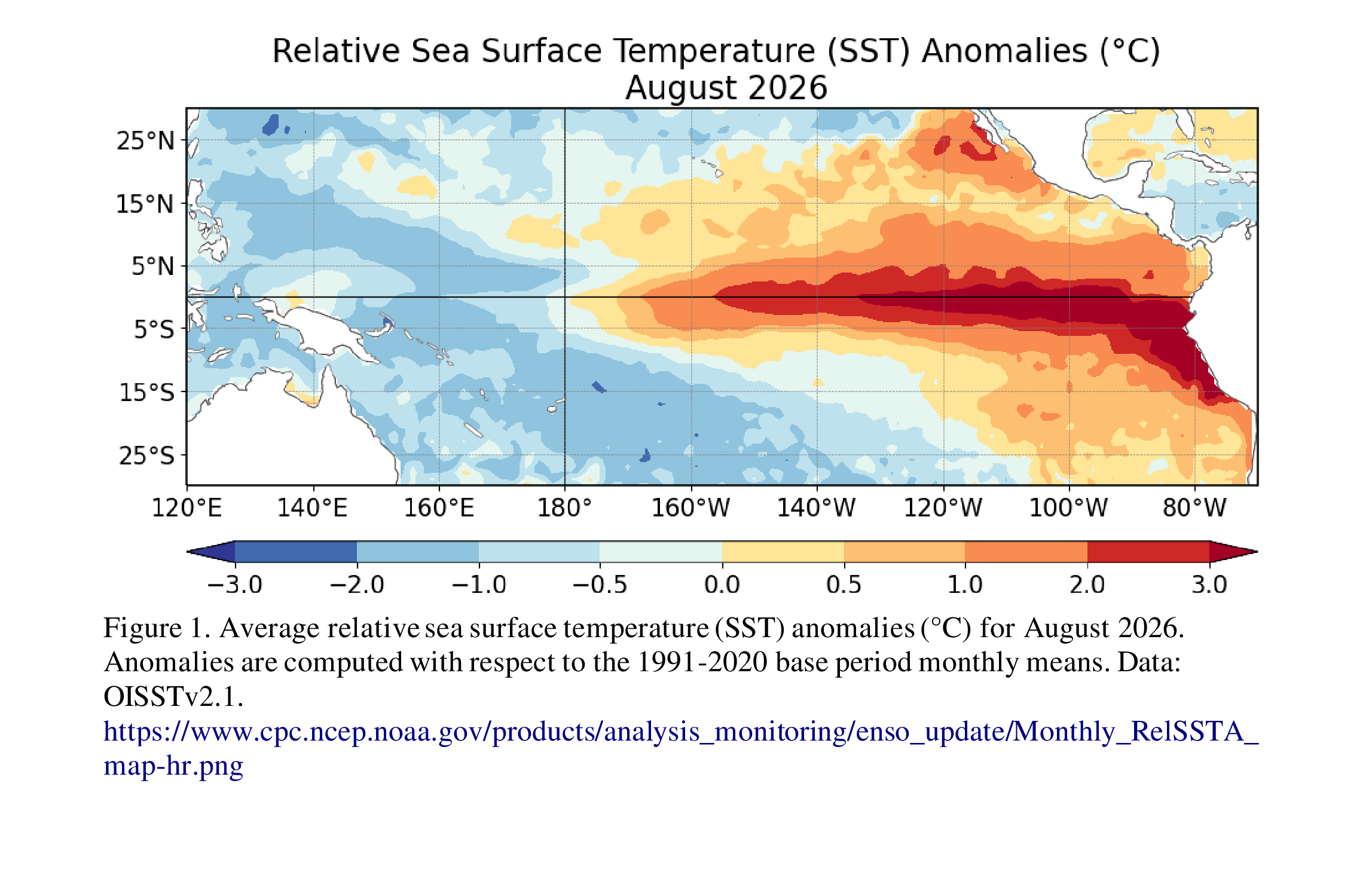
Following predictions of a strong El Niño event for the remainder of 2026 and into 2027, the US National Oceanic and Atmospheric Administration (NOAA) has indicated that El Niño is present, with equatorial sea surface temperatures above average in the East-Central and Eastern Pacific Ocean. Indications are that El Niño is strengthening, and there is a greater than 90% chance of a very strong event during the Northern Hemisphere autumn and winter that is likely to last into February of 2027.31
Meteorologists at the Pacific Community (SPC) have indicated that El Niño signifies likely limited rain for some PICs (Fiji, Papua New Guinea, Solomon Islands, Vanuatu, Samoa, Niue, southern Cook Islands, Tonga and Paula), and for others, flooding, higher and warmer seas (Kiribati, Tokelau, parts of Tuvalu) and unusually productive tuna grounds (Kiribati). 32
From mid-July into August, the Central and Eastern Equatorial Pacific had average sea surface temperature anomalies around +1.5°C to +3°C above average, with the strongest warming towards the EPO, in the high seas, and the EEZs of Peru, Ecuador, and Colombia.33 As conditions unfolded, in July, Solomon Islands saw low fishing activity followed by an uptick in August. Effort remained roughly normal in Papua New Guinea’s central region, though further toward the east that in non-El Niño years. After the annual FAD ban, effort shifted into the high seas and towards Kiribati and Tuvalu EEZs.34
Fishing conditions are also expected to be impacted in the Eastern Pacific, where El Niño will deepen the thermocline, expanding tuna’s habitat and making it more difficult for fleets to efficiently catch them. The Ecuadorian industry is forecasting a drop of 90,000 mt in 2026 catches.35 Industry is also facing higher fuel and raw material costs – including from purchasing supply from other oceans – as trading prices have elevated.36
Impacts will span the oceans.37 As time passes, El Niño will alter winds over the Indian Ocean, driving a positive Indian Ocean Dipole (IOD), which will yield warmer than average sea surface temperatures in the Western Indian Ocean, and cooler sea surface temperatures in the Eastern Indian Ocean.
These changes alter sea surface temps, nutrient levels and other variables that impact tuna behaviour, and thus, catch rates; scientists are expecting negative impacts on yellowfin catches, in particular. In the Atlantic, El Niño is likely to suppress hurricane development and also redistribute skipjack populations. Traditional grounds in the Gulf of Guinea and equatorial areas are likely to be less productive than usual.
31 Climate Prediction Center 2026. ENSO: Recent evolution, current status and predictions, National Oceanic and Atmospheric Administration. 8 September.
32 Koroi Tadulala 2026. ‘El Niño is back, and Pacific meterorologists are turning outlooks into action’, Pacific Community, 8 July.
33 ‘Pacific tuna fleet must brace for more challenging months ahead’, Atuna, 12 August 2026.
34 ‘El Niño affects WCPO seiner activity in August’, Atuna, 10 September 2026.
35 ‘El Niño’s global toll: Indian and Atlantic tuna fisheries also feel impact’, Atuna, 26 August 2026.
36 ‘Likelihood for strong El Niño increases: to stay until early 2027’, Atuna, 15 July 2026; ‘Super El Niño drives EPO sea temperatures to critical levels, Ecuador tuna sector hit’, Atuna, 25 August.
37 ‘El Niño’s global toll: Indian and Atlantic tuna fisheries also feel impact’, Atuna, 26 August 2026.