I spend much of my working life thinking about who manages bits of ocean and what they do with them, so in my last two blogs, I walked down memory lane on some aspects of the geopolitics of sovereignty in the PICs.
History has always interested me, and in another (richer) life I could see myself being a historian and philosopher
So when I read years ago about a potential Spanish claim to some islands in Micronesia in the 1950s, I went down that rabbit hole. And when I was recently in Madrid, I bought the ultimate book on that unique story: ¿Micronesia española? Historia de la reclamación española de soberanía en las islas del Pacífico (Comillas, 2015)
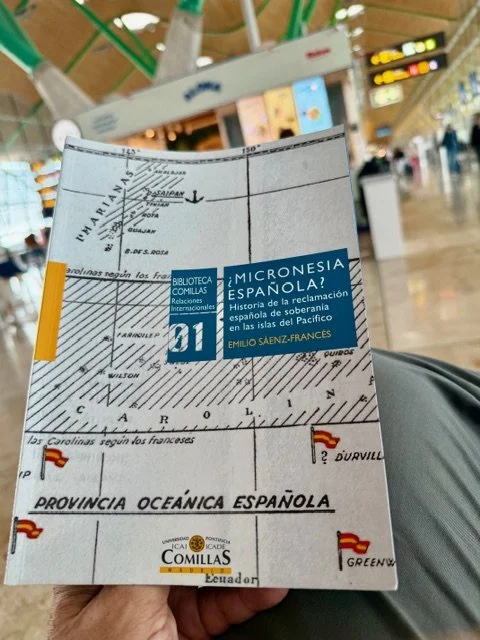
read it VERY fast
Saying this is the story of a Spanish state lawyer who, in 1948, convinced himself and, briefly, the Madrid press that Spain still owned a handful of Micronesian atolls doesn't capture the bigger picture.
The colonial angle is obvious, and the book handles it well. What interests me is what happened in those waters after Spain left and the slightly absurd fact that Spain did come back, not with naval stations but with purse seiners.
From “Spanish lake” to fire sale
For a couple of centuries the Pacific was the Lago español. Legazpi claimed the Marianas in 1565, and Guam became the watering stop for the Manila galleons for 250 years. The 1668 Jesuit mission brought wars and epidemics that pushed the Chamorro to the brink of collapse, a part of the story that colonials tend to skip.
Spanish navigators sighted the Carolines, named after Carlos II, from the 16th century onward but barely administered them. Because the Viceroy of Mexico oversaw the administration of the Philippines, the islands were merely a stopover in the galleon trade between the two sides of the Pacific.
That changed in 1885, when a German gunboat raised the imperial flag on Yap. Madrid protested, Bismarck proposed papal mediation, and Leo XIII recognised Spanish sovereignty over the Carolines and Palau, granting Germany trade and fishing freedoms and expecting Spain to make that sovereignty effective. That year's Hispano-German Protocol defined the archipelagos by coordinates. Spain set up posts on Yap and Pohnpei and, within two years, a rebellion on Pohnpei killed the governor.
After the 1898 end of the Spain-USA war over Cuba, the USA took control of the Philippines and Guam (along with Puerto Rico), and in 1899 Spain sold the Carolines, Palau, Marshalls and the Northern Marianas to Germany (that had parts of PNG and Samoa) for 25 million pesetas. Article 3 allowed Spain to retain coaling stations in each group, a right it never exercised. Joaquín Costa said the politicians who walked away “no tenían valor ni para soñar”: they lacked the courage even to dream.
1948: four islands down the back of the sofa
Fifty years later, Emilio Pastor y Santos, a state lawyer attached to the CSIC (Consejo Superior de Investigaciones Científicas), was working through the Foreign Ministry archives. In March 1948, he argued that Spain had the right to set up the fueling stations under Article 3 of the sale agreement.
By October, he had a bigger idea. The 1885 Protocol had defined the Carolines by coordinates, but the 1899 sale and its royal decrees simply named archipelagos. Comparing these with old Spanish discovery records and period charts, Pastor concluded that several islands discovered by Spaniards (Güedes, Coroa, Pescadores, and Ocea, among them) lay outside the defined Carolines and were never sold.
In December 1948, ABC announced that Spain possessed four groups of islands in Micronesia, and in 1950 the CSIC’s Instituto de Estudios Africanos published its Territorios de soberanía española en Oceanía, proposing a “Provincia Oceánica Española” with permanent bases.
The weak point, besides the law, is the geography. Hernando de Grijalva’s 1537 voyage left no usable positions, and nobody then had a reliable longitude. Depending on the source, Pescadores is Kapingamarangi or Rongerik; Ocea is Nukuoro, a submerged reef, or (in one confused version) Kiritimati; and Güedes is Mapia, now Indonesian. Anyone who has tried to match an old fishing log to a modern chart knows the problem. A sovereignty claim that cannot say which island it means is not a strong claim.
Franco, Washington and Rongerik
Spain's political timing also explains a lot. In 1946 the UN had recommended that members withdraw their ambassadors from Madrid. Franc’s Spain was isolated, hungry and autarkic, and the regime needed patriotic headlines. A lost Pacific province fitted the mood. The problem was who ran those waters: since 1947 they had been the Trust Territory of the Pacific Islands, a strategic trust under the United States, with nuclear tests at Bikini and Enewetak.
Franco’s only road out of isolation ran through Washington, which is where it led with the Pact of Madrid in 1953. Claiming islands inside a US strategic trust was not a clever move.
There is a darker irony. Rongerik, one of Pastor’s candidates, was home to the people of Bikini during those years, and the US Navy moved them there in 1946 to clear the atoll for Operation Crossroads. Rongerik could not feed them, and they were near starvation when they were moved again in 1948. Madrid’s papers said Spain owned Rongerik, but the people on it were displaced islanders nobody in Madrid had heard of, let alone asked about.
The Council of Ministers took up the matter on 12 January 1949 and filed it with the minute “procede esperar” (best to wait). Nobody reopened the drawer. Sáenz-Francés shows from Spanish and foreign archives that Spain’s intention in 1899 was to get rid of everything, named or not, and that it never exercised sovereignty there afterwards.
Pastor’s thesis is best read as propaganda of its moment. The idea still resurfaces in the Spanish press like a seasonal run, and in 2014 a question reached the Congreso de los Diputados, where the government replied that the 1899 cession covered all of Spain’s Pacific possessions.
The tuna angle
This is where I part company with the purely colonial reading. What mattered most about the 1899 sale came after Germany. Japan took the islands in 1914 and administered them under a League of Nations mandate, and tuna was one of its major successes. Pole-and-line skipjack fishing began in Palau in the 1920s, and by the mid-1930s around 45 pole-and-line boats were based in Palau, 52 in what is now FSM, and 19 in the Northern Marianas, with most of the catch processed into katsuobushi for the Japanese market.
Here is the part that should sound familiar to anyone in Pacific tuna today: Micronesians had almost no part in it. Okinawan crews manned the boats, Japanese firms ran the processing ashore, and the value went north. The fishery was in Micronesian waters, but it was not a Micronesian fishery.
That did not change much under the US Trust Territory either. It took independence, UNCLOS, the 1982 Nauru Agreement, and eventually the Vessel Day Scheme for FSM, Palau, and the Marshall Islands to turn their zones into national revenue.
That, to me, is the real Provincia Oceánica: coastal states turning scattered atolls into fishing rights that others pay for by the day.
What if Pastor had been listened to?
Suppose the claim had stuck and Spain still held Kapingamarangi, Rongerik and Mapia in 1982. Kapingamarangi is an inhabited atoll, not a rock under Article 121(3), so it would carry a full EEZ, roughly 430,000 km² before trimming overlaps. It sits about a degree north of the equator, in the warm pool, in the middle of the equatorial purse-seine grounds.
Spain would have been a coastal state within the PNA area, licensing Basque and Galician seiners, and sitting at the WCPFC table, as France does. It also shows what the claim would have taken away: those waters now underpin the fisheries revenue of FSM, the Marshall Islands and Indonesia. And the people of Kapingamarangi (a Polynesian outlier) were never asked, then or since.
Spain came back anyway
The final irony is that Spain did return. The Spanish purse-seine fleet began fishing in the WCPFC area in the late 1990s and has maintained a small presence of two to five boats; the EU’s own reports to the WCPFC record four Spanish-flagged seiners in the Convention Area in both 2023 and 2024.
Spanish capital also operates under Pacific flags, and the EU’s regional partnership agreements have largely focused on Spanish boats. Those boats need licences, fishing days and observers, all issued by the Micronesian states that Pastor thought belonged to a forgotten Spanish province. The coaling stations were never used. The fishing day is worth much more.
A lesson here?
Saenz-Frances ends by welcoming Spain’s rediscovery of the “Indo-Pacific”, and I agree. But my lesson is a fisheries one. Leo XIII made Spanish sovereignty conditional on effective occupation, and Spain lost because it never really showed up.
EEZs work the same way. A zone that is declared, mapped and licensed but not monitored, controlled and surveilled is closer to Pastor’s paper province than we care to admit. Sovereignty without presence is a cartographic hobby. In the Pacific today, presence means fisheries management, MCS, VMS, port inspections and the capacity to act on what they reveal.
My last two posts show that PICs understood this right from HNCLOS onwards.
Sources
Emilio Saenz-Frances (2015) ¿Micronesia española? Historia de la reclamación española de soberanía en las islas del Pacífico. Madrid: Publicaciones de la Universidad Pontificia de Comillas. 96 páginas ISBN: 9788484686088
Pastor y Santos, E. (1950). Territorios de soberanía española en Oceanía. Madrid: CSIC. https://archive.org/details/territorios-de-soberania-espanola-en-oceania
El Español (2017) on the 1949 Council of Ministers. https://www.elespanol.com/ciencia/investigacion/20170907/244976312_0.html
Xataka on Pastor’s four islands. https://www.xataka.com/magnet/hay-quien-piensa-que-espana-sigue-teniendo-cuatro-islas-perdidas-oceano-pacifico-complicado-que-parece
COPE on the 2014 parliamentary question. https://www.cope.es/actualidad/sociedad/historia/noticias/cuatro-islas-oceania-espana-pudo-reclamar-2014-hizo-lugar-estrategico-mundo-20250515_3150817.html
FAO, pre-WWII Pacific tuna fisheries. https://www.fao.org/4/ai001e/ai001e04.htm
Higuchi, W. (2007). Pre-war Japanese fisheries in Micronesia. Immigration Studies 3: 49–68. https://www.soest.hawaii.edu/PFRP/reprints/higuchi_micronesia_prewar_fisheries.pdf
EU-Spain Annual Reports Part 1 to the WCPFC, 2023 https://meetings.wcpfc.int/file/15235/downloadand 2024 https://meetings.wcpfc.int/file/17874/download