The Scientific Committee of the WCPFC met in Apia from 11 to 19 August, and the outcomes document is out. It runs to a few hundred paragraphs across almost 100 pages, so full respect to the group that made it! Not sure if anyone one ever reads it completely! It is very dry reading; most paragraphs begin with the institutional language of "SC22 noted" or "SC22 recommended", and, like all such documents, it buries the interesting parts in careful language.
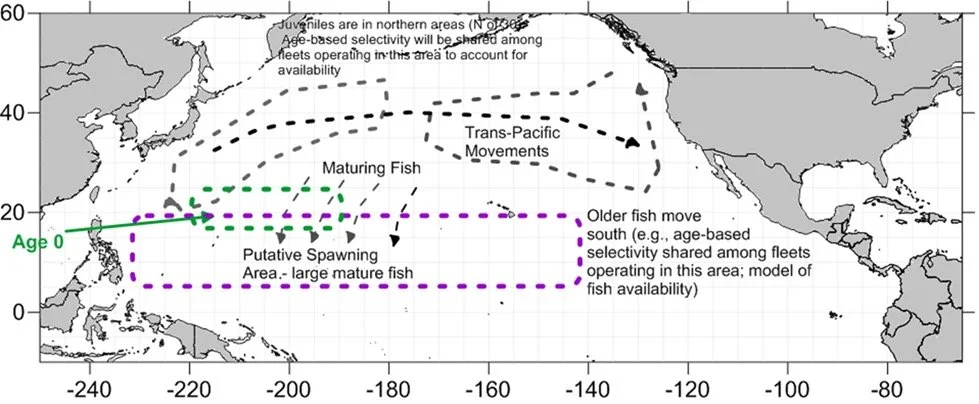
Conceptual model of north Pacific albacore biology and population dynamics.
I did not read it all, partly because much of it went over my current level of scientific knowledge, yet I have areas of interest, and this document will be the basis for the advances that can be made… so here is what I take from it.
The bigeye assessment was the best one ever produced, and the meeting could not agree on it
SPC presented a new bigeye tuna assessment. SC22 called it the most scientifically advanced assessment of the stock developed to date, and commended the openness and reproducibility of the process, which let member scientists engage with the model as it was being built rather than argue with it afterwards. That is real praise, and not the sort you usually see in these documents.
Then it could not agree on the answer.
The disagreement concerns which set of model runs best describes stock status. When you build an assessment, you do not produce one model; you produce a grid of them, each with different assumptions about the things you cannot measure. Some members preferred a grid of 80 models that keeps both options on one uncertainty axis: the treatment of tag reporting rates during the mixing period. Others preferred a grid of 34 models that keeps only one of those options, and thought it more defensible.
Both grids give the same qualitative answer. The stock is not overfished and is not subject to overfishing, and recent biomass is slightly below the 2012 to 2015 average the tropical tuna measure uses as its objective. What differs is the risk. Grid 1 puts the chance of being below the limit reference point at 18.6 per cent and the chance of fishing mortality above FMSY at 24.1 per cent.
Grid 2 puts them at 23.6 and 29.2 per cent. Five percentage points on the risk of breaching a limit reference point is the kind of number that decides an allocation argument, which is why nobody was in a hurry to concede. There was even a proposal to weight the two grids 60/40 rather than treat them equally.
Underneath it sits tagging. SC22 identified tag mixing and the possible overdispersion of tag recaptures as the outstanding uncertainties that must be resolved before consensus can be reached. So the Committee asked SPC to convene a technical workshop in 2027 on how tagging data are used in regional assessments, with the results feeding into the next bigeye assessment in 2029 and an independent peer review of that in 2030. Meanwhile, the formal advice reverts to SC19, and SC22 had to note that the SC19 assessment contained an error in model specification and should be read with caution. That is an uncomfortable place to be, and everyone in the room knew it.
The yellowfin assessment did not fare better, for a duller reason. It arrived too late for members to review properly, so adoption was deferred to SC23, with a list of items to address, including whether the model's spatial structure is distorting the growth estimates.
The tagging programme produced mixed results. SC22 endorsed its workplan and indicative budget to 2029, noted the revised terms of reference, and stressed the importance of tag seeding. It also told SPC to strengthen the paper before FAC20 and the Commission by linking each activity to a management issue and making the value-for-money case explicit. Given that the bigeye stalemate turns on how tagging data are handled, asking for a better argument is fair enough. It does leave SPC defending a programme whose data the meeting could not agree on how to use.
The important line is buried in the BigEye section
Two sentences deserve more attention than they will get. SC22 agreed that the lack of consensus should not delay the bigeye management procedure, because the Commission's consideration of the procedure depends on the estimation method rather than on acceptance of the latest assessment. And it noted that, within the harvest strategy framework, management advice should come from adopted procedures, while assessments primarily serve to monitor and review those procedures.
That is a restatement of what the Commission is becoming. For twenty years, the annual argument was about the assessment because it produced the advice. Under harvest strategies the advice comes from a rule agreed in advance, and the assessment becomes a diagnostic tool. Whether members behave that way is another question, but the principle is now on paper.
You can see it working already. The South Pacific albacore management procedure ran for the first time and produced an actual number: 56,096 tonnes, applying to longline and troll fisheries south of 10 degrees south, excluding the EEZs of Tokelau and Tuvalu. No debate about the assessment, just the output of an agreed rule. The skipjack monitoring strategy also found nothing preventing the skipjack procedure from operating.
Bigeye is not there yet. The operating models were revised, the estimation method was accepted in principle, and the candidate procedures now sit on something called a nuclear grid, which sounds alarming but is a table of combinations of longline catch and FAD closure periods that reach a given target. Some members think the candidates do not reflect what was agreed at the first bigeye management workshop, particularly on how catch limits and FAD closures sit alongside the exemptions in CMM 2025-02. SC22 has requested a two-day special session alongside the Commission meeting in Port Vila to sign off on the operating model grid.
Yellowfin gets no procedure of its own and will be managed implicitly through the skipjack, bigeye and albacore rules, which is a bet worth watching, especially since none of the current bigeye candidates reaches the interim yellowfin target.
The northern stocks are in good shape
North Pacific albacore is virtually certain, above 99 percent, to be neither overfished nor experiencing overfishing, with spawning biomass around 60 percent of the unfished level and fishing intensity below target for six years running. Pacific blue marlin sits at the same place relative to MSY-based reference points, and the ISC noted that the stock might support somewhat higher removals.
SC22 did not simply pass that on. It pointed out that terminal-year status is less certain than the headline probabilities suggest, that the assessment relies on biological parameters sampled almost entirely in the North Pacific for a fish assessed as a single Pacific-wide stock, and that southwest Pacific sample holdings are close to zero.
Given how much blue marlin matters to coastal longline and sport fisheries in the islands, it recommended caution about any catch increase. The Committee read the number, then the fishery, which is what you want it to do.
The unpretentious decisions that will matter
Data work moved forward in ways nobody will notice for years. Cannery receipt data, Project 114, gets a workshop later this year and an extension to 2027, aimed at using cannery weights to correct logbook data (this, for me, is a key issue that, if we could get right, plus the transhipment scales, could give us the real numbers in under- or misreporting). Size data submission gets a formal proforma and a traffic light system for spotting sampling gaps, with an explicit instruction that the thresholds are not to be used for compliance.
On monitoring, SC22 told the Commission plainly that coverage of at least 10 per cent of longline effort is needed for reasonably good bycatch estimates of common species, and more than that for turtles and cetaceans. It also linked electronic monitoring to the increased longline bigeye limit under CMM 2025-02, noting that some members may use EM to meet the coverage requirement.
On FADs, the Committee agreed a stepwise introduction of biodegradable drifting FADs is technically feasible, while recognising that material supply chains make this disproportionately costly for atoll states and SIDS. On loss and abandonment, it prioritised prevention and shore-based recovery, noted that many strandings originate outside the region, and recorded that several members believe the cost of recovery should fall on those who benefit from the fishery (which has been my posture for years)
Climate ran through the meeting. SC22 noted with concern the record global ocean heat content in 2025 and the eleven warmest years on record, and asked that ecosystem indicators be reported in a way that separates short-term variability from long-term trends from plain changes in fishing behaviour.
SC22 also noted the growing use of AI tools to access WCPFC scientific information, and the risk that, without a well-curated source, these tools may return material that is simply wrong. It recommended the Commission discuss whether it needs a policy on AI access to its information. That is the first time I have seen an RFMO put that on the record.
Marine pollution, and the limits of what the SC could say
The gear that fisheries lost got a proper airing, and most of what the Committee said concerned what it does not know.
On abandoned, lost, or discarded fishing gear, SC22 recommended that the Commission strengthen observer monitoring across longline observer programmes, including through electronic reporting and observer training, and encourage more members to participate. Only 13 members monitor it at present. Some members want the data recorded in standardised fields rather than free-text comments: whether gear was abandoned, lost or discarded, why, and how much, down to mainline and branchline length and the number of floats and beacons.
Then the honest part. SC22 advised that the scientific value of extra reporting stays limited while longline observer coverage remains as low as it is, and it recorded that it did not have the information to advise on which lost gear poses a significant risk of ghost fishing or to navigation. That is precisely the judgement the draft measure wants from it. Underwater noise and greenhouse gas emissions were parked as needing more science and as having management implications that are better handled at TCC, and the Committee suggested a three-year review period once the new measure is adopted.
Doing less, on purpose
The most consequential decision may be procedural. SC22 agreed a three-year process to prioritise its own work: the assessment schedule this year, the harvest strategy work plan next year, and conservation measure reviews in 2028. Assessments for stocks that have passed peer review may now alternate between full benchmarks and lighter updates. The shark measure review is proposed for deferral to 2028. The long-running effectiveness analysis of the tropical tuna measure is recommended for discontinuation, since monitoring strategies will do that job once the procedures are running.
There was even a suggestion to swap the timing of the Commission and Scientific Committee meetings so assessments arrive with time to be reviewed. Given that yellowfin was deferred this year for exactly that reason, it is not a silly idea.
SC23 is in Pohnpei, 10 to 18 August 2027. Solomon Islands have offered to host in 2028.
What it adds up to
The science is in better shape than the consensus process around it. An assessment can be the best ever produced and still fail to be adopted, because adoption is a political act and the numbers in dispute are the ones that translate into catch. The harvest strategy framework is meant to take that pressure off the assessment, and this year gave the first real sight of it working for albacore and skipjack while bigeye stayed stuck in the old pattern.
The other thing I notice is a committee that has started saying no to itself. Deferring items, dropping an analysis, spacing out assessments, asking for a prioritisation process. Some of that is good discipline. Some of it is a body admitting it has more work than it can do, which is worth saying out loud rather than discovering later through another late assessment.