Every August, the Scientific Committee of the Western and Central Pacific Fisheries Commission sits down to work out many of the science challenges for the year ahead, (at least partly) the numbers from the year before, and this year's overview paper, put together by Tiffany Vidal, Thomas Ruaia and Freddie Heather, tells a fairly clear story about 2025. After a record-breaking 2024, the fishery pulled back across almost every measure: catch, value, and the economic conditions underpinning the main fleets.
The headline number is the total tuna catch from the WCPFC Statistical Area, which came in at a provisional 2,588,945 mt for 2025. That is about 472,000 mt below the 2024 record of just over 3 million tonnes, though it sits close to the 2023 level of 2,685,724 mt. So rather than reading 2025 as some new low point, it looks more like the fishery reverting to its recent normal after an unusually good year.
We still dominate the global tuna supply. The WCPO catch represented 72% of the total Pacific tuna catch and 49% of the global tuna catch for the year, and unlike other oceans, the overwhelming majority of that catch, 86% in 2025, is taken inside the waters of Pacific Island coastal states rather than on the high seas.
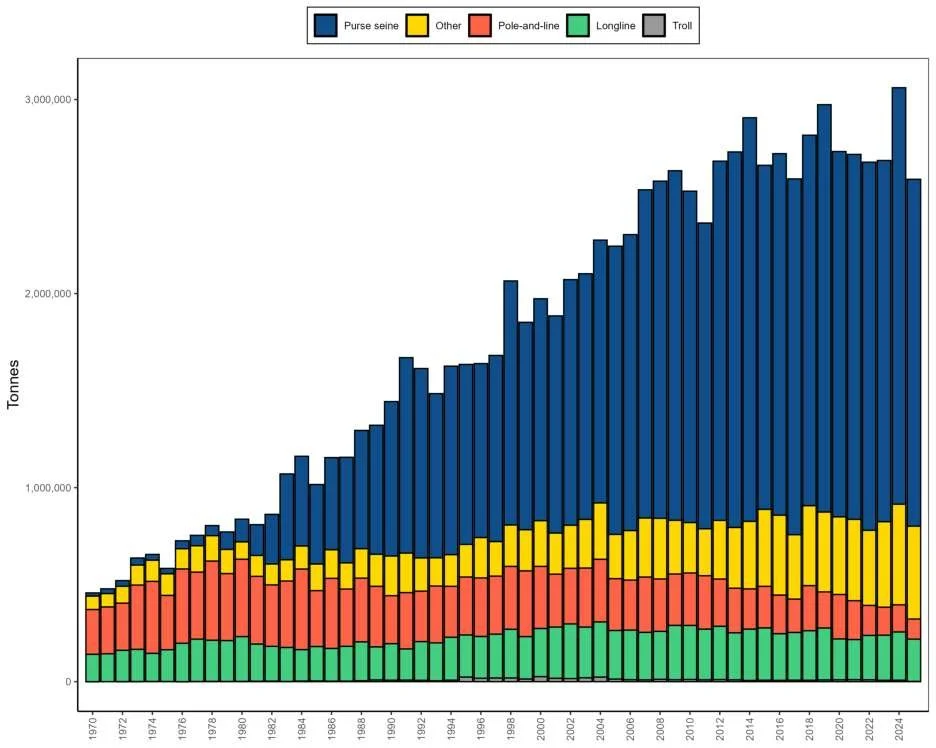
Catch (mt) of albacore, bigeye, skipjack, and yellowfin tuna in the WCPFC-CA, by longline, pole-and-line, purse seine, troll, and other small-scale gear types
Skipjack remains the backbone of the fishery. The 2025 catch of 1,668,409 mt made up 64% of the total, but that was about 393,000 mt down on the 2024 record. Yellowfin came in at 677,123 mt (26%), continuing a gentle decline from the 2021 record. Bigeye actually went the other way, up 9,146 mt to 155,864 mt (6%), and albacore fell to its lowest level since 1993 at 87,549 mt (3%).
The purse seine fishery is still the biggest part, taking 69% of the total catch by volume in 2025 at 1,787,386 mt, a drop of around 359,000 mt from 2024's record. Skipjack made up 76% of that purse seine catch, yellowfin 20%, and bigeye 4%.
What stands out in the detail is how much of the story is about where the fish were, not just how many there were. The fishery has been shaped for the past five years by persistent La Niña conditions, with a brief wobble toward El Niño in early 2025 before La Niña reasserted itself for the rest of the year. That kept effort concentrated in the western side of the WCPO, particularly around PNG, FSM and the Solomon Islands, a pattern reinforced in 2024 when PNG cut licensing fees to draw fleets into its waters.
The Pacific Islands flagged fleet, now 167 vessels and the largest it has ever been, continues to be the dominant force in the fishery, taking well over half the region's purse seine catch on its own, though even this fleet saw a slight downturn in 2025 after its record 2024.
One technical detail worth flagging for anyone who watches catch rates: there has been a documented shift in how vessels report transit days versus searching days on their logsheets, which is quietly inflating the nominal CPUE figures reported in this and other papers. The authors flag this explicitly, so any casual reading of "catch rates are up" needs that caveat attached.
Bigeye catches in the purse seine fishery jumped 42% in 2025 to 63,579 mt, the highest since 2018, driven by a heavier reliance on drifting FAD sets, which rose from 17% of all sets in 2024 to 32% in 2025. That is a meaningful swing in fishing strategy within a single year, and it shows up clearly in the size composition data too, with FAD-associated catches skewing smaller and more mixed-species than the free school sets.
Pole-and-line had a rough year, with the 2025 catch of 103,588 mt the lowest since the early 1960s. Japan's distant water and offshore fleets, still the mainstay of this gear type alongside Indonesia, saw catches drop 5% as the fleet itself shrank from 61 to 57 vessels. This is a slow, structural decline that has been running for decades now, driven by the economics of pole-and-line relative to purse seine rather than any one bad season.
Longline told a similarly downbeat story. The 2025 catch of 218,014 mt was below the ten-year average, with bigeye at its lowest since 1983 and albacore down sharply too. The Japanese and Korean distant water fleets continue to shrink (Japan's bigeye catch has fallen from 20,725 mt in 2004 to just 2,702 mt in 2025, alongside a vessel count that's dropped from 366 to 62 over the same period), while the Pacific Islands domestic albacore fleet keeps growing its share of the South Pacific albacore catch, now taking 57% of it compared to a third back in 1998.
Prices were a mixed bag through the year. Skipjack recovered somewhat after a rough 2024, with Thai import prices up 8% to $1,641/mt and Yaizu prices edging up 2%. Yellowfin and bigeye prices moved in different directions depending on the market and product form, fresh versus frozen, Japan versus the US, with US fresh yellowfin import prices actually falling 18% even as frozen product from Japan rose 16%. Albacore had a rough year in the US market, down 23% after a record high in 2024.
Put all the catch and price movements together, and the total delivered value of the WCPO tuna catch fell 5% to $5.4 billion in 2025. Purse seine still accounts for 57% of that value despite an 11% drop, while longline actually grew 9% to $1.18 billion and pole-and-line grew 13% to $230 million on the back of a big jump in albacore volumes. Skipjack value fell 15% to $2.7 billion even as the other three species all grew in value, a reminder that skipjack's sheer volume means its price and catch swings dominate the headline economics of the whole fishery.
The part of this paper that will matter most to anyone thinking about the industry's near-term prospects is the economic conditions indexes, which track fish prices, fishing costs and catch rates against a 20-year baseline. All three of the major fisheries went backwards in 2025. The tropical purse seine index fell to 80, well below its long-run average, driven mainly by a real decline in catch rates that outweighed cheaper fuel and slightly higher fish prices.
That is a sharp reversal from 2024, when the index sat at 109 on the back of strong catches. The southern longline fishery fell to 79, and the tropical longline fishery to 74, both weighed down by falling catch rates and, in the tropical fishery's case, persistently low fish prices as well.
None of these numbers is catastrophic in isolation, but the direction across all three fisheries in the same year, after several years of relatively favourable conditions, is the kind of signal that tends to get noticed at the coastal state level given how much of the region's fisheries revenue flows from access arrangements tied to these fleets. And i’m sure the fuel costs have had their share of influence on this slowdown.
Away from the big three gear types, the paper also captures a genuinely large shift in how Indonesia's handline fishery is being reported. After a 2024 handline workshop, Indonesia was able to properly split its large-fish handline catches from its small-fish hook-and-line catches for the first time, and the result was a big jump in the reported large-fish handline catch, to 176,314 mt in 2025, about 62% of it yellowfin. The authors are careful to note this looks like a reporting artefact rather than a real change in the fishery, but it is a good example of how much of what looks like a trend in these annual reports is actually a data collection story.
On the billfish side, most species tracked lower in 2025 than 2024: blue marlin down to 9,257 mt, black marlin down 44% after a record 2024, striped marlin down slightly. Swordfish in the South Pacific held roughly steady at 18,501 mt, still dominated by the EU-Spanish fleet.
Taken as a whole, 2025 reads as a fishery cooling off from an exceptional 2024 rather than one in trouble, but the simultaneous decline across catch rates, prices in several key markets, and the economic indexes for all three major gear types is worth watching into 2026, especially with forecasters now flagging a potential swing toward a strong El Niño later in the year, which would reshape where the fish, and the fleets chasing them, end up.