FAO has recently published Implementation of the Voluntary Guidelines for Transhipment: 1. A guide for fisheries managers (Technical Guidelines for Responsible Fisheries No. 15, Suppl. 1, Rome 2026). It is the operational companion to the Voluntary Guidelines for Transhipment (VGTS) that COFI endorsed back in 2022, and it was written by Shelley Clarke and Esther Boy Carmona, with contributions from Giuliano Carrara and Glenn Quelch, and technical backstopping from Matthew Camilleri and Alicia Mosteiro.
I have to declare my bias upfront. I have known Shelley for a long time, and I admire her work more than that of almost anyone else operating in this space. She is one of the very few people who move comfortably between science, policy, and compliance reality, and who does not let any of the three off the hook. When she puts her name to something, I read it properly rather than skimming the executive summary, and this one repaid that.
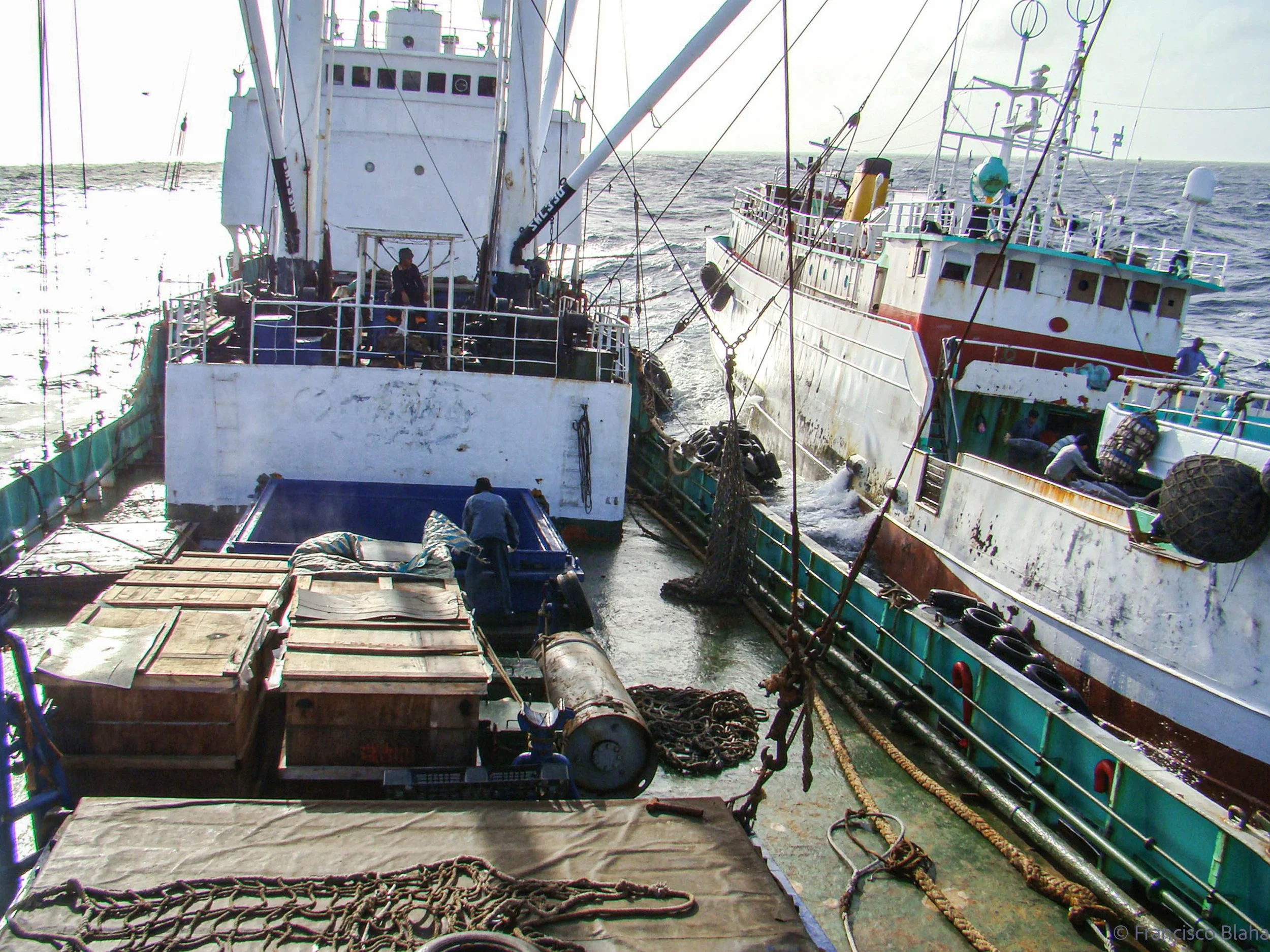
And it repaid it for a very specific reason. This is the first document I have read that explicitly places the required due diligence on the flag States of both the fishing vessel and the carrier before the transhipment takes place on the high seas. Not after. Not at the port of landing, when the fish is already mixed in a hold with the catch of eleven other vessels. Before.
What the guide actually says
The architecture is built around what FAO calls critical tracking events and functional requirements, borrowed from the catch documentation scheme guidelines of 2022. Fish get an identity (V1, V2 for the vessel and its authorisations, C1, C2 for the catch and the legality of its capture), and those assurances then have to survive the transhipment event (T1, T2, T3) and the landing (L1, L2, L3).
The point the guide hammers home, and that I think is the real contribution, is that these things are linked. If the species verified at landing is not the species declared at catch, then C1 fails, and if C1 fails then C2 or V2 may fail too, because the gear may not be capable of catching that species, or the vessel was never authorised for it. And if C1 and C2 fail, then T2 and T3 fail with them. One broken link and the chain is not a chain.
So who is supposed to hold that together at sea? The guide is unambiguous. Before acknowledging and confirming that a transhipment event can proceed, the flag State of the donor vessel must verify, for the current fishing trip, compliance with the applicable CMMs, compliance with MCS measures, VMS reporting, and regular reporting of catch and effort. And it says this in a sentence that should be printed on the wall of every fisheries administration:
It is important that this confirmation be based on sources of information that are independent of the operator's own declarations.
The listed sources are VMS, observer reports, inspection reports from port and coastal States, and surveillance reports from sea or air patrols. Then there is a checklist (Table 3) that is genuinely usable. Is the vessel identity aligned with your own register? Is the fishing authorisation in force during this trip. Which species are authorised, is there a quantity limit, is there a prohibited species in the fishery, what area, what gear. Are the reported quantities coherent with the timing and the authorised gear? Is the VMS track coherent with the gear, judging by speed and pattern? Is there any unjustified zero-speed gap near a receiving vessel that is not authorised? Is there satellite imagery to cross-check?
The carrier side is not left out either. In the authorisation stage, before any specific event, both flag States are expected to do their own due diligence on their vessels: IMO number where eligible, a functioning approved VMS, inclusion in the flag State's observer programme for transhipments with 100 per cent coverage for receiving vessels, entry in the FAO Global Record and in the relevant RFMO authorised vessel lists. And there is a step in the flow, step D, that I had not seen articulated anywhere before: a pre-arrangement between the flag State of the donor vessel and the flag State of the receiving vessel, to confirm that both are actually operating in conformance with the VGTS and that information exchange protocols exist between them before their vessels ever meet.
The guide is honest about the one gap it cannot close on its own. The VGTS requires confirmation of each event from the donor vessel's flag State, but not from the receiving vessel's flag State. The authors work around it as far as guidance allows: nothing precludes the receiving vessel's flag State from withdrawing the transhipment authorisation after a pre-notification if risk assessment and due diligence reveal evidence of IUU fishing or breaches of the conditions.
Now the reality
None of this is happening at the moment, and I say that as someone whose job for the last twenty-odd years has been to look at the logistics and paperwork these operations generate.
What happens in practice on the high seas is a notification, generally 24 or 36 hours in advance depending on the RFMO, that is treated as an administrative formality rather than as a trigger for verification. The guide notes politely that several RFMOs require 24-hour advance notification and that this "may not support effective MCS". I would put it less politely. Twenty-four hours is not a verification window; it is a courtesy.
And in the vast majority of cases nobody at the donor vessel's flag State opens the VMS track and asks whether it is coherent with the gear and the catch, because either the capacity to do that does not exist, or the vessel is flagged somewhere that has no interest in asking.
The carrier side is worse, because the flag States of the reefer fleet are, with few exceptions, not fisheries administrations in any meaningful sense. They are registries. Asking a registry to perform pre-arrangement with another flag State, to run an observer programme with 100 per cent coverage on its carriers, and to cross-check pre-notification positions against VMS and surveillance data is asking for a function that, in many cases, has never existed.
Where 100 per cent carrier observer coverage exists, it exists because an RFMO imposed it through a regional observer programme, not because a flag State decided to exercise due diligence.
So the honest reading of this guide is that it describes a system that almost no one is running, and that is exactly why it is useful. Until now, when I asked who is responsible for confirming that the fish going over the rail has legal provenance, the answer was a shrug and a gesture toward the port State, three weeks and 4,000 miles later. This document says: it is the flag State of the donor vessel, before the event, on independent evidence, and here is the checklist. That is a benchmark. Appendix 1 is literally set up as a benchmarking table so you can compare your national procedures against it.
A few other things worth your time
The container work in section 4.1.3.3 quietly closes a hole I have been complaining about for years. Because the VGTS finally defines a landing, moving unlanded fish from a vessel into a container is a landing, so it needs a landing declaration meeting VGTS Annex II, and the PSMA Article 3(1)(b) container exemption only applies if that declaration exists and shows port State measures were applied. The old trick of calling it a "transit activity" and letting the receiving port assume that fish in a box must already have been landed no longer has cover.
The weight chapter is unglamorous and important. Estimates at sea against verified weights at landing, processed weight rather than live weight in the declarations, conversion factors that need official definition, ice percentages, and a margin of tolerance typically around 10 per cent. The mass balance logic in Figure 18, where a donor vessel's reported catch has to reconcile with the sum of what each receiving vessel actually landed across different ports, is the check that would catch most laundering. It only works if everyone weighs and classifies the same way, which is the guide's real ask.
And the force majeure section deserves a read, because falsely claiming distress is the obvious route to transhipping into a carrier that would never have been authorised.
None of this is binding. It is guidance on voluntary guidelines. But it names the responsibility precisely, and gives the people who want to do the job a defensible set of steps. That is more than we ever had
FAO. 2026. Implementation of the Voluntary Guidelines for Transshipment. 1. A guide for fisheries managers. FAO Technical Guidelines for Responsible Fisheries, No. 15, Suppl. 1. Rome. https://doi.org/10.4060/ce0610en