On my way back from the Marshall Islands and Micronesia, I always have a overnight stopover in Honolulu, so I took up on an invite from Jimmy Freese from Ai.Fish, and we caught up for lunch and a few beers
Jimmy is an interesting character who sees fisheries from a different angle, and I always learn from people like him.
We had crossed paths at a few conferences, so it was good to see him at home. He was born and raised on Oahu, grew up surfing, and still surfs, so we have that in common, except he is about 10000 times better than me. But that is not really the point of mentioning it.
As a surfer myself, I get why he says the ocean is not background for him; it is context. When you spend that much time in and around the water, you start noticing what is in it. You pick up the small details that make big differences; you read the swell, the wind and the currents for what is coming, where to be and when, and which board to take.
So I really see his point when he says everyone looking at the same ocean is working from a different slice of it.
Fishermen talk about where the fish are and what the season looks like. Scientists talk about stock assessments and data gaps. Regulators talk about compliance. One activity, three groups, one ocean, three incomplete pictures.
That's the gap that Jimmy’s Ai.Fish, is built to close.
Let’s go back a bit… Ai.Fish is a Hawaii-based team Jimmy co-founded in 2019 with Justin Kay, whose background is in computer vision research, including automated salmon counting work at Caltech and ongoing AI-for-climate research at MIT. The wider team is small and distributed, spread across the US, Canada, Kenya, Spain, and Turkey. What they're applying that computer vision expertise to is electronic monitoring, or EM: cameras and sensors on commercial fishing vessels that record what happens on deck, so there's an independent record of catch and bycatch.
EM sounds simple in principle, and I have written a lot about it… But in practice, it has a bottleneck that anyone who has worked in fisheries management will recognise immediately. A single trip can generate hundreds of hours of footage, and while AI is helping, someone still has to watch it to confirm what the algorithm may pick up, frame by frame, to log species, count fish, and flag anything unusual.
That review bottleneck costs money and, in my view, more than anything else, is why EM adoption has lagged for years, despite pilot programs proving the underlying concept works.
But here's the part of the conversation with Jimmy that stuck with me most, because it's something I've argued for a long time from the policy side. Whenever you try to impose a monitoring system on fishermen, whether it's observers, logbooks, or EM, there is a “fisherman’s question” sitting in the back of their mind: “what's in it for me?” You can explain compliance and sustainability all day, but if the system only extracts data from them and gives nothing back, it will always be resisted, or at best tolerated.
Ai.Fish's whole approach goes straight at that question.
If a vessel already has to run cameras and collect footage for regulatory purposes anyway, the marginal cost of also using that same footage to make the fishing itself better is close to zero.
That's the insight. The same video that a reviewer uses to count and classify catch for a regulator can, in principle, answer the questions a fisherman actually cares about, in real time: where did I catch my biggest bigeye, at what depth/hook number, what was the water temperature, what phase was the moon in, what trolling speed was I running, what bait was on the hook, a picture of the fish (coloration),? None of that requires new hardware or a second monitoring burden. It's the same footage, mined for a second purpose.
Suddenly EM isn't just a science/compliance cost sitting on top of the trip; it's a source of operational intelligence the skipper can use to fish smarter next time out. Jimmy showed me their software called Tuna Insights, and you can see some of the screenshots below:
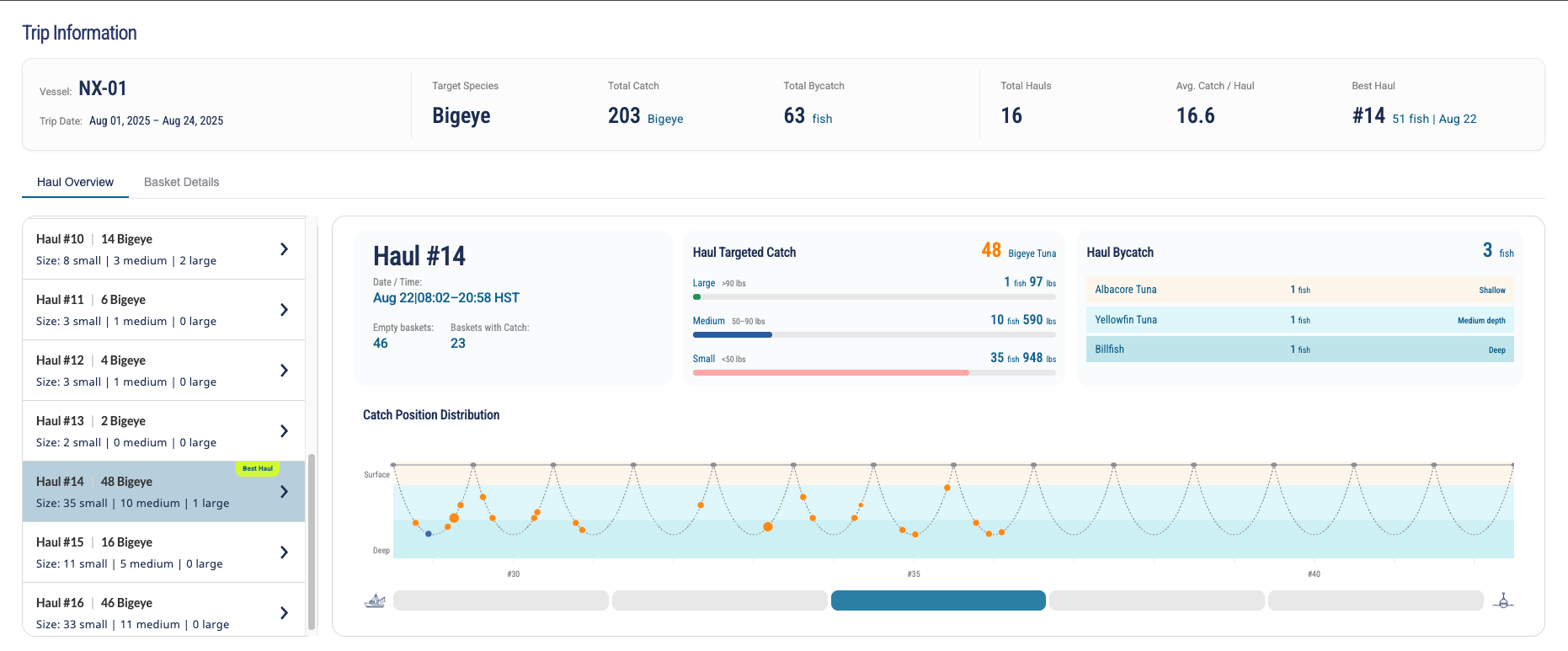
the info for the haul
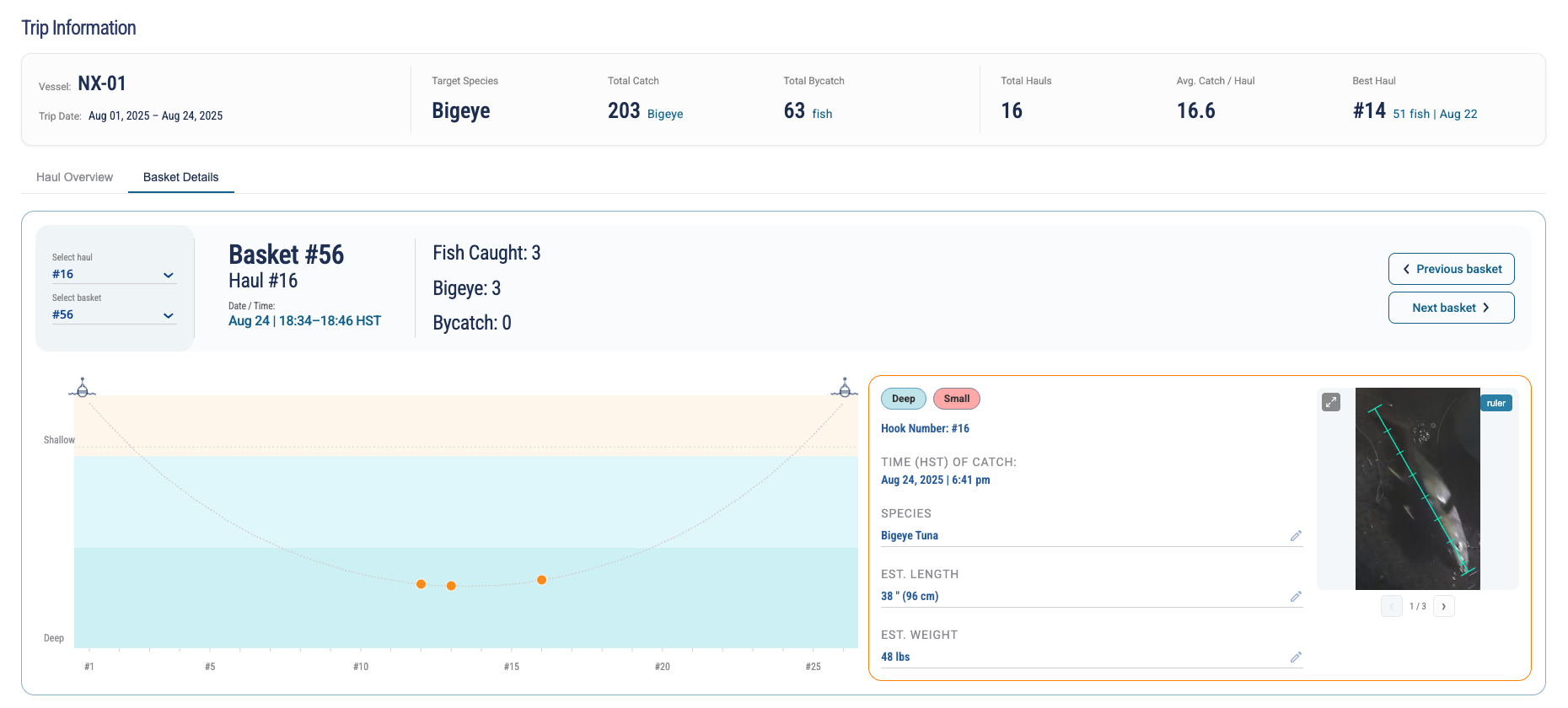
the info for the basket
For companies that already have their own EM hardware or review software, Ai.Fish also offers an API, so the same computer vision models can be plugged in directly, without adopting the whole platform.
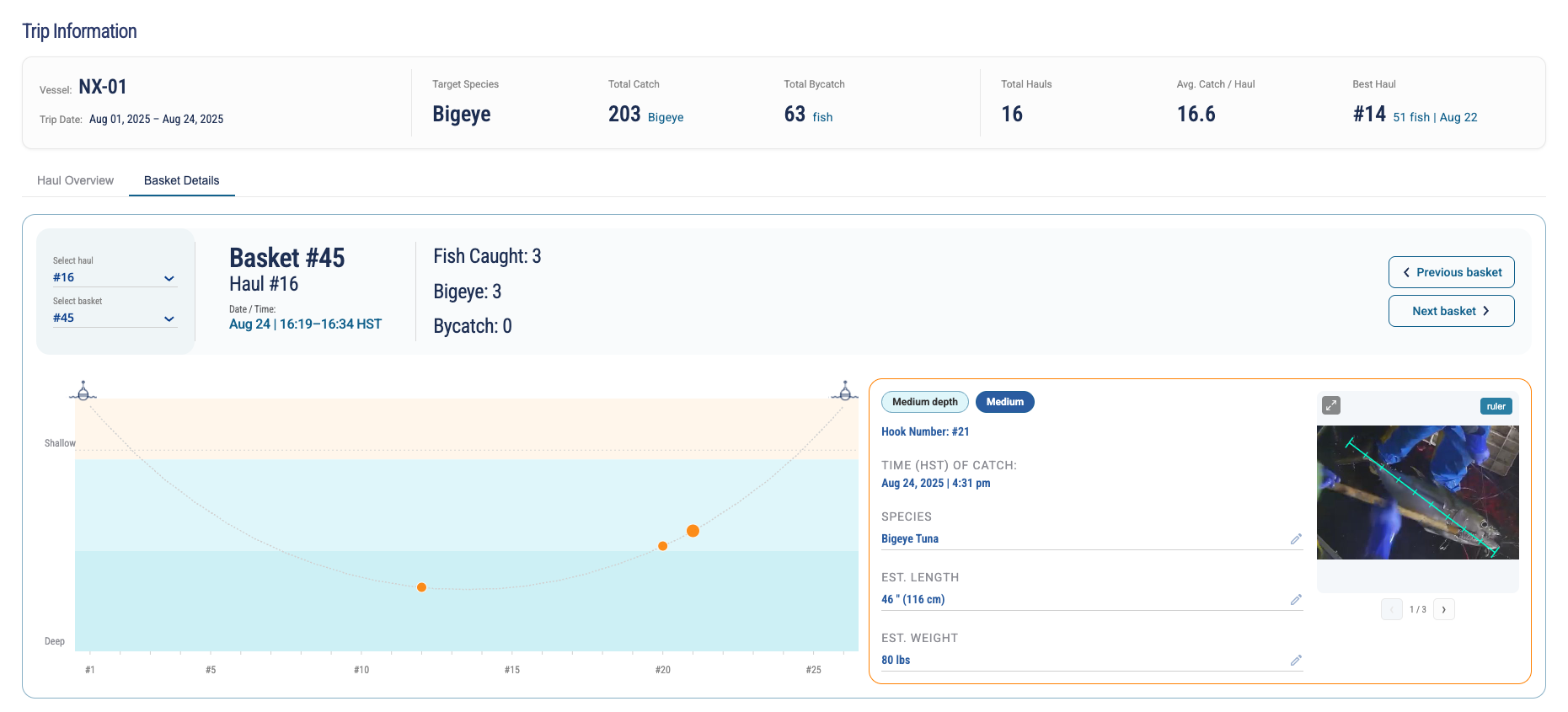
Another basket analysis
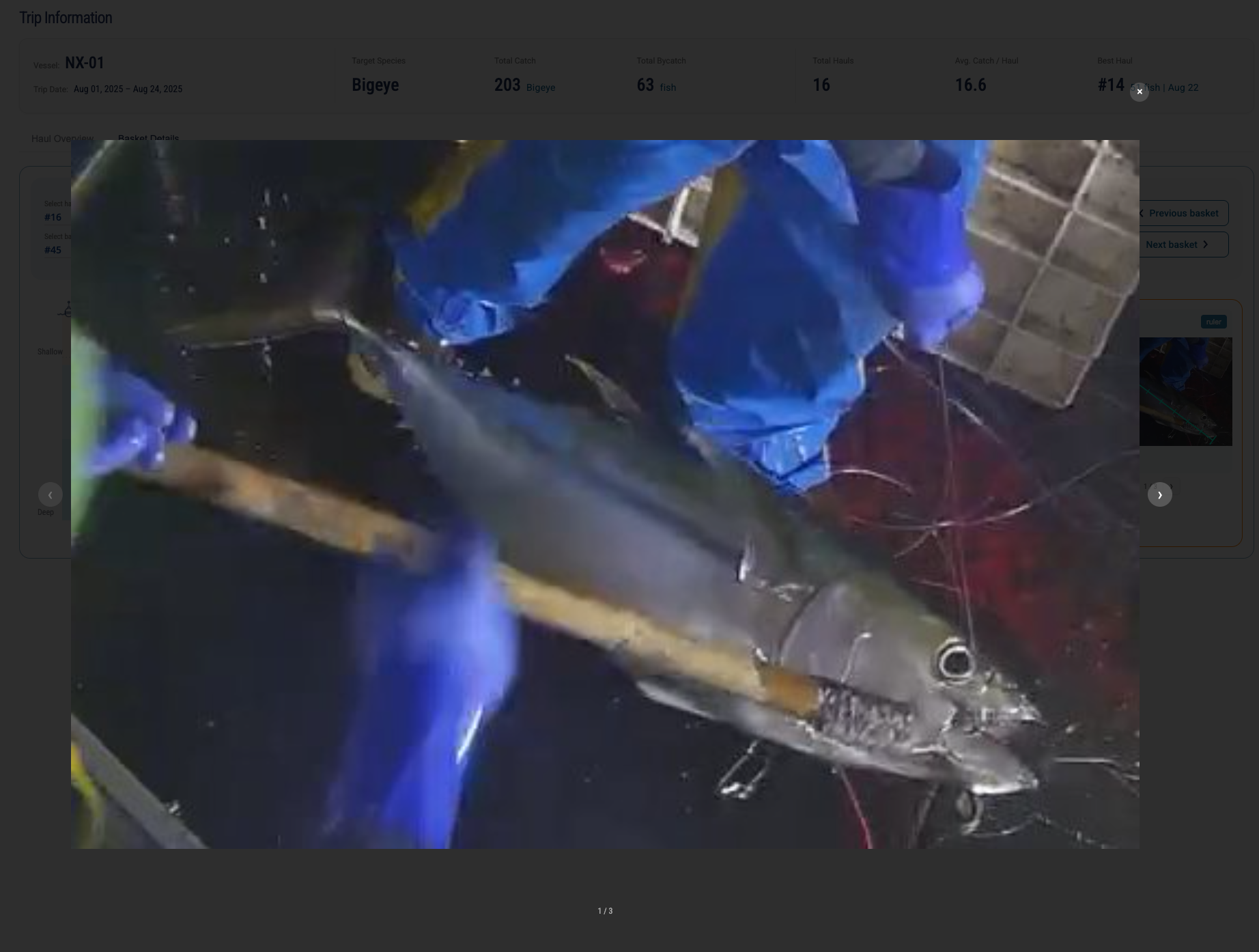
and the indiviusal fish at each hook with data on the position on the basket, the depth, the bait, etc that you used for example… for those most interested on the value chain than the fishing event… think the traceability value of this info.
As you see above, color matters as it's an indicator of how long that fish has been alive, etc. Any depredation, even one cookie cutter shark bite can bring down the prices and that's nice to know in real time when you're thinking about the economics of when one is thinking about their fleet and in 10 days you could have 100 or 200 sets depending on how many boats are monitored.
Beyond the software, they also run a services side: in-house video and image annotation (they say they've delivered millions of annotations), custom AI model development, AI strategy consulting, and cloud- and edge-based systems engineering for vessels that need onboard processing rather than a live connection back to shore.
Getting EM to a point where it's affordable and fast enough to deploy everywhere, not just in well-funded fisheries, is one of the clearest levers for making sustainable fishing verifiable at the scale at which the industry operates.
Jimmy frames the whole effort as building "the Fishery of the Future," which could sound like a slogan until you sit with him for an afternoon and hear how specific the thinking is: software built for the people who'll use it day to day rather than for engineers like him; EM review cheap enough to reach fisheries that could never afford a full observer programme; data that fishermen own and that still feeds securely into regional and international management; and real-time edge AI onboard that's reliable enough to trust without a shore connection.
What struck me most as I walked away from that conversation wasn't the technology stack. It was how clearly Jimmy has internalised the “fisherman's question” and built the answer into the product itself, rather than treating it as a communications problem to be solved after the fact.
Seven years into this, he told me the work has only convinced him further that the ocean economy runs on better data than it currently has, and that the gap is closeable.
Having spent my career on the fisheries monitoring side of that same gap, I think he's right, and I think Ai.Fish is one of the more sensible attempts I've seen to actually close it rather than just talk about it, while helping fishermen fish better with a product generated and tailored to their own vessels.
On top of that is a really smart guy who is fun to talk to.
Just for the record, I have no commercial interest in Jimmy’s business… I just happen to believe that fisheries are made up of interesting people, and in the same way that I read a paper I find interesting and blog about it, here is a product I find interesting and blog about it!