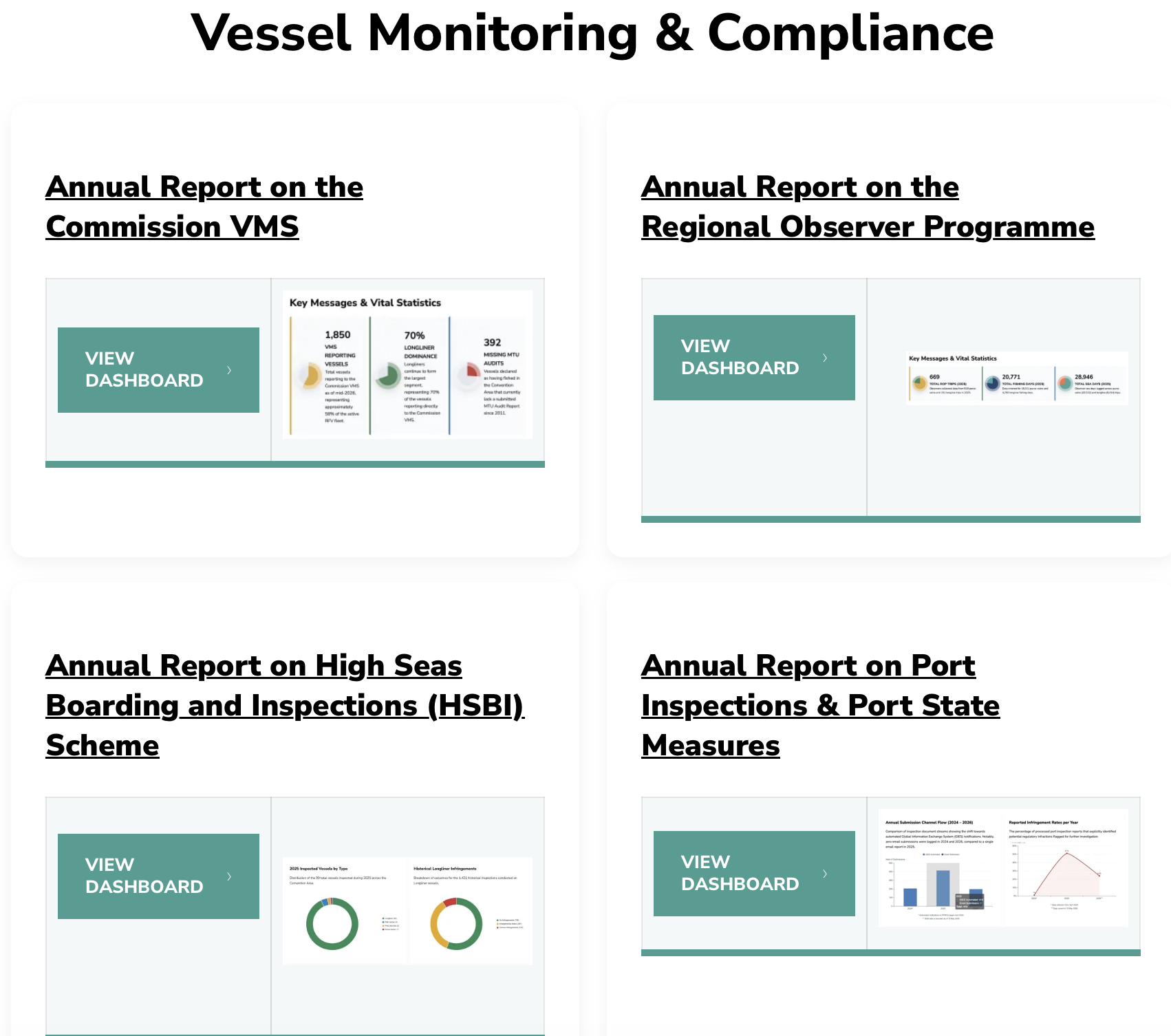
The WCPFC Secretariat has published its annual monitoring, control and surveillance report covering 2025 activities, this time with dashboards alongside the reports. Eleven of them: the Commission VMS, the Regional Observer Programme, high seas boarding and inspection, port inspections and port state measures, transhipment reporting, the Record of Fishing Vessels and charter notifications, the Eastern High Seas Pocket and the other high seas pockets, the WCPFC and IATTC overlap area, administration of the data access rules, and performance of the e-reporting and e-monitoring standards.
Let me start with the good part, because it deserves it.
This is real transparency, and it is a change. For years, if you wanted to know how much high seas transhipment was actually happening in this ocean, you went hunting through the meetings portal, found a PDF with the number buried on page 14 of an annex, and hoped nobody had revised it since.
Now there is a dashboard. You can open it on your phone in a workshop. A coastal state fisheries officer, an NGO analyst, a journalist, and a consultant can all argue from the same published numbers instead of anecdote and general vibes. Anyone who has sat in a TCC session where two people quote different figures for the same thing knows why this matters.
So credit where it is due. The Secretariat has done the unglamorous work of turning compliance paperwork into something a normal person can look at. That is not a small thing, and it did not have to happen.
Now the awkward part, which is what the numbers actually say.
The legal starting point almost nobody honours
CMM 2009-06 is still the operative transhipment measure. It has been in force since February 2010 and every attempt to revise it since 2017 has bogged down. Paragraph 34 is the one that matters: high seas transhipment is prohibited, unless the CCM has determined that it is impracticable for its vessels to operate without it, and has notified the Commission accordingly.
Read that again. Prohibited, with an exception for impracticability. Not a permission you apply for, not a default operating mode. An exception.
Now look at the 2025 record. Of the 3,143 vessels on the Record of Fishing Vessels, 56% hold a high seas transhipment authorisation. That is roughly 1,760 vessels pre-authorised to do the thing that the measure says is prohibited unless impracticable.
Of those 1,760, only about 28% actually transhipped on the high seas in 2025. Around 495 vessels did the thing; roughly 1,265 were authorised for it and did not need it.
That gap is the whole story. If the impracticability test were being applied vessel by vessel, as the measure contemplates, you would expect the authorised number and the active number to be reasonably close. They are not. The authorisation has become a field that gets ticked when a vessel is entered on the Record, kept live in case it is ever useful. It is not a reasoned determination that this vessel, on this fishery, genuinely cannot get to a port.
I am not saying flag states are acting in bad faith. I am saying the test has quietly stopped being a test.
The numbers themselves
In 2025, there were 888 reported high-seas transhipment events. That is about 60% of the 2019 peak of 1,469 events, and the downward trend is genuinely encouraging.
But be careful about celebrating a declining number in a self-reported dataset. A drop in reported events is consistent with reduced transhipment. It is also consistent with the same amount happening and less of it being reported, or with fleet consolidation, or with more of it moving into EEZs and ports where different rules apply. The dashboard tells you what was declared. It cannot tell you what was not.
Longliners are the overwhelming bulk of the vessels involved, which surprises nobody who has spent time on this. The purse seine side of high seas transhipment was effectively closed years ago and it stayed closed. Longline is where the problem lives.
Thirty two hulls
Here is the figure that stopped me. Of the 495 vessels involved in 2025 events, 463 were offloading and 32 were receiving.
Thirty two.
The entire high seas transhipment problem in the largest tuna fishery on earth passes through 32 receiving vessels. That is a number you could assign to a human observer. That is a number you could put cameras on, with a budget that would not embarrass anyone. That is a number you could require to carry a functioning, tamper-evident e-monitoring system as a condition of being on the Record at all.
We do not have a scale problem here. We have a will problem. Every time somebody says independent monitoring of high seas transhipment is too hard or too expensive, hold up the number 32.
The observer question, again
I wrote back in 2022 about the case for an independent high-seas transhipment observer programme, and I would like to report that things have moved forward. They have not moved much.
The 2025 ROP figures show 669 observer trips: 518 purse seine trips covering 20,532 sea days and 11,944 sets, and 151 longline trips covering 8,414 sea days and about 10.4 million hooks. Purse seine coverage is approaching full monitoring. Longline sits at the historical sampling level of around 5 %
More to the point, the Secretariat's own assessment is that observer reporting is currently insufficient for full independent verification of transhipment, and it flags that cross-observer arrangements compromise the data's independence. That is a polite way of describing something I have heard about from the deck for years. If the observer on the carrier is placed, paid, fed and housed through arrangements that run back to the operator, and if the same person is expected to report on the vessel hosting them for weeks at a time in the middle of the ocean, we should not be surprised that the reporting has a particular flavour to it.
There is another number in the ROP data worth chewing on. Observers recorded transfer or transhipment infractions on 8 purse seine and 38 longline observations in 2025, which the report scales up to something in the order of 760 incidents fleet-wide. If I am reading the scaling correctly, that is a lot of unreported transfer activity hidden behind a compliance record showing 24 cases filed under CMM 2009-06 since 2016.
Twenty-four cases. Ten years. Somewhere north of ten thousand declared events, plus everything that was not declared. Mostly for failing to carry an observer or filing the declaration late. That is not an enforcement record. It is a rounding error.
The port side is not picking up the slack
Paragraph 35(a)(v) of the measure requires CCMs that authorise high seas transhipment to submit a plan explaining how they will move towards port-based transhipment. It is a reasonable idea. Fish that cross a wharf can be counted, sampled, inspected and cross-checked against a landing record by a person standing next to it.
So how is that going? As of March 2026, eleven CCMs have notified designated ports under CMM 2017-02. Several CCMs are outside both CMM 2017-02 and the FAO Port State Measures Agreement. And in 2025, 413 inspection reports came in against 816 automated notifications since April 2024, so roughly half the notified arrivals generated no inspection report at all.
The report is also honest about something that matters in this region: inspection standards must not put disproportionate administrative and financial strain on SIDS ports. Correct. And that is precisely the point. You cannot tell coastal states to absorb transhipment into their ports as the safer option, and then hand them the full cost of doing it properly, and then treat a missing inspection report as their compliance failure. Port-based transhipment is only the better option if somebody funds the port.
Where this lands for a coastal state officer
This is not abstract for me. I had this issue last week when one of my former trainees at a PIC fisheries authority in the region was dealing with a version of the same scenario: two longliners, neither licensed here, both on the Record with high seas authorisation, catch taken on the high seas, transhipped vessel-to-vessel somewhere out there, now alongside, asking to unload for export. Is it legal, and do we release it or hold it?
To answer that, the officer has to rely on a transhipment declaration filled in by the people who did the transhipping, an advance notification from the same source, and an observer report whose independence the Commission's own Secretariat says is compromised. Then they have to make a decision that has real consequences for a real operator, on a wharf, that afternoon.
That is the coastal state carrying the risk for a system it does not control and did not design. The published data helps because, at least now, the officer can check whether declarations were lodged at all and whether the flag state has an impracticability notification on file. That is a genuine improvement on last year. But greater visibility into a weak system does not make it strong.
What would actually move it
None of this is new, and none of it is complicated:
Make the impracticability determination mean something. A reasoned, published determination, renewed annually, vessel by vessel, rather than a permanent field on the Record.
Put independent monitoring on the 32 receiving vessels. Human observers, e-monitoring, or both, funded through a levy on operators rather than by the vessel being observed.
Join up the four datasets. The declaration, the VMS track, the observer report and the port landing record should be reconciled as a matter of routine, not as a special analysis when somebody complains. The Secretariat is already detecting spatial anomalies by comparing declarations against VMS positions, which is exactly the right instinct. Make it standard, and publish the reconciliation rate.
Fund the port option properly, so that moving transhipment ashore is an offer to SIDS rather than a cost transfer.
And publish the paragraph 35(a)(v) implementation plans, alongside what they have actually achieved.
I would like to be surprised.
Anyway…
I don't want to end sour, because I can write any of this only because the Commission published the numbers. Five years ago this post would have been opinion with three footnotes. Today, it is opinion-anchored to a public dashboard, and anyone who thinks I have read it wrong can go and check.
This is what transparency is for. It may not fix the problems. It just makes it much harder to pretend the problem is not there.
As always, happy to be corrected.
Sources:
WCPFC, Latest MCS data covering 2025 activities: https://www.wcpfc.int/monitoring-and-evaluation/latest-mcs-data-covering-2025-activities
Annual Report on Transhipment Reporting dashboard (WCPFC-TCC22-2026-RP03)
Annual Report on the Regional Observer Programme dashboard
Annual Report on Port Inspections and Port State Measures dashboard
CMM 2009-06, Conservation and Management Measure on the Regulation of Transhipment: https://cmm.wcpfc.int/measure/cmm-2009-06