In April 2021, I wrote a blog called "The paralysis of any fisheries management initiative in the South-Western Atlantic". I started it by admitting that I'm not always keen to talk much about the situation down there. Being Argentinian by birth, a navy search-and-rescue swimmer cadet during the war, and a fisherman and fisheries scientist after that, I find that particular corner of the ocean is where my history and my profession pull in opposite directions, and where any attempt at nuance gets flattened by colonialism and geopolitics.
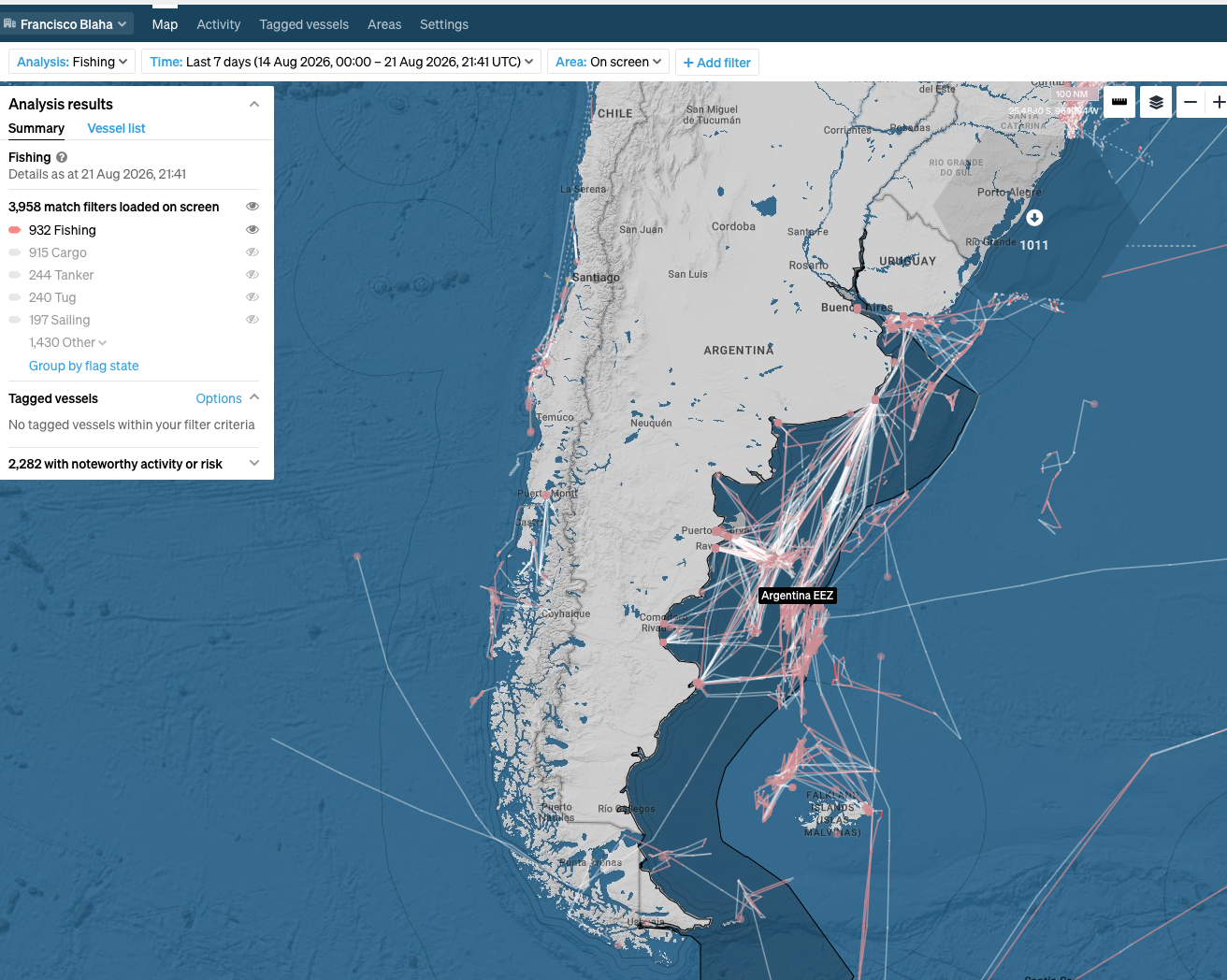
fishing activity if the Argentinean EEZ and the mile 201from the 19 to the 21 August 2026 by starboard.nz
My argument is simple: that area is perhaps the last purely unregulated fishery in the world; an RFMO would fix a good chunk of that, and Argentina's refusal to be part of one, on the grounds that it would imply tacit recognition of Falklands coastal rights, is basically self-inflicted fisheries mismanagement with no real impact on sovereignty claims. Other authors have studied the issue and reached the same conclusion.
I got the expected mix of responses. Some quiet agreement from people in the industry, some very loud disagreement from people who read "RFMO" as "surrender".
So I was not expecting much when five master's students from the Universidad de San Andrés got in touch a few weeks ago. They were working on a paper for their Elements of Public International Law course in the Master's in International Politics and Economics at San Andrés University and wanted to interview me about the blog entry and fisheries situation in the South-West Atlantic.
I say yes to most of these requests because whatever I've achieved in life is thanks to many people who took the time to answer my questions… So I always pay it forward.
After a really nice online talk with them, I was really happy they sent me the finished paper: five thousand words comparing the British licensing regime in the islands with the fishing at mile 201, and asking what each one actually does to Argentina's rights and obligations under international law.
I read it in one sitting... It is a serious piece of work, and more importantly, it is honest in three ways that the public conversation in Argentina almost never is.
They looked back at the 90s, when it worked
The first thing they do, and this is the part that impressed me most, is go back to what happened between 1989 and 2005 instead of starting the story at whatever outrage is currently on the news.
The Madrid Joint Declarations of 1989 and 1990 created something genuinely clever: the "sovereignty umbrella" formula, under which both countries agreed that nothing done under the arrangements would be taken to affirm, support or deny either side's position on sovereignty or maritime jurisdiction.
Under that umbrella, they set up the South Atlantic Fisheries Commission (SAFC) in 1990; they exchanged scientific data; they ran joint research cruises (which I was part of in 1990 and 1991, working with scientists who then, years later, I worked with in New Zealand and the WCPFC); we talked then about Illex argentinus as a biological population rather than as a flag.
Then it fell apart. The paper traces it carefully: the 1986 interim conservation zone, the 1990 outer zone, the 2005 shift from annual licences to 25-year individual transferable quota concessions available only to companies registered in the islands, the Argentine protest invoking Resolution 31/49 against unilateral modifications, and the fact that the Commission has not met since.
In 2021, the islands offered holders another optional 25 years on top of licences expiring in 2031. So the horizon is now 2056, and there is no forum.
What the students understood, and what many much older people refuse to understand, is that the 90s prove that what everyone claims today is impossible is not impossible. It already happened. Argentina cooperated technically with the United Kingdom on fisheries for fifteen years without conceding one millimetre of its sovereignty claim, because the umbrella formula was designed precisely to make that possible.
Their conclusion says it plainly: Argentina's own experience of cooperation in the 1990s shows it can be done without legal effect on the claim. That is not a young person being naive about diplomacy. That is a young person reading the record.
They refused the easy cliche
The second thing they got right is the one I care most about professionally, because it is the one that does the most damage.
Almost everything written in Argentina about mile 201 refers to it as illegal fishing. It is not. Beyond 200 nautical miles lie the high seas, and articles 116 to 119 of UNCLOS grant states the right to allow their nationals to fish there. A Chinese, Korean, or Taiwanese squid jigger, sitting at 201 with a valid flag-state authorisation and reporting its catch to its flag state, is doing something legal. Perhaps uncomfortable, ecologically disastrous, economically infuriating, but legal.
The students consulted the FAO's 2001 IUU International Plan of Action definitions and rightly concluded that the one that fits is unregulated fishing: activity in areas or on stocks for which no applicable conservation measure exists.
And then they say the quiet part out loud. The obstacle to regulating fishing at mile 201 is the absence of an RFMO. Not Chinese or Korean wickedness, not flag-of-convenience trickery, just the absence of an agreed set of rules.
This matters enormously and not just semantically. If you call it illegal, you have located the fault entirely outside yourself, and your policy options are patrol boats, outrage and victimhood. If you call it unregulated, the finger points at the empty chair, and the empty chair is one that Argentina has chosen not to fill.
Precision here is the difference between a strategy and a grievance. There is plenty of genuinely illegal behaviour in that fleet when they conduct incursions into the EEZ (or in the alleged crewing situation on board). But the act of fishing at 201 is not one of them, and pretending otherwise has cost Argentina credibility in every multilateral room I have sat in.
I also noticed something else. They cite the ITLOS Advisory Opinion 21 of 2015 on flag state due diligence, which is the obvious card to play, and then immediately tell you it does not quite fit, because that opinion concerned vessels inside the EEZs of the SRFC member states and not high seas fishing, so it works as a general standard by analogy and not as direct precedent. Politicians overclaim, and these students underclaim deliberately, and their argument is stronger for it.
They separated the two problems
The third thing is the paper's overall framing. The two cases look similar from a distance and are legally nothing alike. Licensing in the islands is a sovereignty dispute expressed through fish. Mile 201 is a high seas governance failure expressed through fish.
Argentina has been treating them as one problem for two decades, and the result, as the students conclude, is that the protests have not changed the de facto situation on the islands by one inch, while the refusal to countenance an RFMO has left the highest concentration of distant water fishing vessels on the planet without any regional instrument at all.
They also do the homework on what exists elsewhere, based on my advice… Taiwan is participating in the WCPFC as a “fishing entity” under Article 1.3 of the 1995 Agreement, with full decision-making rights and no implications for statehood (I’m sure such a status could be of interest to the FIG; otherwise, their interest would be represented from London); furthermore, here in the WCPFC we have the Matthew and Hunter Islands, claimed by both France and Vanuatu… both parties work inside the WCPFC and the dispute stays untouched
Articles 74.3 and 83.3 of UNCLOS, which actively require states with overlapping claims to seek provisional arrangements and to avoid jeopardising a final settlement. All of it points the same way: international law has spent fifty years building tools for exactly this situation, and Argentina is choosing not to pick any of them up.
They are honest about the gaps on the Argentine side, too, which cannot have been comfortable to write about. As of August 2026, Argentina is still not a party to the Port State Measures Agreement, yet has passed Ley 27.815, approving accession to the PSMA (AMERP in Spanish). While it has signed, it has not ratified either the 1995 Fish Stocks Agreement or the BBNJ Agreement.
None of this weakens the sovereignty claim. That is the whole point, and it is the point I tried to get across in 2021. Fisheries management and sovereignty are separable; the work we did in the 90s proved they are separable, and every year they are kept fused, the squid gets scarcer, and everybody loses.
These five students worked that out on their own and wrote it down with their names on it. I'm cynical by default about this stuff, but that gave me more hope than anything I have read on the topic in years.
Personally, I'm painfully aware of the honest grievances behind the case made for the 649 who did not survive the 1982 war, and for the families of the estimated 500 who did not survive coming home and took their own lives since then. I served with three of them, and none of this is any consolation to those left behind. Nor is the bigger picture of the many thousands that died during the military dictatorship that led Argentina into that war… Still, I keep coming back to the same position: fisheries management and sovereignty are separate issues, and I say that because I worked in the years when they were kept separate.
Source: Álvarez Peón, E., Lestani, N., Nizzo, C., Patane, B., & Zaffaroni Safar, M. (2026). Análisis comparativo del otorgamiento de licencias pesqueras en las Islas Malvinas y la pesca INDNR en la milla 201. Universidad de San Andrés, Maestría en Política y Economía Internacionales, Elementos del Derecho Internacional Público (Dr. Facundo Pérez Aznar).