Life has handed me plenty of surprises and honours. Some from inside my own field, some from outside my world entirely. When in 2017, Gilles Hosch and I published a technical book with FAO on seafood traceability and catch documentation schemes, I wrote then that my eyes went teary when I saw my name on one of those green books.
I need to explain this part a bit… as you are all painfully aware from reading these blogs, being dyslexic and writing are not good bedfellows.
Back in my school days, if you didn’t write well, you were “dumb”… even though many of my marks were good enough because I love reading, had a good memory, and liked science. Still… that “dumb” brand was (still is) a hard one to walk away from, and it was part of why I turned to fishing and physical work.
And maybe because of that “fisherman thing”, where we push the limits and react to authority just because we are told that we can’t (or are not good enough) to do something… is that I never gave up on learning; I guess it is my nature to give things a go, just because I know I'm not good at them...
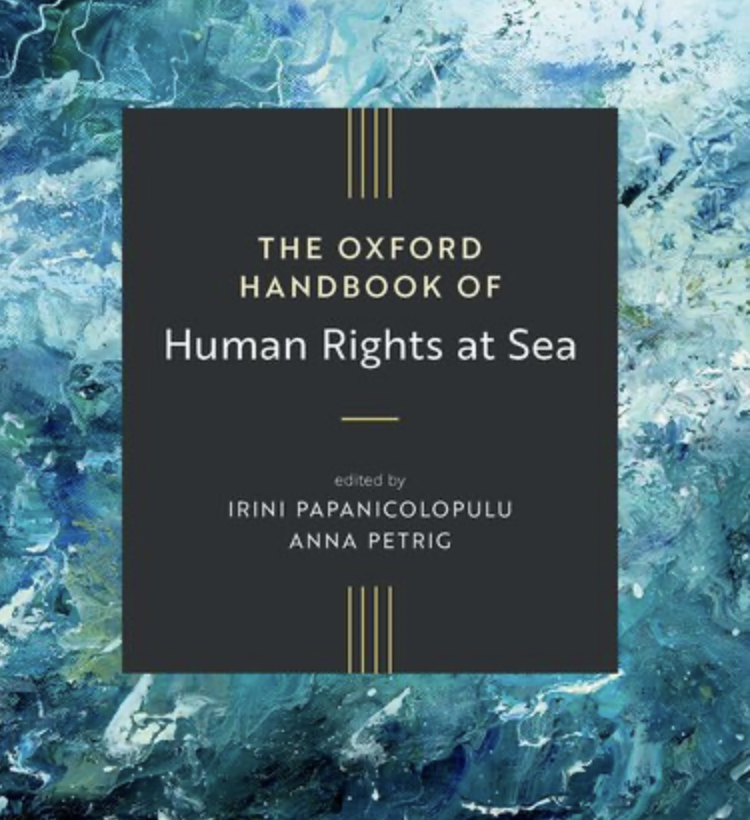
This week, the Oxford Handbook of Human Rights at Sea came out, edited by professors Irini Papanicolopulu and Anna Petrig… and I wrote chapter 47 on Fisheries and Aquaculture.
I never would have seen this one coming… As far as I can tell, I'm the only one of the over 50 authors who isn't a legal academic. So when the editors invited me, I assumed someone had made a filing error. I said yes before they could check.
The connection goes back to the Rhodes Academy of Oceans Law and Policy, where I spent time in 2022 as one of the very few people in the room who was not a lawyer. That was the point, for me. I spent all my working years inside UNCLOS right from when it entered into force, without ever seeing the whole architecture laid out by the people who argue it for a living, and Irini and Anna were both part of that faculty.
I suspect I was memorable there mostly for having been a fisherman and framing things from the boat up, not the other way around. Apparently that didn't count against me, since a couple of years later the invitation to write this chapter arrived.
I owe my life to fishing. It paid for my studies and gave me a life I could not have imagined. Writing about fishers' labour rights at this level, as the only non-academic, was daunting. The gap between what the instruments promise and what a deckhand experiences is the whole point of the chapter
My chapter runs 27 pages and is mostly about fishers. Not about fish, not about supply chains, but about the people who catch the fish and who are consistently the least represented voice in the rooms where their conditions get discussed. Inadequate training, forced employment, unpaid or underpaid wages, and a jurisdictional muddle that lets everyone point at someone else. A small part of the chapter deals with gaps in potential aquaculture operations in the EEZ and high seas.
I walk through who is actually responsible. Flag States have obligations under UNCLOS and mostly fail to meet them. Coastal States have started filling the gap inside their EEZs, as the FFA has done through its Minimum Terms and Conditions, though that stops at the high seas boundary. Port States can inspect against the ILO Work in Fishing Convention, up to a point. Market States can close their door to vessels using slave labour, but only their own door, and only vessel by vessel. States whose nationals crew these boats struggle to reach the crewing agents, who are usually somewhere else. The WFC is a good instrument, but ratification numbers are low. The Cape Town Agreement and STCW-F aim at safety and training and lack teeth. Among RFMOs, only WCPFC has adopted a crew labour standards measure so far.
I also say plainly what I think about private certification in this space. It is not a substitute for ratifying, implementing and enforcing the law, and there is a decent argument that it is neo-colonial: it casts fishers as subjects in need of rescue, paints developing States as incapable, and sets up private jurisdictions with no statutory body behind them..
The fishers I have worked alongside for over 40 years are among the most resourceful, resilient and generous people I have met. What they need is respect, fair rules and fair pay. Not pity.
The book is £175 / €245, so it is not a beach read. But it exists, and my name is in it, and I’m so incredibly stoked about it.