Continuing with my read on papers tabled at the 22nd Scientific Committee in Apia this August, here is another one I found interesting “An assessment of the quantity of ALDFG in the pelagic longline fishery in the WCPFC Area” WCPFC-SC22-2026-EB-WP11, by Keith Bigelow, Aurélien Panizza, Tiffany Vidal and Raymond Clarke,.
I have been circling the ALDFG topic (Abandoned, Lost or Discarded Fishing Gear) for a while now, mostly from the purse seine and FAD side, because that is where the attention has been. Drifting FADs are visible; they wash up on reefs; they have a constituency of angry people photographing them. Longline gear does not. It is monofilament; it sinks or drifts sub-surface; nobody films it; and, as a result, the assumption in the region has quietly been that longlining is not much of an ALDFG problem… and as someone who did longline for a living and thinks it is a very unique type of gear, I can confirm that it is.
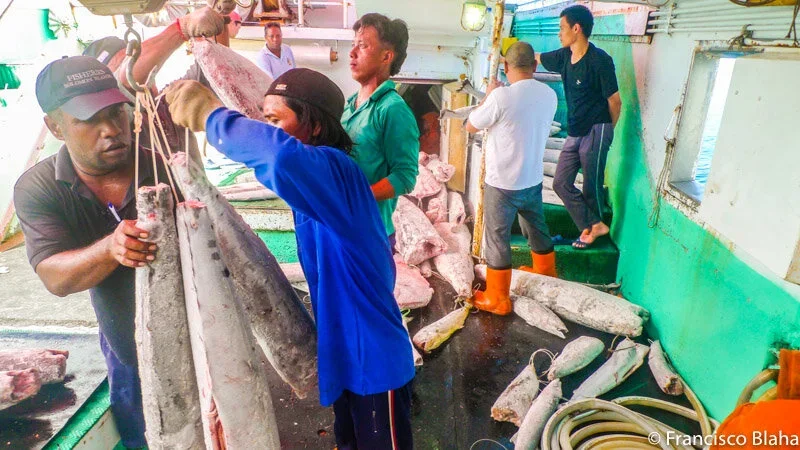
This paper is the first serious attempt I have seen to test that assumption with actual observer data across multiple flags in the WCPFC Convention Area, and the answer is more interesting than a simple yes or no.
What they did
The authors pulled twenty years of observer records, 2005 to 2024, from two very different sources. The first is the SPC/FFA Regional Observer Pollution Report, the GEN-6 form, submitted by eleven CCMs (the FFA membership plus French Polynesia). The second is the Pacific Islands Region Observer Program, PIROP, covering the US longline fleets based in Hawaii and American Samoa. Thirteen CCMs in total had to individually authorise the release of their data, which is not a trivial bit of diplomacy and deserves acknowledgement, because both datasets are confidential.
That gave them 9,864 observed trips. To my knowledge, nobody has combined GEN-6 and PIROP at this scale before.
The headline: ALDFG was reported on 4.8% of trips, 477 of 9,864. But the split between the two data sources is where it gets useful. GEN-6 trips reported incidents at 8.7%, PIROP at 2.2%. That is a fourfold difference, and it is not because Pacific Island flagged vessels are dirtier. It is because PIROP observers do not record deliberate gear discard at all, only loss and abandonment. Take discards out of the GEN-6 numbers, and the two datasets converge. Of the 844 total incidents, 587 were discards, 189 were losses, and 68 were abandonments. In other words, the majority of what shows up in the regional data is gear being deliberately thrown over the side as a means of disposal.
That single fact reframes the whole issue for me. This is not primarily a story about the sea taking gear from fishers. It is a story about waste management.
Why gear is actually lost
The paper does something I appreciate: it categorises the drivers rather than just counting incidents. They could assign a possible driver to 257 incidents. Half of them, 49%, came back as unknown, which tells you plenty about the state of the forms. Of the rest, the dominant cause of loss is the mainline parting and the vessel then being unable to find and retrieve the gear, 23.3% of cases. The secondary cause is not being able to locate the terminal radio buoy to haul back in reverse, 4.6%.
Here is the number that stopped me. In the Hawaii and American Samoa fleets, the mainline parts on 44.5% of all sets. Nearly half. That is routine, not exceptional. The standard response is to locate the next segment, tie the mainline back together and carry on hauling, and most of the time that works. Loss only occurs when it does not. So the frequency of parting is very high, and the conversion rate into actual gear loss is comparatively low, which is a useful thing to understand if you want to intervene.
For abandonment, the leading driver is a large gear tangle that makes recovery impractical, 14.7%, followed by interaction with a drifting object, 13.2%, which observers almost always recorded as a dFAD… so the two problems are not separate.
The paper also notes that modern GPS/AIS longline buoys are far better than radio beacons for finding gear, that the Hawaii fleet typically runs five or six of them per set, and that radio beacons are now hard to source anyway because direction finders are difficult to procure. That is an obvious mitigation lever sitting right there.
The estimation, and its honesty
To get from observed incidents to a regional number, the authors worked at the set level rather than the trip level, which makes sense. A set is a fairly consistent unit of about 2,500 to 3,000 hooks, whereas observed trips in the dataset averaged 43,394 hooks and ranged from 20,036 to 206,642. Then they ran a Monte Carlo simulation, sampling each distribution 5,000 times, and scaled the result to the annual WCPFC-CA longline effort, which averaged 756 million hooks over the period and peaked in 2012.
The honest part is what they do about all the sets where the observer recorded nothing. Rather than pretend to know, they ran four scenarios. Scenario 1 assumes every set in a trip has ALDFG. Scenario 2 assumes only one set in fifteen does, and the rest have zero. Both are explicitly labelled implausible and are there to bracket the answer. Scenarios 3 and 4 sit in between and are the ones the authors consider realistic.
Under Scenario 4, which assumes one set in fifteen at full ALDFG and the other fourteen at 25%, the WCPFC-CA is losing roughly 135,355 km of mainline and branchline per year, weighing about 1,408 metric tonnes, along with 9,852 buoys and around 2.08 million hooks. Scenario 3 roughly doubles that.
I like that they published the bracket rather than a single confident number. The upper bound, Scenario 1, is over 6,000 tonnes. The lower bound is 404 tonnes. That spread is the honest measure of how little we know.
Ten times lower than the global estimate
The most consequential finding is the comparison with Richardson et al. (2022), the study that surveyed 451 fishers globally and is widely cited for gear loss rates. Richardson's longline numbers were 3.33% of mainline, 3.58% of branchlines and 2.86% of hooks lost annually. This study's Scenario 4 gives 0.30% of mainline, 0.39% of branchlines and 0.39% of hooks. Roughly ten times lower.
Two readings are possible, and the paper does not pretend to resolve them. Either interview-based global estimates are overstated, which Richardson's own 2021 paper on methodological challenges would allow for, or observer coverage in the WCPFC is so thin and so spatially unrepresentative that the real regional figure is much higher. The authors lean toward the second as a real risk.
Longline observer coverage under CMM 2018-05 is only required to be 5%, coverage was below that for years, COVID knocked it back further, and only in 2024 did all nine reporting CCMs hit the 5% mark. And observer monitoring specifically for ALDFG is lower still than headline coverage. Nobody should be quoting the Scenario 4 number as settled.
There are also gear assumptions doing quiet work here. Everything is calculated assuming 4.0 mm mainline and 2.1 mm branchline, based on the Hawaii fleet. Vessels using 3.5 mm mainline or 1.8 mm branchline would push the tonnage down. And for discard volumes reported by observers in buckets and partly filled 50 kg rice sacks, the team physically obtained end-of-life gear in Honolulu and weighed it to build the conversion. I find that detail quite cool, as I remember weighing individual bait plastic bags on a study on waste we did a few years ago, but also a fair indictment of the reporting forms.
Ports are not always the solution
The last section is the one I would push hardest at the Commission. Seven CCMs interviewed at the last annual session (American Samoa, Cook Islands, French Polynesia, South Korea, Marshall Islands, Tonga, Solomon Islands) reported that unusable longline gear simply goes to land because there is no alternative.
Port surveys in Pohnpei and Majuro found something instructive. For purse seine gear, a functioning private sector system already exists. Local firms collect, consolidate, store and ship webbing and floats offshore for recycling; municipal dumping is prohibited, and some webbing gets reused locally for fencing and hammocks. For longline monofilament, nothing. No collection infrastructure, no recycling outlet, no agency with the mandate or budget.
That gap is the discard driver. If there is nowhere to put end-of-life monofilament in port, the incentive is to leave it at sea, and remember that discards were 587 of the 844 incidents in this study. Honolulu shows the alternative works: the Center for Marine Debris Research and the Hawaii Longline Association run a bin, CMDR sorts and de-metals the line, and some goes to H-Power for waste-to-energy at no cost to the fleet.
The eight recommendations
Raise longline observer coverage with a timeline toward 100%. Build ALDFG indicators into electronic monitoring, which is the only realistic path to representative data. Extend GEN-6 reporting into the full ROP and beyond the FFA, French Polynesia and US to the distant water fleets of Japan, Korea, Taiwan and China, whose gear currently sits entirely outside this analysis. Update the GEN-6 form, unchanged since 2014, replacing the free text comment field with tick boxes for reason of loss. Train observers specifically on ALDFG. Look at FFA observer journals, which the team was not authorised to access. And work on port reception facilities.
My own reading is that recommendations to expand the ALDFG reporting to additional WCPFC fleets carry the most weight. Right now, the biggest longline fleets in the region are invisible in this dataset.
As for disposal onshore, I refer to the plastics study we did: why do Pacific Island ports have to deal with the externalities of the LL fishery? Particularly considering that the main culprits are the DWFN? We examined the potential to off-load waste at several Pacific Island ports, and I quote: “The picture is grim: of the five fishing ports in the region that were looked at, only one – Suva in Fiji – has access to a landfill facility that is in any way compliant with any desirable standards. The other four nations – the Federated States of Micronesia, Kiribati, Marshall Islands and Solomon Islands – struggle with their own local waste management to varying degrees, and their landfill facilities are mostly already overwhelmed. Adding foreign commercial waste to existing domestic waste is not a viable solution where that is avoidable. While some fishing vessels do operate out of Pacific Island ports as a home base (e.g. one company in the Marshall Islands and another in Noro, Solomon Islands) and have to dump their waste in local dumpsites, the majority of fishing vessels are actually foreign-based, and materials that are now waste were once provisioned onto those vessels either at overseas ports or from carrier vessels.
Perhaps we should think along the lines of what I discussed on FADs. My personal view is that we are treating it as a “waste management” issue, centred on disposal and limited recycling, which happens at the end of the problem and shifts the burden onto those who did not cause it… and this is simply not right.
So we need to see it from the perspective of “reverse logistics” that differs from traditional waste management in that it adds a “value” to recovering and repurposing products and routes while respecting the internationally recognised UNCLOS principle that the country to which a fishing vessel belongs is responsible for all the actions of the vessel, including the waste produced by that vessel.
I think we should consider a targeted “waste-bond” system that combines a deposit on longline gear with a recoverable payment for verified retrievals, creating a market signal that turns abandoned gear into an asset rather than waste.
The gear loss question is genuinely hard. The gear disposal question is not.