The good people at ISSF put out another excellent technical report this month that I've just had time to properly sit down and read. Josu Santiago pulled together the authorised longline vessel records from all five tuna RFMOs, ICCAT, IOTC, IATTC, WCPFC and CCSBT, as they stood in June 2026, and matched them against each other. That sounds like a hardcore data-cleaning exercise, so my respect for his work is very high!
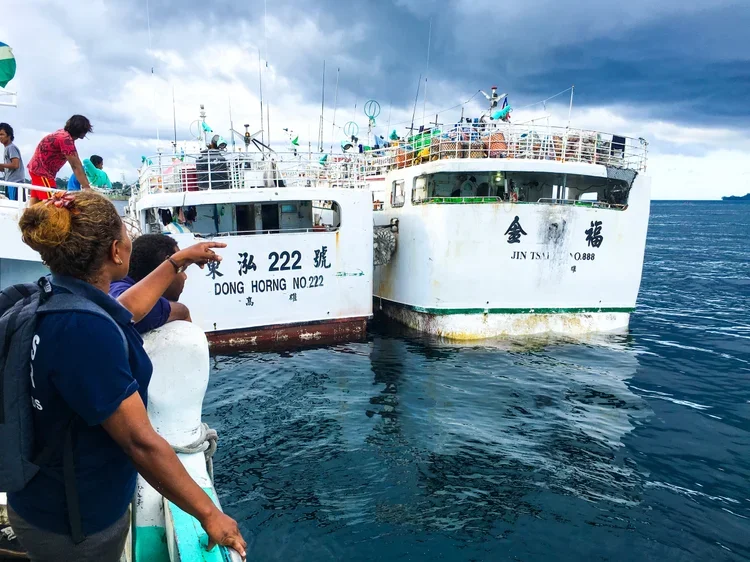
We got two here!
So this is not me having a go at the gear. It's me having another go at how little we actually know about the fleet that uses it.
The reports find that across the five RFMO registries, there were 9,084 authorised longline vessels on paper. Once you strip out the duplicates (the same vessel sitting on more than one RFMO's list) that comes down to 7,288 unique boats. One in five records was a repeat, and unsurprisingly it's the bigger, more mobile vessels doing the repeating.
Here's the number that matters most to me. Vessels 24 m or longer are only 31% of that fleet by count, 2,283 boats, but they carry 86% of the estimated fishhold volume. So almost seven out of ten vessels on these registries are, in capacity terms, close to irrelevant, while a relatively small club of large-scale longliners is doing almost all the actual catching and carrying.
And that club is dominated by the usual DWFN, China, Chinese Taipei, Japan and Korea; between them, they own 59% of the large-scale fleet by numbers and 78% of it by fishhold volume. China alone has 601 vessels of that size, with roughly 229,000 m³ of hold capacity between them. That's more than any other flag by a wide margin.
What vessel counts tell us
Here's the part that will not surprise anyone who has worked in this region. Most RFMOs don't require small and medium vessels to register at all. IOTC and WCPFC use a 24 m cut-off. IATTC's large-scale longline rules also apply only above that length.
ICCAT is the one exception, as its Mediterranean requirements pull in a lot of smaller boats, which is why its registry looks so different from the other four.
This means Indonesia, the Philippines, and Vietnam, all strong small-scale longline nations, barely show up in this data because their small-scale fleets simply aren't on the books. Hence, fishhold volume should be more vital than vessel counts whenever this comes up.
It's not a nicer statistic to quote; it's the only one that gives you an honest read on what a fleet can actually land, given that the vessels missing from the registries are, almost by definition, the small ones.
The IMO number problem, again
40% of all registered longline vessels have no IMO number. That drops to under 4% once you look only at the large-scale fleet, which is something, but it still leaves a chunk of the fleet where you genuinely cannot tell if the boat on one RFMO's list is the same boat sitting on another under a different name or flag.
Santiago falls back on national registration codes to catch duplicates where the IMO is missing, which is a fair workaround, but it's not the same as a proper universal identifier, and we've known that for a long time now.
The report is also upfront about something I have noticed before: these registries record vessels authorised to fish, not vessels actually fishing. That distinction matters more than people give it credit for.
A vessel can be authorised across all five RFMOs and only ever operate in one of them or in none. The co-occurrence numbers here are a good illustration: 1,191 large vessels are registered in just one tRFMO, 861 in two, 137 in three, 72 in four, and 26 boats authorised in all five at once.
My take
I like to think that Santiago's ISSF report is the solid paperwork side of the complexity of MCS for the longline fleet… If most of the fleet never has to register, and 40% of what does register has no reliable identifier, then of course MCS can't keep up. The fleet is built, almost by accident, to be hard to see.
The 86% of capacity sitting in 31% of vessels is also worth sitting with for a moment. Every time an RFMO reports a fleet reduction in terms of vessel numbers, it can look like real progress while barely touching actual fishing capacity, because the boats that are easiest to drop off a registry are usually the small ones with next to no hold volume anyway. If we're serious about managing capacity, hold volume and gross tonnage need to be the numbers on the table, not just headcount.
None of this means longline is the villain. Done properly, it's still one of the more selective ways to catch a mature, high-value tuna or swordfish, and I'll defend that all day. But “done properly” depends entirely on being able to see the fleet, and this report is a useful, if slightly depressing, reminder of how much of it we still can't.
Santiago's excellent recommendations- mandatory registration for the smaller vessels, universal IMO numbers, and dynamic registries that track who's actually fishing rather than who's merely authorised- are not new, yet remain partially implemented.
What this report gives us is a clean, quantified baseline to hold the industry and RFMOs to next time they claim progress on capacity reduction based on fleet size by number of vessels