This paper became the second half of the study I wrote about last week. The first part asked whether human fisheries observers could reasonably be expanded from data collectors into monitors of labour and human rights abuses at sea and concluded that the idea runs straight into the same power imbalance and safety risks that already make an observer's job dangerous. This second paper picks up where one first left off and asks a more technical but no less important question: if not observers, then what about cameras?
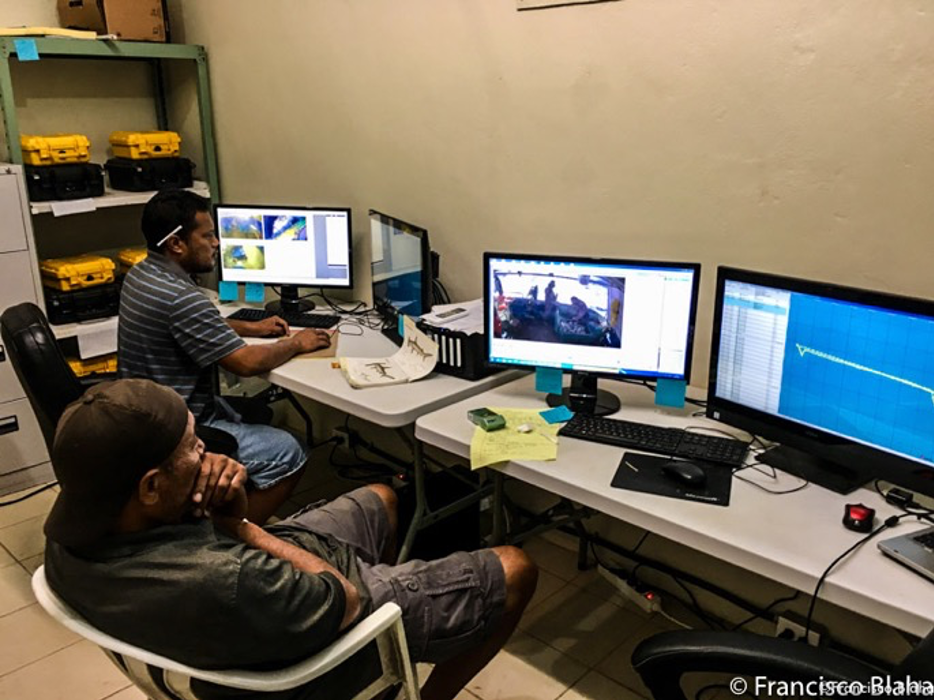
Electronic monitoring, or EM, isn't new to fisheries management; it's been quietly working its way into commercial fishing fleets for the better part of two decades. What began with Vessel Monitoring Systems tracking GPS position has evolved into full onboard camera rigs paired with gear sensors, winch and hydraulic pressure monitors, and increasingly capable machine learning that can help identify species and estimate catch size from footage. The paper draws a useful distinction that's easy to gloss over: E-Reporting (ER) is an "open" system that still relies on people typing into electronic log sheets and offloading records and observer reports submitted digitally. E-Monitoring (EM) is a "closed" system by design, with sealed, tamper-evident equipment that doesn't accept manual input and can't be talked out of what it recorded. That distinction turns out to matter a great deal once you start thinking about labour compliance, because a closed system is much harder to bribe, intimidate, or pressure into looking the other way than a person is.
That's the appeal in a nutshell. Human observers, however professional, get tired, need to sleep and eat, can only be in one place on the vessel at a time, and, as the first paper set out in some detail, can be subject to intimidation, corruption, or worse precisely because they're isolated on someone else's boat for weeks at a stretch. A camera doesn't get tired and can't be bought a drink. It also doesn't get to decide, on a bad night, whether reporting something is worth the risk.
But the paper is careful not to oversell EM as a silver bullet, and I think that caution is the most important part. Cameras have real limitations. Current technology still can't reliably determine the sex, age or species composition of a bulk catch sample the way a trained observer can. Blind spots are unavoidable on complex vessels unless the camera setup is extremely elaborate, and elaborate setups cost money. Crucially, none of the footage means anything without skilled analysts on land who understand the fishery, the vessel type and the processes on board well enough to interpret what they're looking at; the technology doesn't replace expertise; it relocates where that expertise is applied. For all these reasons, the paper's honest conclusion is that EM complements observers rather than replacing them outright, at least for the foreseeable future.
Where the paper does more original work is in mapping out what it would take to extend an EM system, built for fisheries science and compliance, to also cover labour standards. It's a genuinely practical roadmap: how to engage stakeholders who each see EM differently (a coastal state losing licence revenue if distant-water fleets flee to the high seas to dodge cameras is a very different worry from the ILO wanting a workable global standard); how to define minimum technical standards so systems from different vendors are comparable; how to structure a programme, whether through a single vendor or a certified-standards model; and how to grapple with cost, video review alone typically accounts for about half of an EM programme's budget, a sobering figure for anyone assuming cameras are the cheap option, albeit the raise of AI… yet the usefulness of AI on labour rights, is a whole paper in itself.
The paper also gets specific about which labour-focused capabilities could realistically be bolted onto an existing EM system. Crew identification via facial recognition at embarkation and disembarkation could help close a real regulatory blind spot: workers who join and leave vessels via at-sea transfers from carrier ships, far from any port authority's oversight. From there, calculating days at sea and actual working hours becomes a fairly straightforward extension, particularly on longliners, where most of the work happens on deck, where cameras already point. More ambitiously, the paper suggests EM-supported grievance mechanisms, with reported complaints logged alongside time and location data so they can't simply be dismissed as no proof, no problem.
None of this comes without real friction, and the paper doesn't pretend otherwise. Privacy is a genuine and legitimate concern; fishing vessels are cramped, crews already have almost no personal space, and being recorded around the clock is a real imposition that needs to be handled with actual limits on placement and use, not just reassurances.
Cost recovery is politically sensitive: someone has to pay for all this hardware and analysis, and industry pushback over who foots the bill is predictable. And there's a coordination problem baked into the whole exercise. Coastal states, flag states, RFMOs and vendors all need to move roughly in step, or fleets will simply drift towards whichever waters have the least monitoring.
What I find most useful about this paper, on a second reading, is that it doesn't ask EM to solve everything on its own. Its real argument is that EM already has a proven track record in fisheries data and compliance, so the technical and institutional case for expanding it into labour monitoring isn't a leap of faith; it's an extension of something already tested.
The genuinely honest caveat, though, is that nobody had actually piloted EM for labour purposes at the time we wrote this. The gap between "technically plausible" and "demonstrated to work" is exactly where the paper leaves things: recommending a proper pilot run in partnership with the ILO, flag and coastal states, and the fleets themselves before anyone claims cameras have solved a problem that people have struggled with for decades.