A new study out of New Zealand's snapper fishery has put a number on something recreational fishers rarely think about once a fish disappears back under the boat: how many of those released fish actually survive.
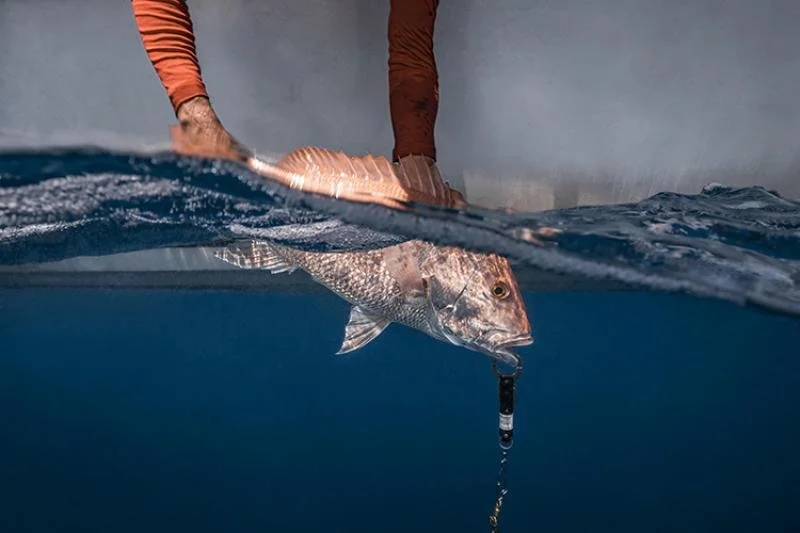
Source: https://www.fisheries.noaa.gov/feature-story/gear-summer-snapper-season-return-em-right
The paper, published this month in Fisheries Management and Ecology by Jade Maggs and colleagues from Earth Sciences New Zealand and Blue Water Marine Research (whom I worked with in 2004 on a similar area), tackles the SNA 1 stock (the snapper fishery on the upper east coast of the North Island, and by some measure, the largest recreational fishery in the country).
Private boats alone harvested more than 1.3 million snapper in the 2022–23 season, with another 237,000 taken by charter operators. But harvest is only half the catch. Because of a 30 cm minimum legal size and increasingly restrictive bag limits, well over half of everything hooked in this fishery goes back over the side, 62% in the private sector, 69% on charters.
The question the authors set out to answer is deceptively simple: of all those released fish, how many die?
How they did it
Rather than relying on lab trials alone, the team combined three things. First, they sent interviewers to eleven boat ramps and observers aboard charter vessels for a full year (January 2024–January 2025), recording fork length, capture depth, hook location (lip, foul, or gut), and fate (kept or released) for nearly 24,000 snappers. Second, they used mortality probabilities from an earlier controlled field experiment by Maggs and colleagues, which had already shown that depth of capture and where the hook lodges are the two strongest predictors of whether a released fish lives or dies. Third, they scaled all of this up using national harvest survey data, so the sampled proportions could be converted into fishery-wide tonnes and numbers.
The result: an estimated 1,110 tonnes (2.6 million fish) were released across the SNA 1 fishery over the year. Of those, roughly 248 tonnes (about 580,000 fish) were expected to die from the stress and injury of capture and release, even though they swam away. That is 200 t in the private boat fishery and 48 t in the charter sector, and it lines up almost exactly with the 20% mortality rate found in the earlier experimental work, which is a nice bit of internal consistency for the model.
Put another way: 22% of the biomass of snapper released in this fishery is expected to die anyway. Nearly a quarter of every fish anglers believe they are returning to the water unharmed don't make it.
Most of the mortality risk can be traced back to two things. Deep-hooked and foul-hooked fish die at much higher rates than lip-hooked fish, and fish caught from deeper water, where barotrauma and rapid decompression come into play, fare worse than those taken in the shallows. The good news is that most snapper in this fishery are lip-hooked (around 89–95%, depending on sector), which keeps the overall mortality rate from being far worse.
The less good news is that the current stock assessment's allowance for "other sources of mortality" across all three fishing sectors is only 450 t a year, and recreational post-release deaths alone account for more than half of that, without counting under-reporting, ghost fishing, or illegal take.
Why this matters beyond the numbers
I wrote a piece back in May about the New Zealand Fisheries Amendment Bill debate, and one of the threads I pulled on was the discard and minimum legal size provisions and how the entire argument, on both sides, tends to collapse into slogans like "legalising discards" without engaging with what discarding already looks like in practice or why it happens.
The core point I was making then is that incentives, not intentions, drive outcomes. Under the current rules, undersized fish, commercial or recreational, can be released without consequence, even in situations where we've known since the mid-2000s that survival is often poor.
There's no cost attached to catching a fish you can't legally keep, so there's little built-in incentive to avoid catching it in the first place. The Bill's proposal to require landing and counting undersized fish against quota in low-survival commercial fisheries was, I argued, at least a coherent attempt to fix that incentive gap, even if it opens up other legitimate concerns about markets for small fish.
This new snapper study is exactly the kind of evidence that the debate needed and largely didn't have. It's easy to argue about minimum legal sizes in the abstract. It's harder to argue with 580,000 dead fish a year, quantified with published mortality probabilities and a proper bootstrap-derived confidence interval, sitting inside a species-specific allowance that's clearly too small for the job.
And it cuts both ways politically, which is what makes it useful rather than just another talking point. It's not an argument for scrapping the minimum legal size — the authors are explicit that removing or lowering it wouldn't necessarily reduce the number of releases since around 15% of released snapper were already above the legal size and released voluntarily or to stay within bag limits. But it is a strong argument that regulatory settings built around size limits and release-and-hope have a real, quantifiable biological cost that current management allowances don't reflect.
The paper's authors put it plainly: the current 450 t allowance for "other mortality" across all sectors is very likely insufficient once you actually measure what's happening at sea rather than assume it away.
The encouraging part of the story is that SNA 1 is, right now, a stock in good shape, rebuilt substantially since the 1990s low. Better hook and gear choices; awareness of depth-related mortality; and, as I said in May, clearer, less politically charged rules agreed upon before the pressure arrives, rather than fought over in the middle of a crisis.
Fish that swim away aren't necessarily fish that survive. If we're going to build fisheries policy, recreational or commercial, around the assumption that release equals conservation, we need studies like this one to keep testing whether that assumption actually holds.