Back in February, I was in Tahiti for the International Workshop on Mitigation of dFAD Loss and Abandonment in the Pacific, organised by SPC with the Direction des Ressources Marines of French Polynesia, ISSF, The Nature Conservancy and IATTC. I wrote about the experience at the time, first describing it as a waste crisis in the WCPO, and then, once I'd had time to sit with the FAO/IMO framing, arguing that dFADs are effectively ALDFG — abandoned, lost or otherwise discarded fishing gear — whatever the legal semantics say.
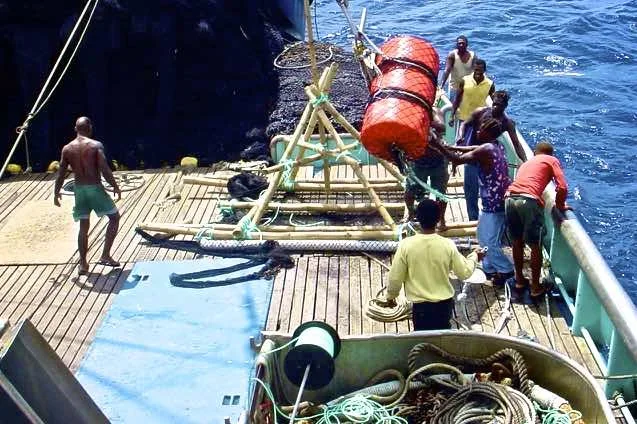
The official workshop report has now been published, and it's worth going back to it, because it puts numbers and structure around what was, at the time, mostly a feeling of watching a slow-motion train crash.
The scale of the meeting itself tells you something: 110 participants from 25 countries and territories, 35 presentations, three group exercises, spread across three themes — building shared definitions, exchanging stranded data, and identifying what a sustainable dFAD fishery would actually look like. This was the second such gathering, following the first international workshop on FAD recovery in Galapagos in 2024, and the difference in maturity between the two is, I think, the real story.
The numbers that frame the problem
Between 46,000 and 65,000 dFADs are deployed annually across the Pacific. More than 70% are never re-observed in the Eastern Pacific. An estimated 23.4% of EPO-deployed dFADs cross or drift into the WCPFC Convention Area. In the WCPO, at least 11.3% end up stranded, and 82% have an unknown ultimate fate.
That last figure is the one that matters most: we are managing a fishery input at an industrial scale while being unable to say, for the overwhelming majority of units, what happened to them. You can't govern what you can't see.
Finally, some shared language
A large part of the workshop went into something deceptively basic: agreeing on what "lost," "abandoned," "discarded", and "stranded" actually mean for a dFAD. Different stakeholder groups (fishers, governments, NGOs, scientists, regional bodies) proposed and voted on definitions, and the spread of answers was itself revealing.
Fishers, for instance, pushed hard on the idea that a dFAD drifting into a zone they're not licensed to fish or an MPA, is not "abandoned" in any meaningful sense, even though it is abandoned in law. That's exactly the tension I flagged in the ALDFG post: intentionality is a legal question, but ecologically irrelevant.
The workshop didn't resolve that tension so much as map it, producing a full lifecycle table that traces a dFAD from deployment through to its three real endpoints — retrieved, stranded, or sunk — with "lost," "abandoned," "discarded" and "reused" as the intermediate, contestable states in between.
The money is starting to move
This is where the report earns its keep. At the first Galapagos workshop in 2024, the funding discussion apparently went nowhere, and no concrete model emerged.
In Tahiti, that changed. Danielle Ferraro and Erin O'Reilly from UC Santa Barbara's Environmental Markets Lab presented an actual deposit-refund model: a deposit paid by the fishing company on deployment, a refund paid to whoever retrieves the dFAD, regardless of whether that's the original owner.
SPC's own feasibility study laid out five mitigation options side by side, deposit-refund among them, alongside dedicated cleaning vessels, better deployment siting, and shore-based "FAD watch" retrieval. None of these is mutually exclusive, which is a useful correction to my own instinct to look for one silver-bullet mechanism.
Interestingly, my friend Craig Heberer and I submitted a proposal a month ago to a PNA consultancy opportunity to help with initiating a FAD Buoy Recovery Programme. Let's see how it goes.
More concretely still, a sustainable funding initiative to recover dFADs before they strand was presented by an industry-backed body — the Ocean dFAD Recovery Foundation, drawing on several purse-seine associations (ATA, ATUNEC, OPAGAC) — and was positively received by a significant segment of the EPO fleet, with some WCPO uptake. And the three dominant buoy manufacturers, Marine Instruments, Zunibal and Satlink, the same trio whose competitive pricing I've argued turned dFADs into disposable, buy-forget-abandon commodities, signed a first-of-its-kind joint declaration of intent to align on recovery and circularity practices. Whether that translates into anything more than a press-friendly commitment remains to be seen, but it's a different starting position than a year ago.
What's actually happening on the water
The report is refreshingly concrete about existing programmes: SPC's regional stranding database now holds over 4,000 entries (with records going back to 2006); the Solomon Islands programme has logged more than 600 strandings across four dedicated trips; Tuvalu pays fishers for buoys brought in; Hawaii runs a bounty system for derelict gear, including FADs; French Polynesia has collected over 1,500 stranding reports through community networks. A 250kg-capacity portable crane developed by AZTI was floated as a practical fix for the very unglamorous problem of small vessels being unable to physically lift a stranded dFAD off a reef.
Workshop groups also produced a list of 51 candidate performance indicators for recovery programmes — cost per retrieval, weight of material recovered, response time, proportion of fleet participating, and so on… and four draft project proposals, including a genuinely interesting one to test whether sunk dFADs actually biodegrade at 200–6,000m depth, versus simply assuming they do.
Where this leaves things
None of this closes the legal gaps Justin Rose's review for SPC surfaced — when a dFAD counts as "fishing," who owns it once it drifts, whether MARPOL, Basel, BBNJ or UNCLOS actually bite on an artificial structure adrift in someone else's EEZ. MSC's revised standards, phasing in from 2027 for new fisheries and 2030 for recertification, will force some of this into certification audits regardless of how the legal questions get resolved.
But the shift in tone between the two workshops is real: from a room agreeing there's a problem, to a room with an actual bond mechanism on the table, an industry foundation with money behind it, and buoy manufacturers signing their names to something. It's still, as I said in February, a bill that the Pacific's coastal communities have been paying on our behalf. This report is the first sign that the industry is starting to reach for its wallet.