Why How You Thaw Your Fish Matters More Than You Think
While I was fishing commercially and going to university, I was always the guy who wrote all the documentation on board... and there was a lot of writing to do!
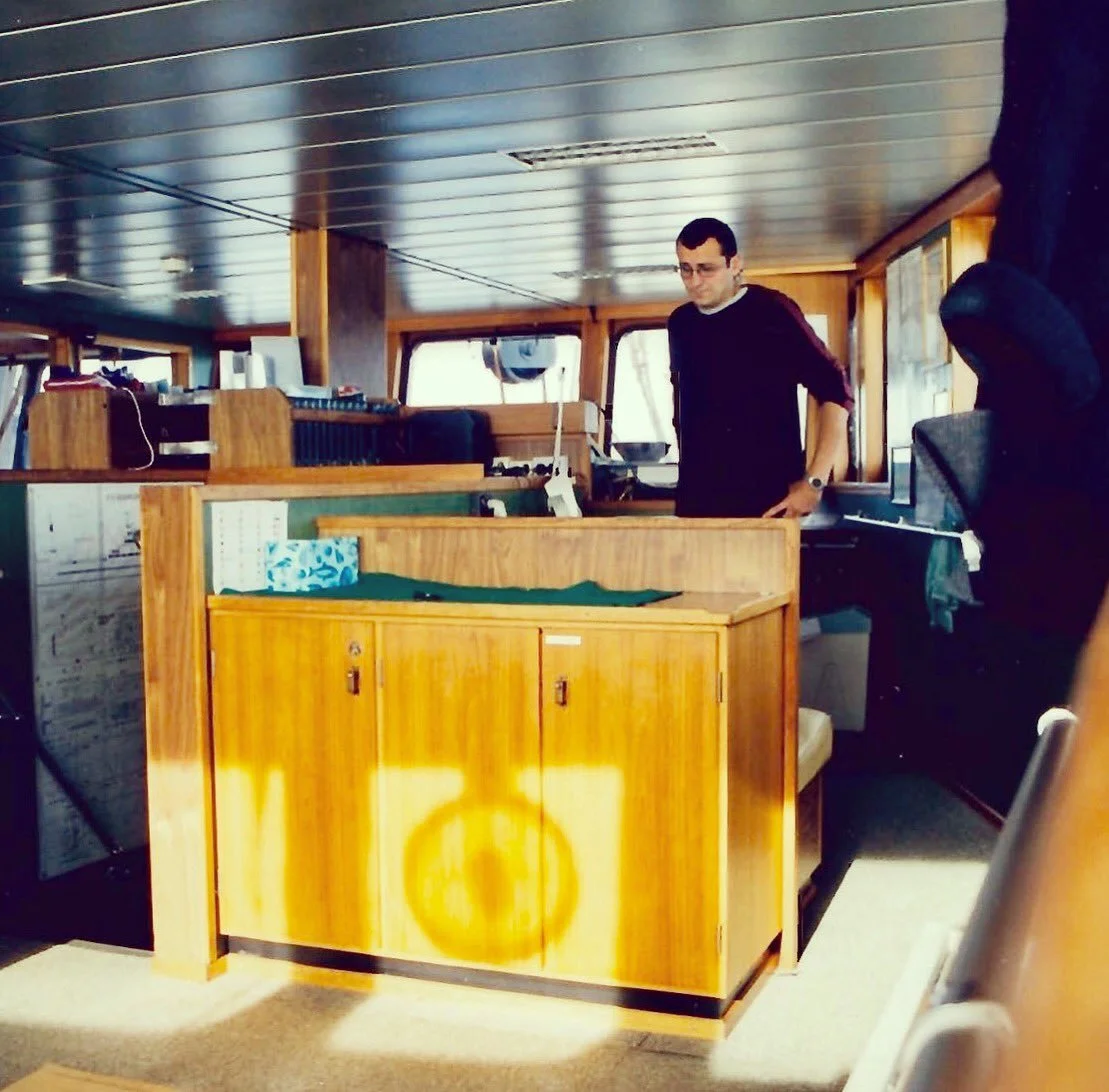
Confronting the paper work on the Ocean Dawn, aNZ factory twawler that produced filled hoki at the end of the 90s … NZ fisheries and seafood paper work is really heavy, yet that was my job!
You have the fisheries side (logsheets, reports, etc.), the maritime side (safety, logbooks, radio, etc), the labour side (working hours, crew safety), and the seafood safety side (cleaning records, maintenance, etc.). While fishing in the WCPO in the 90s, most of it was the FFA log sheets and port entries.
Only after the WCPFC was established did we get the standardised ones. And once in NZ, the whole HACCP world and the deepening of market access requirements kicked in, and not many people were doing that... so I rode the wave and did a lot of work on the seafood safety side of fishing... “Once fish is on deck, it becomes food”, and a whole other regulatory universe becomes necessary, one that, until the last two decades, wasn’t as critical as now.
Partly because of that, I did my 2nd master's in Seafood Science, as I knew fish but wanted credibility in ‘fish as food’, particularly since it was associated with the official certification world, which prepared me for what was to come with the various catch certifications and CDS.
I did a lot of work around that. In fact, the EU itself contracted me for over 10 years to train seafood inspectors on vessels and at landing sites worldwide, including in Europe. I wrote guides on the EU certifications and even a chapter in a book on refrigeration on board, which is still quoted today.
I found the physics and chemistry of freezing very interesting, as well as the best relationship between fishing methods and types. For example, it would be ridiculous to use blast or plate freezing on a purse seiner, just as it would be ridiculous to use brine freezing on a longliner or a hoki trawler. Yet the corollary of freezing, namely thawing, didn't get much attention those days… mostly you just took it out of the freezer and left it in a cold, humid place, or directly in water before processing…
Things have changed, and this particular paper brings updates to a lot of the newer methods… not all related to fish… for now… yet the nerd in me likes to learn new tricks for old methods.
So yeah, here is a summary of the paper, but as always, I recommend you read the original.
Freezing is the backbone of the global meat and seafood trade. Vast quantities of fish, beef, pork, and poultry are frozen and shipped around the world every day, typically stored at −18°C or below. The problem isn't the freezing itself — it's what comes next.
Traditional thawing methods, such as leaving the product at room temperature or running it under water, are slow, wasteful, and damaging. As ice crystals melt, they disrupt muscle fibres, cause water to leak out (known as drip loss), and create ideal conditions for bacterial growth. That drip loss isn't just water — it carries soluble proteins, vitamins, and other nutrients. For the food industry, this translates directly into lost weight, quality, and money. For anyone operating within a HACCP framework, it also represents a Critical Control Point that demands close attention.
The damage goes deeper than the surface. Thawing triggers a cascade of chemical changes: proteins unfold and denature, fats oxidise and develop off-flavours, and the muscle’s fine microstructure — the tight bundles of fibres that give it texture — breaks down. The longer the thaw takes, the worse these effects become.
What Actually Goes Wrong Inside the Muscle
The review identifies four main areas of quality deterioration during thawing, all of which will be familiar to anyone who has worked seriously with frozen seafood.
Water-holding capacity is arguably the most commercially important. During freezing, water forms ice crystals outside muscle cells. When it thaws, an osmotic imbalance draws water out rather than back in. The result is the spongy, pale, wet surface you sometimes see on thawed product. Once this water is lost, so are the nutrients dissolved in it. Fish and crustaceans are particularly vulnerable here because their connective tissue is structurally weaker than mammalian muscle, making their cell walls more susceptible to irreversible ice-crystal damage.
Protein changes are subtler but equally significant. Roughly 20% of muscle is protein, and these proteins — particularly the myofibrillar proteins that control texture — are highly sensitive to freeze-thaw cycles. During thawing, protein structures partially unfold, hydrogen bonds weaken, and reactive oxygen species attack them. This is why thawed product can turn mushy or lose elasticity. Fish myosin is notably less stable than its mammalian counterpart, so temperature control during seafood thawing needs to be stricter.
Lipid oxidation is the primary cause of off-flavours and reduced shelf life. When cellular compartments rupture during thawing, fats come into contact with oxygen and iron-containing compounds in the drip fluid, accelerating rancidity. Seafood faces heightened risk here because of its high content of polyunsaturated fatty acids (PUFAs), which are far more chemically reactive than the saturated fats that dominate red meat. Anyone who has thawed tuna or salmon poorly knows exactly what this smells like.
Finally, microstructural damage — visible under electron microscopy — reveals physical tearing of muscle fibres, widened gaps between cells, and disrupted connective tissue. These gaps become channels through which additional water and nutrients escape, compounding the drip loss problem.
Seven Technologies Changing the Game
The review evaluates seven emerging thawing technologies, each based on different physical principles.
High-Voltage Electric Field (HVEF) thawing uses a strong DC electric field to reorient water molecules in the ice, accelerating melting without generating significant heat. It shows real promise for inhibiting microbial growth, but requires careful calibration. Exceed the right voltage threshold, and you enter corona discharge territory, generating ozone that accelerates fat oxidation — the opposite of what you want, especially with PUFA-rich seafood.
Ohmic thawing passes an alternating electrical current directly through the product, generating heat uniformly from within via electrical resistance. One study found it thawed frozen tuna more than five times faster than water immersion, while preserving nutrient content. The main concern is the potential migration of metallic ions from the electrodes into the food if parameters aren't tightly controlled.
Microwave thawing generates internal heat by exciting water molecules with high-frequency electromagnetic waves — a principle familiar to anyone who has used a domestic microwave. The limitation is uneven heating. The classic "still frozen in the middle, cooking on the outside" problem is a genuine quality and safety concern in industrial settings, causing localised protein denaturation and textural damage.
Radiofrequency (RF) thawing operates on the same electromagnetic principle but at much lower frequencies — around 27 MHz, compared with 2,450 MHz for microwaves. The longer wavelengths penetrate more deeply and more evenly, making RF particularly well-suited to large commercial frozen blocks. Several studies confirm that it produces a more uniform temperature distribution than microwaves, with significantly less surface overheating.
Ultrasound-assisted thawing uses high-intensity sound waves to induce cavitation — microscopic bubbles that collapse, releasing intense local heat and pressure, thereby accelerating thawing and inhibiting microbial growth. The trade-off is that excessive power can mechanically damage muscle fibres. Research into multi-frequency ultrasound systems, which use transducers operating at multiple frequencies simultaneously, shows considerable promise in overcoming this limitation.
Low-temperature, high-humidity (LHT) thawing surrounds the product with near-saturated humid air at temperatures just above freezing. The humidity forms a thin water film on the surface, which blocks oxygen and dramatically slows oxidation. Of the seven technologies reviewed, LHT consistently produced the best results for preserving water-holding capacity and minimising lipid oxidation. Its main drawback is speed — it is the slowest of the methods examined.
Vacuum thawing reduces atmospheric pressure, causing water vapour to condense on the frozen product's surface and release latent heat that drives thawing. The low-oxygen environment effectively prevents oxidation, but the process can cause moisture loss through sublimation. Recent developments — particularly vacuum sublimation-rehydration thawing — aim to address this by reintroducing water during the thawing cycle.
So Which Is Best?
The honest answer is that it depends on your operational priorities. The review is clear: no single technology wins across all criteria.
For large-scale industrial operations where speed and uniformity matter most, RF thawing is the most practical standalone method. For operations where quality preservation is the priority — minimising drip loss, protecting protein structure, and limiting oxidation — LHT thawing delivers the best outcomes. For the optimal balance of speed and quality, the combination of microwave and ultrasound-assisted thawing emerges as the most scientifically robust hybrid approach, with each technology compensating for the other's weaknesses.
Technologies such as standalone vacuum thawing and ultrasound remain largely confined to the laboratory scale, hampered by scalability challenges and equipment costs.
The Road Ahead
The review is candid about the gap between laboratory promise and industrial reality. Most studies have been conducted on small, neat samples in controlled settings, and there is a critical shortage of data on how these technologies perform on the large, irregularly shaped commercial blocks that real-world processing involves.
The authors identify three key pillars for future progress: integrating multiple physical technologies into combined systems; deploying machine learning and digital twin models to dynamically adjust thawing parameters in real time; and developing standardised Life Cycle Assessments to quantify the true energy and carbon costs of each approach.
For those of us who have spent careers thinking about what happens to fish between the moment it hits the deck and the moment it reaches the consumer, that last point feels particularly timely. The physics of freezing has always attracted attention. It's good to see thawing finally catching up.
Wang, Y. et al. (2026). Emerging Thawing Technologies for Frozen Muscle Foods: Mechanisms, Quality Impacts, and Industrial Prospects. Foods, 15, 1991. https://doi.org/10.3390/foods15111991