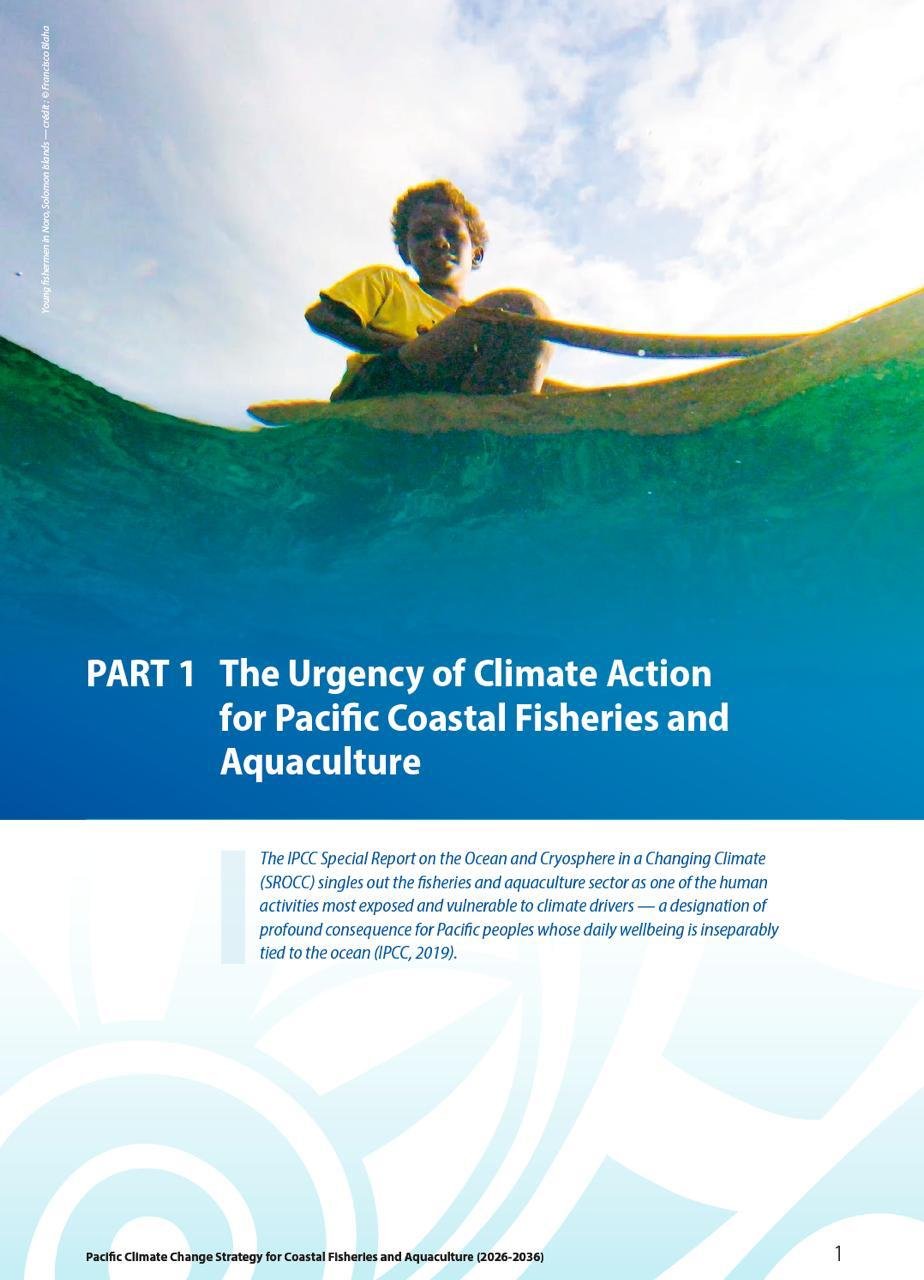
I was moved beyond words by having one of my photographs on the cover of what may be this region's most important publication on the future of coastal communities — and another in its key opening chapter. This region has been home for more than half my life. I would not be who I am without my Pacific colleagues and friends.
While I don’t really work on coastal fisheries, I wanted to write about this document beyond the fact that my camera often happened to be with coastal fishers.
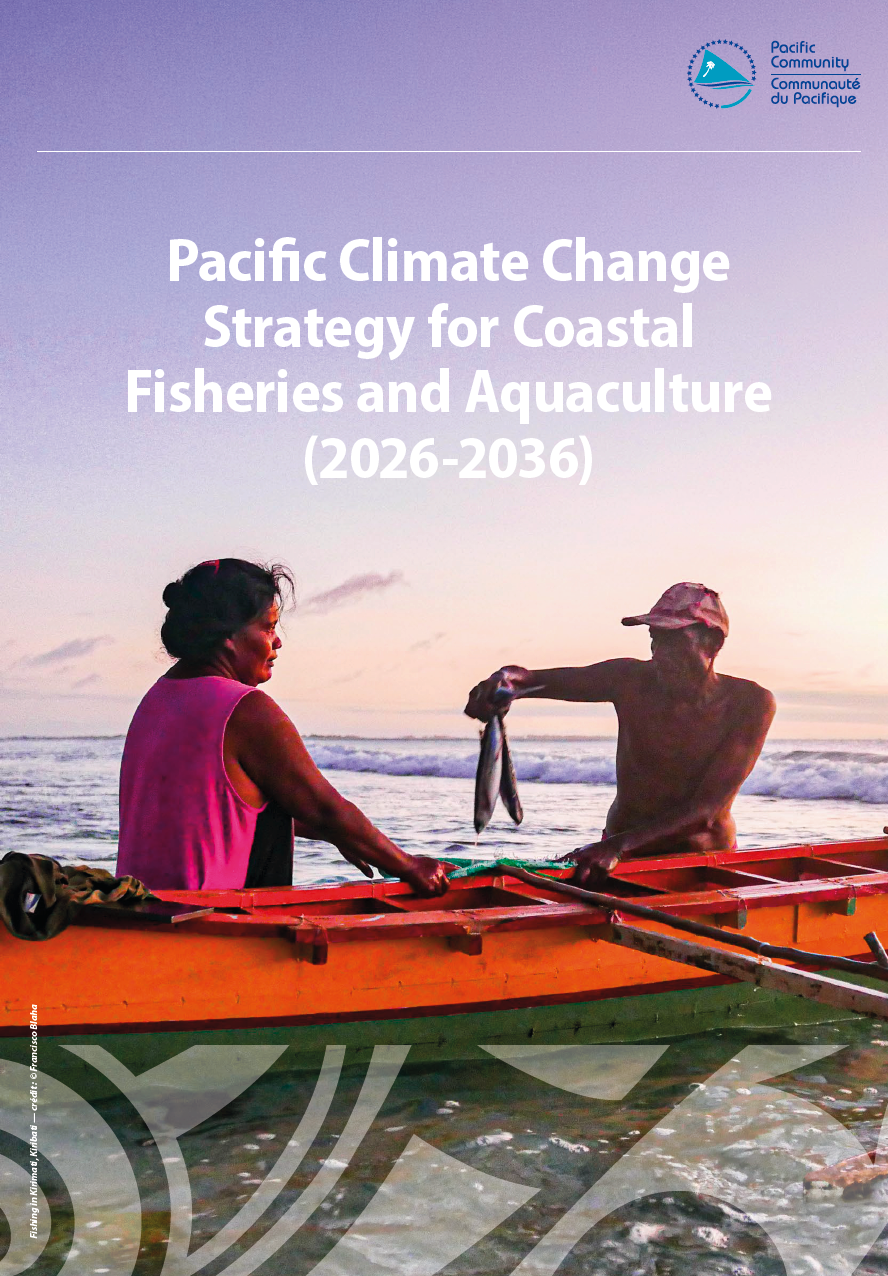
The Pacific Climate Change Strategy for Coastal Fisheries and Aquaculture (2026–2036), released by the Pacific Community (SPC) out of Noumea, is the product of two years of Member-led negotiation — from a mandate at the Heads of Fisheries meeting in 2024, through ministerial endorsement in Niue in 2025, to final clearance in Noumea this April. It is dense, technical, and, in places, quietly devastating. It is also, I think, the kind of document this region has needed for a long time.
Why coastal fisheries, and why now
It's easy for coastal fisheries to get lost in conversations about the Pacific and climate change, overshadowed by the offshore tuna industry's economic weight or by the more visceral imagery of sinking atolls. But coastal fisheries are the fabric of daily life here. They account for an estimated 57% of fisheries-related GDP across the region, and coastal marine resources supply roughly half of all animal protein Pacific Islanders eat. In Palau, for example, aquatic food consumption reaches up to 125 kg per person per year, among the highest rates anywhere on Earth. These fisheries aren't just an economic sector. They're food security, they're women's livelihoods, they're the social safety net that kept communities fed when COVID-19 cut off imported supplies, and they're inseparable from custom, ceremony, and identity.
And they're under serious threat. Coral bleaching, ocean acidification, sea-level rise, and shifting species distributions are already degrading the reefs, mangroves, and seagrass meadows these fisheries depend on. The modelling in the Strategy is stark: coastal fisheries catches across the Pacific are projected to fall by 2050, with losses reaching as high as 65% of annual catch in the hardest-hit locations under high-emissions scenarios, and some countries facing protein deficits of up to 29 kg per person per year.
Yet despite all this exposure, the sector receives less than 1% of global climate adaptation finance, and the Pacific as a whole has accessed only 0.22% of global climate funds. Coastal fisheries barely feature in most national climate plans. This Strategy exists to close that gap, between how much this sector matters and how little it has been resourced to adapt.
Six objectives, twenty-two actions
Rather than treating climate change as a single problem, the Strategy organises its response around six connected strategic objectives: strengthening adaptation and resilience; advancing mitigation and blue carbon protection; recognising and responding to loss and damage; ensuring fishing communities are informed and heard; mobilising climate finance; and embedding coastal fisheries in Pacific and global climate policy.
Underlying these are 22 specific actions, ranging from scaling up community-based fisheries management (still, the document argues, the single most effective governance tool the region has) to piloting climate risk insurance for small-scale fishers, to helping countries build the technical capacity to write competitive proposals for funds such as the Green Climate Fund or the newly established Fund for Responding to Loss and Damage.
What struck me most, reading it, was the loss and damage section. The Strategy is blunt about this: for Pacific fishing communities, loss and damage are not a future risk to be modelled. As it puts it, it “is a present reality.” That section pushes for something more than economic accounting; it calls for national capacity to document slow, cumulative losses that don't show up neatly in a spreadsheet: the disappearance of species a family has fished for generations, the erosion of access to traditional grounds, the loss of species central to ceremony. Documentation methods, the Strategy insists, should be decided nationally and can be qualitative, narrative, or culturally grounded… not forced into a template that was never built for this region.
I also appreciated that this isn't a document that treats gender equity as an afterthought. Women make up roughly half of everyone engaged in subsistence fishing in the Pacific and account for 56% of small-scale catch by volume, yet they're consistently the least visible in the data and the governance structures that decide who gets heard and who gets resourced. The Strategy builds gender, disability, and social inclusion into a mandatory accountability standard running through every single objective and action, not a side box to tick.
A regional framework, not a regional mandate
One thing the Strategy is careful about is not overreaching. It explicitly describes itself as “a regional framework, not a regional prescription”— each Pacific Island country and territory implements it through its own national fisheries plans, on its own political timeline, adapted to its own capacity and vulnerability. An accompanying tiering framework sorts the 22 actions by sequence: what has to happen first (strengthening data systems, scaling community-based management, embedding fisheries in disaster planning), what accelerates once those foundations exist, and what requires longer, sustained investment, like innovative finance mechanisms and insurance products.
Why this matters to me
I've spent more than half my life in this region, mostly working on compliance mentoring and research on boats and docks, and sometimes photographing the people for whom fisheries is not a hobby, but their livelihood, mostly fellow commercial fishermen, but sometimes, a couple helping each other after a fishing day in Kiritimati, or the young men in Noro coming to check me out while superfinishing,.
Seeing those pictures in the cover and opening chapter of the Strategy is something I still haven't fully processed. This document won't fix everything (no strategy could), but it names, clearly and with real evidence behind it, what people here have known for a long time: that these waters, and the people who depend on them, deserve far more attention and far more finance than they've been given. I hope it gets both.
The full Strategy is available through the Pacific Community (SPC). Many thanks to Marie Lecomte for choosing the pictures and to SPC for the acknowledgement.