I’ve been interested in this topic for a while, and when my friend Gilles sent me this paper, Glover, A.G. et al., 2026, “The environmental impacts of deep-sea mining,” Current Biology 36, R400–R419 (, it struck me as a good, rigorous treatment of the subject.
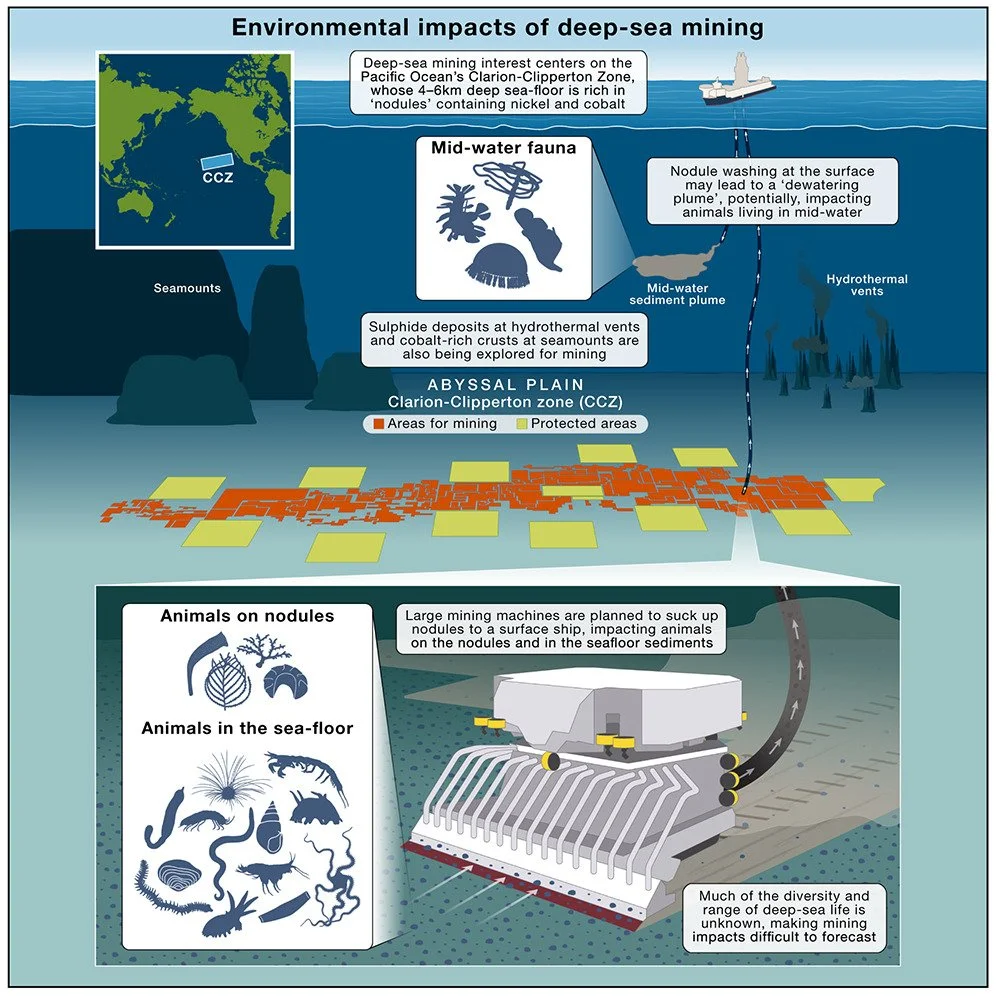
Source: Graphical abstract of the paper
At the end of 2024, I completed the ISA’s Deep Dive 3 training programme — the Authority’s most advanced capacity-building course, covering over 50 lessons across UNCLOS, geological and biological oceanography, environmental assessment, and the engineering realities of prospecting in the Area. That training gave me some foundation for reading this paper with some discipline rather than just reacting to the loudest voices on either side.
This review brings a deep and credible roster of deep-sea biologists — many of them from the Natural History Museum, the National Oceanography Centre and Southampton’s long-running SMARTEX programme — that methodically dismantles that myth that the deep sea as a cold, dark, food-poor desert where almost nothing lived., and in doing so produces one of the more honest accounts of seabed mining’s environmental stakes I’ve read. Its great virtue is refusing the easy story in either direction.
The first thing the paper insists on is that “deep-sea mining” is not one thing. There are three quite different targets — polymetallic nodules on the abyssal plains, seafloor massive sulphides at hydrothermal vents, and cobalt-rich crusts on seamounts — and they sit in ecosystems so different that lumping them together is a category error. A fourth, often-forgotten impact cuts across all three: the midwater plume created when ships dewater the ore, which can affect the water column far from the seabed. Treat these as one problem, and you will get the policy wrong.
The nodule fields: scarring and slow, partial recovery
On the nodule fields of the Clarion-Clipperton Zone, the science is now genuinely informative, and the picture is nuanced rather than damning. The abyss turns out to be biodiverse but at vanishingly low biomass — Southern Ocean sediments can hold three orders of magnitude more animals per square metre. A commercial 20-year mine might clear an area the size of Crete, scraping nodules and the surface sediment and laying down a benthic plume. The standout dataset comes from revisiting a 1979 US mining test: 44 years on, the tracks are still visibly cut into the seabed, and megafaunal density in the collection area remains reduced. Yet the story isn’t uniformly bleak. Macrofauna and foraminifera showed no clear spatial impact, a xenophyophore had actively recolonised the most disturbed ground, and recent tests — the 2021 Patania and 2022 NORI-D trials — suggest the plume is more constrained than once feared, though the NORI-D work did find macrofaunal density down 37% in the tracks. The honest summary is “persistent geophysical scarring, mixed and partial biological recovery over decades,” not “instant catastrophe” and not “no harm done.”
Impact is not extinction
Crucially, the authors draw a distinction that most public debate collapses: ecological impact (animals die, communities shift, recovery takes decades) is not the same as biodiversity loss (extinction). For the abyssal nodule fields, they are admirably candid that we cannot currently predict extinction risk. Of an estimated 6,000–8,000 animal species in the CCZ, only 436 are named, and 98% of the wider abyss is unsampled. Some common species have ocean-basin-scale ranges, which would lower extinction risk; but there are also real biogeographic boundaries that could shrink ranges and raise it. The data simply aren’t there yet. This is the paper at its best — naming an absence of evidence rather than dressing precaution up as certainty, or treating ignorance as licence.
Vents and seamounts
Vents and seamounts are where the verdict sharpens. Active hydrothermal vents are minuscule — under 50 km² globally, a rounding error on Earth’s surface — island-like, and full of endemic species found nowhere else; 71 of 184 assessed vent molluscs are already Endangered or Critically Endangered. Seamounts likewise show high endemism and host slow-growing corals and sponges that recover from disturbance over centuries, if at all. Here, the logic flips relative to the abyss: we have limited data on the precise ecological impacts of mining them, but clear reason to expect biodiversity loss, precisely because the habitats are rare and their inhabitants restricted. The review’s most pointed conclusion follows directly: if vents and seamounts were classified as areas of “high biodiversity importance” under the Convention on Biological Diversity, mining them would not be scientifically compatible with the Kunming-Montreal Global Biodiversity Framework. That is a strong claim, but it is carefully bounded — a scientific “if/then,” not a political demand.
The comparison the paper doesn’t make: land-based mining
Where the paper is necessarily thinner is on the comparison that any informed reader will be reaching for: how does this stack up against land-based mining for the same metals? The review largely brackets that question, and that is a real limitation given that the entire commercial rationale for seabed mining is that terrestrial cobalt and nickel extraction carries its own heavy ecological and human costs. The authors gesture at it — noting that abandoning one resource simply shifts demand elsewhere is the industry’s core argument — but they don’t adjudicate it, which leaves the most consequential trade-off for policy unresolved. To their credit, they don’t pretend to settle it; the paper is explicitly about in-situ effects and extinction risk, not life-cycle accounting. But a reader wanting “seabed versus terrestrial, all things considered” won’t find the answer here, and shouldn’t pretend the review offers one.
A word on positioning
In fairness, the authors’ institutions have received research funding from across the spectrum — governments, NGOs, and public and private companies — to conduct baseline work for ISA-regulated exploration, though this particular paper was government-funded with declared independence. That breadth of funding is disclosed, and the measured tone bears it out; this does not read as advocacy for any side.
I also should be transparent about where I’m coming from. When I did the ISA’s Deep Dive 3 programme (fifty-plus lessons, each with its own exam requiring a minimum of 80% to pass), I did it as an independent learning resource to expand the horizon of my work, and I found it genuinely rigorous. It didn’t hand me a position on whether seabed mining should proceed; it gave me the vocabulary and the disciplinary grounding to interrogate the claims made on all sides.
My professional background is in fisheries compliance. The marine realm beyond national jurisdiction is not new territory for me. What Deep Dive 3 added was the seabed dimension: the geology, the governance architecture of the Area, and the environmental assessment frameworks that any responsible regulatory conversation about mining has to engage with seriously. I cite this not to claim authority I don’t have, but because I think it’s relevant context: the Glover et al. review reads very differently once you have some grounding in the underlying science rather than arriving at it purely through the advocacy literature, whether that advocacy comes from the industry or the campaign groups.
Why it matters
What I take from it is a model of how to talk about an uncertain environmental issue. The deep sea is not a desert — it is biodiverse, ancient, and slow to recover. But it is also not a single fragile monolith: the abyss, the vents and the seamounts demand separate verdicts, and the science supports a cautious “we don’t yet know” for nodules and a much firmer warning for vents and seamounts. The campaigners who say “ban it all” and the contractors who say “it’s basically empty down there” are both flattening a story that refuses to be flat.
That refusal is exactly why this review is worth reading