A few weeks ago, I wrote about the science of deep-sea mining and the Glover et al. review that rejected the easy story in either direction. This post is about the other half of the problem, the half the science can't touch: the governance.
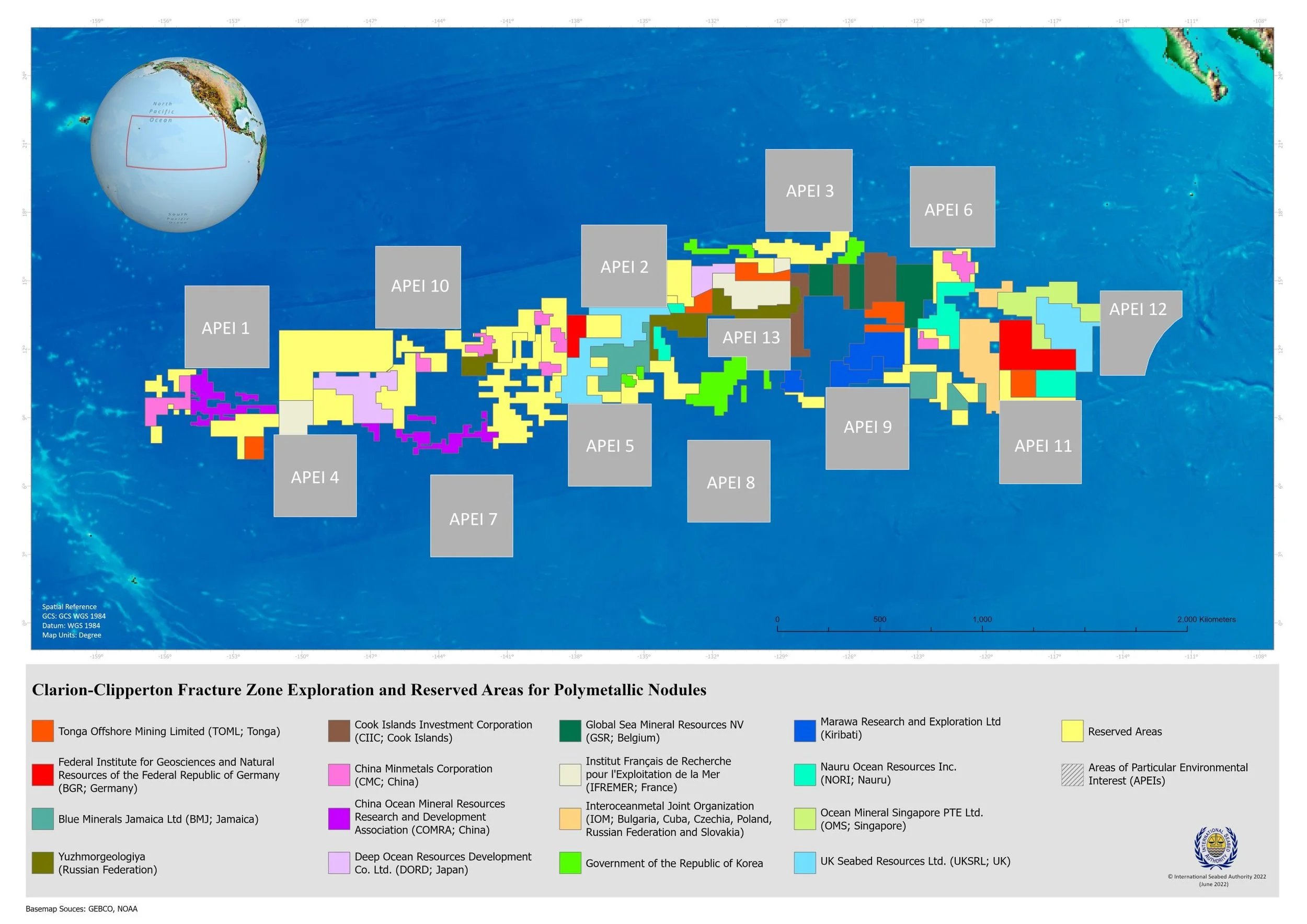
source: https://isa.org.jm/maps/clarion-clipperton-fracture-zone/
And for that I've been reading a very different kind of document — an edited version of a lecture Michael Lodge gave at the US Naval War College in March, published in International Law Studies (108 INT'L L. STUD. 256 (2026)).
Michael Lodge is not a neutral observer. He served as Secretary-General of the International Seabed Authority (ISA) from 2017 to 2024 and was part of its machinery for 26 years. He now advises governments and industry. So you read him, knowing where he sits. But that's exactly why the piece is worth engaging with — it's an insider describing, with unusual bluntness, how the institution he led has hit what he calls an existential crisis.
I should say upfront that I actually know and really appreciate Michael. We shared an expert consultation on flag-state performance in Washington some years back, and he was a reference for my application to the Rhodes Academy of Ocean Law and Policy. I've always appreciated his frankness and, more than that, his willingness to work things from the inside rather than lob criticism from the sidelines, which is precisely what makes this lecture worth reading. He's not a man who walks away from a broken thing; he stays and tells you exactly how it broke.
When I did the ISA's Deep Dive 3 training back in 2024, the governance architecture of the Area was one of the modules. Reading Lodge, I kept thinking: the infrastructure I studied is the same, but the pressure in it has changed completely.
Three ages, and one broken promise
Mr Lodge frames the whole history as three "ages." The first ran from the late 1960s to UNCLOS in 1982 — a period of real commercial interest, ten international consortia, and actual recovery tests in the Clarion-Clipperton Zone. That age died when Part XI of UNCLOS turned out, in industry's reading, to be deliberately designed to make private mining unviable: mandatory technology transfer, production ceilings to protect land-based producers, and a review conference that could rewrite contracts retroactively. The US voted against the Convention in 1982. Reagan set out conditions it never met.
The second age began with UNCLOS entering into force in 1994, after an Implementation Agreement that stripped out the most punitive bits of Part XI. This is the age I was trained in. Exploration contracts grew from six in 2001 to thirty-one by 2024. Twenty-two sponsoring states. More than $2 billion invested. Lodge says that five years ago he'd have called the regime an unqualified success — and I believe him, because that's roughly the story Deep Dive 3 tells.
Then comes the part that genuinely changed how I think about this. The 1994 deal rested on a "fundamental bargain": the ISA would not stand in the way of commercial mining once a contractor was ready. The safety valve was the so-called two-year rule—any contractor ready to apply could ask the Council to finalise exploitation regulations within two years, and if it didn't, the Council still had to consider the application under whatever rules existed.
Nauru invoked it in 2021. The two years expired in July 2023. The Council did not adopt regulations and then questioned whether Nauru had the right to trigger the rule at all.
Mr Lodge's outrage here is the sharpest passage in the lecture, and I find it hard to dismiss. Many of the same industrialised states that insisted on the two-year rule in the 1990s to protect their own pioneer investors were foremost in opposing a developing state's attempt to apply it.
Some have held exploration claims for over thirty years with, as he puts it, no serious intent to ever produce. France has been at it since 1987 — thirty-nine years of exploration and counting. Germany holds its contract while formally declining to sponsor any mining "until further notice."
The players who wrote the rules now won't play by them when it suits them, and they're doing so to the detriment of a Pacific island state. As someone whose working life is largely in the Pacific, that framing lands.
It is quite obvious from the reading that Mr Lodge does not think highly of the environmental opposition, as he sees it as almost entirely in bad faith — NGOs and civil society coalitions "designed to prevent any viable exploitation regime from materialising," with funders quietly listed to imply hidden agendas.
I pretty much left most of social media after being targeted by Paul Watson and Sea Shepherd because of the death threats I got for pointing out the scientific inconsistencies and the veiled racism in the Seaspiracy movie. So I get that he had very personal attacks on a scale that I can’t imagine. As with fisheries, I share his contempt for groups that offer only opposition and have no willingness to find compromises and solutions to real needs (mineral or seafood).
Yet having just read Glover et all, the environmental caution needs to be considered, and in my opinion, if you look at the comparative surface of the Areas of Especial Environmental Interest in the Clarion Clipperton Fracture Zone, environmental concerns are not being ignored.
The reality is that the science genuinely says "we don't yet fully know" about all the potential impacts of the nodule fields, and even less about vents and seamounts. A regulator dragging its feet is not proof that the concerns are fake. Lodge is describing institutional failure honestly, and the environmental NGOs are not as innocent as they pretend to be… Both things can coexist.
That said, what I think is his central strategic point survives the disagreement, and it's the bit I keep thinking about.
The core argument is this: a dysfunctional ISA is not a stalemate that hurts everyone equally. It suits some players enormously.
China holds ISA exploration contracts across all three mineral categories — nodules, sulphides, crusts. It sits on the Council and the Legal and Technical Commission, and since 2023, it's been the largest financial contributor. Its state contractors face no investor pressure to reach production. So delay costs them nothing and costs Western private operators, who need a bankable timeline before a board will commit capital—everything.
From Beijing's vantage point, Lodge argues, a paralysed ISA is "not a problem to be solved. It is a condition to be managed."
Meanwhile, the US, having never ratified UNCLOS, has simply reactivated its 1980 domestic law (DSHMRA) via Trump's Executive Order 14285, and NOAA now lets companies apply for exploration and recovery permits in one go. I wrote about this here.
The Metals Company has already filed overground that overlaps existing ISA contracts. We now have parallel legal architectures for the same seabed, the multilateral ISA regime and a US national one, and no agreed mechanism for what happens when they collide.
Mr Lodge sees two futures. In the first, ISA members get their act together and fast-track a commercially realistic Mining Code; he thinks this is highly unlikely. In the second, his bet, the ISA stays frozen or worsens; the US builds a plurilateral "reciprocating states" framework with allies (an updated version of the 1980s arrangement); and parallel licensing becomes the working reality. He even floats, carefully, that they will be excising Part XI from UNCLOS altogether.
What I take from it
I read this the way I read Glover… as a model for how to think, not to be handed a position. The lecture is a lawyer-strategist's masterclass, and its structural insight is hard to unsee: paralysis has winners.
An institution that can't decide isn't holding a neutral line while the grown-ups work things out; it's quietly allocating advantage to whoever benefits from the clock running.
For the Pacific especially, that matters. The states with the most at stake, Nauru, the Cook Islands, and others weighing their continental shelves, are the ones being pulled between coalitions, national frameworks, and a multilateral body that promised them a seat and then couldn't function. The "common heritage of mankind" was supposed to be their guarantee. Right now, it reads more like an unresolved argument about what those four words even mean.
Whether mining should proceed is a question science says we're not yet fully equipped to answer. But who gets to decide, and under whose rules… that contest is already underway, and as Mr Lodge says, it'll be settled in about five years. That's a strategic problem far more than a legal one, and the window to shape it is narrow.
In any case… whatever your position on deep-sea mining is… Michael Lodge’s paper is crucial reading if you really want to understand the complexity of the issue.