I have written about high-seas transhipment in the WCPFC so many times now that I've lost count, and every year I tell myself the same thing: let’s keep the light on it… Things may not change, but at least there are no hidden
The latest Annual Report on Transhipment Reporting (WCPFC-TCC22-2026-RP03), pulled together by the WCPFC Secretariat for TCC22, gives me both a bit of hope and the same old frustration. So let me walk through it, because the story it tells is one I've been telling for years, just with fresher numbers.
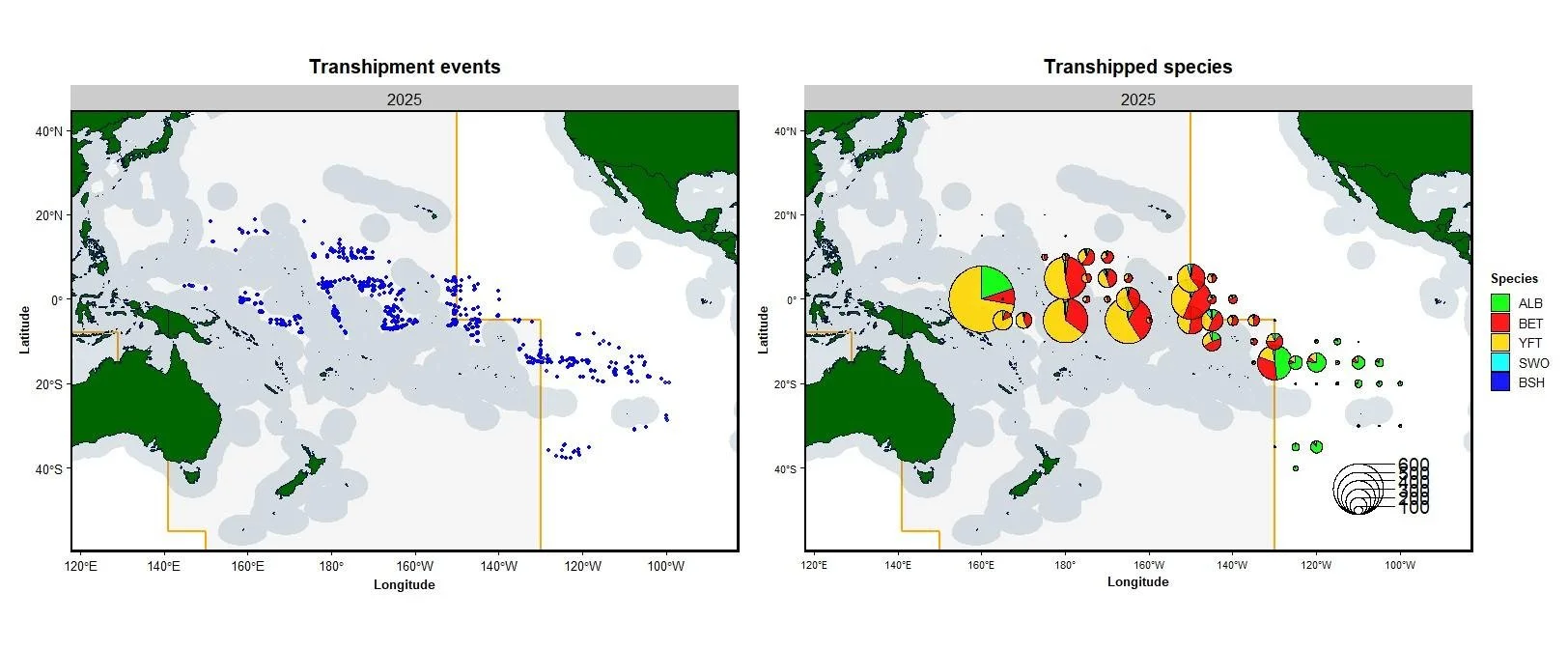
The transhipment events (left) and species transhipped (right) in 2025 within the WCPFC Convention area.
First, the good news: reported high-seas transhipment activity has continued to decline. In 2025, there were 888 events, roughly 60% of the 2019 peak of nearly 1,470. That's a real drop, but it just follows a general drop in LL HS effort, and many LLs are working in the EEZ of some countries that do not allow them to TS in the HS
But also, the WCPFC secretariat has done a lot of quiet, unglamorous work that actually matters: quarterly reconciliation with CCMs instead of relying on the annual crunch, wider use of the TSER e-reporting system, and providing coastal CCMs with routine electronic access to declarations for fish reported as caught in their own waters. That last point is not trivial.
For years, the coastal states in whose EEZs this fish is caught had no visibility of what happened to it once it left for the high seas. Now they do, quarterly. Credit where it's due.
But here's where the frustration comes back in. Look past the declining event count, and the picture is depressingly familiar. In 2025, 56% of the vessels on the Record of Fishing Vessels were authorised to tranship on the high seas; that's over 1,750 vessels holding an authorisation for something that is supposed to be the exception, not the rule.
And of those, only about 28% actually used it. In other words, the authorisation is being handed out far more broadly than the activity justifies, which suggests the "impracticability" test meant to gate this whole thing is not being applied with anything approaching rigour. It's a box to tick, not a hurdle to clear.
And who is doing the transshipping?
The same names as always. The offloading side is dominated by China and Chinese Taipei, with Korea and Vanuatu behind them. The carriers fly to Panama, Korea, Chinese Taipei and China. This is the core group of distant-water fishing nations I've written about repeatedly, and the pattern from the Starboard/MIMRA network analysis holds: vessels mostly tranship within their own flag, carriers cluster by flag, and a small number of carriers move an outsized share of the fish. Nothing structural has shifted.
The volumes remain concentrated in albacore, bigeye and yellowfin — the report estimates that in 2025 something like 25% of the longline albacore catch, 33% of the bigeye, and 37% of the yellowfin from the Convention Area was transshipped on the high seas.
That is not a marginal activity happening at the edges. That is a very large chunk of the region's most valuable catch changing hands out of independent sight.
Which brings me to the part that worries everyone, and it's the part that hasn't improved at all: verification.
The whole point of observer coverage on transhipments is to ensure that an independent observer can confirm what the vessels are self-declaring. And the report is refreshingly blunt about how badly that's going.
Table 7 lays it out: carrier transhipment declarations against observer reports held by SPC, month by month, for 2024 and 2025. The "per cent observed" column consists of single digits and zeros. Whole months in 2025 with zero observer reports against 50, 80, 100+ declared events.
The WCPFC Secretariat is careful to say some reports haven't been entered yet, and that's fair. But even allowing for lag, a significant number of these transhipments simply have no independent observer record available to the Commission. So we are verifying nothing. We are taking the word of the vessels who are doing the activity that it is fine.
And on top of that, the report notes uncomfortable situations in which the same observer covers both the offloading and receiving vessels, or leans heavily on the vessel's own tally of what was moved. That's not independent observation. It's paperwork.
This is exactly why I keep arguing for an independent high-seas transhipment regional observer programme, the way IOTC, ICCAT and IATTC run theirs. Every other tuna RFMO manages some version of independent oversight. We don't.
There's promising work in here too: the Secretariat's proximity-alert tool, the location-discrepancy tool flagging carriers reporting events tens of kilometres, or even 193 km, from their nearest VMS position, and a third tool coming to detect discrepancies between the notifications and declarations for a single event.
These are good, and they're the kind of analytical muscle the region has needed for years. But, and this is the recurring theme, tools flag problems; they don't fix them. Fixing them requires the Commission members to actually make a decision. And that's where we keep failing.
Remember, the Transhipment Intersessional Working Group was disestablished in 2024 because CCMs couldn't agree on the core stuff. The impracticability guidance, the very thing that would give teeth to paragraph 37, is still not done.
High-seas transhipment continues, as the report politely puts it, "based on historical practices," with flag CCMs "noting their consideration of" costs. That is diplomatic language for: the DWFNs claim it's too expensive to come to port, no one makes them prove it, and it carries on.
So here's my message, and it's the same as it's always been…. Take the pressure off, and the curve straightens right back out, because the main DWFNs doing this transshipping have shown no genuine interest in doing the right thing.
They'll report a little better, tranship a little less, hold onto their broad authorisations, and wait for everyone to lose interest.
We can't afford to lose interest. We need to close the impracticability loophole, mandate real observer coverage, and stop pretending self-declaration is verification. Otherwise, we'll be back here next year, admiring another small drop in the numbers, and changing nothing.
The views expressed here are my personal ones.