I started my fishing life in southern Argentina, initially in small trawlers and trap-based fisheries, and then moved up to commercial trawlers and trawl-based research vessels. I know this gear well and, to an extent, marvel at the unique physics involved in the operations. And yes… I’m fully aware, having had frontline experience, of the environmental impacts not only of trawling but of most fishing gear.
Furthermore, I also grew up on a farm. My dad was an agronomist working with Argentina’s National Institute of Agrarian Technology, and I spent my fair share of time ploughing with tractors and managing sheep and cattle herds.
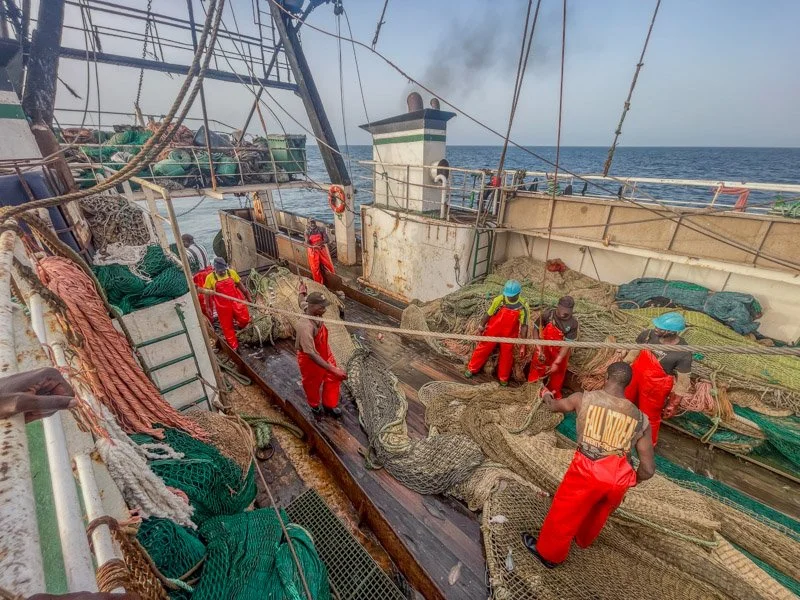
working on a trawler in Guinea Bissau EEZ in 2024
A few weeks ago, I drew on the irate responses from readers in our local weekly newspaper to a letter that appeared the week after the previous edition, which had 3 articles about banning bottom trawling in the Hauraki Gulf and across New Zealand, either through NGOs and the Green Party
My question in the letter concerned consistency: if the justification for banning bottom trawling is its undeniable impact on the seabed ecosystem, then intellectual honesty demands that we apply the same standard to other forms of primary production. Ploughing land for wheat doesn't merely disturb an ecosystem — it eliminates it, replacing a complex native community with a single-species crop and re-tilling it every season. Converting land to a pine plantation removes indigenous vegetation, creating an even-aged exotic monoculture for decades. By most ecological measures — loss of native species, permanence of conversion, soil disturbance, habitat homogenisation — these terrestrial land uses inflict damage that is at least comparable to, and arguably greater and more permanent than, dragging a net across a recoverable muddy seabed (as we have in the Hauraki Gulf).
So a society genuinely willing to ban trawling on impact grounds should, to be consistent, be equally willing to ban wheat farming and plantation forestry. Since virtually no one is, the singling out of trawling looks less like principled environmental policy and more like selective attention — easier to target because the damage is out of sight and the affected industry is small.
Of course, my point wasn’t about banning agriculture, but about highlighting that bans don’t work (look at drugs), that "we can't ban everything" doesn't establish that we should ban nothing, and that the comparison doesn't become a way to excuse all impacts rather than reduce any. Food and fibre from farming are poor substitutes for one another, so trade-offs aren't symmetric. And "you'd have to ban agriculture too" can slide into a tu quoque — pointing at someone else's harm doesn't neutralise your own.
The honest version of the argument isn't "therefore ban nothing" but "therefore judge all primary production on a consistent, evidence-based footing”, and stop treating trawling as uniquely sinful, as a trawled benthos can still support a (modified, depleted) functioning benthic community, whereas a wheat paddock holds almost none of the system it replaced."
Needless to say, my rational argument for what we should be discussing is not blanket prohibitions but rather about where and how much trawling, via spatial closures, as we discuss agriculture and forestry, did not impress the readership… the conversations (allegedly, as I don’t have the most common social media apps) diverted to my past as a commercial fisher (therefore I’m a unredeemable enviromental criminal), that as a scientist I know nothing (and are corrupt), to a mention that, as I worked for the UN FAO, I was involved in the COVID conspiracy…
And then yesterday, a paper landed on my desk (whose author list tells you as much as its abstract) titled "Challenges and Opportunities for Strengthening Bottom-Tow Fisheries Sustainability" that made me feel less lonely in my plight.
Scroll through the byline, and you find over thirty names spanning Alaska to Iceland, Peru to China. It reads like a who's who of those who have spent their careers arguing that fisheries can be managed well rather than merely mourned. That pedigree is worth flagging up front, because it shapes both the strengths of the piece and the questions a fair reader should keep in their back pocket.
The subject is trawls and dredges — gear dragged across or near the seafloor that, between them, lands roughly 24 million tonnes of seafood a year. That is not a niche. It is a globally significant animal-protein system, and the paper's framing is unapologetically food-systems: as the human population heads towards ten billion, abandoning a major protein source simply shifts the ecological burden onto land or other fisheries.
The authors are explicit that many bottom-tow fisheries are already well managed and that over a third of MSC-certified fisheries use these very gears. Their starting position, in other words, is not "ban it" but "fix what's broken and protect what works."
What's broken is laid out with admirable specificity. The group convened a workshop alongside the 2024 World Fisheries Congress and distilled the discussion into 30 sustainability gaps across six challenge areas: seafloor disturbance, bycatch and discards, management design, fishing operations, cross-sector conflicts, and public perception. The honesty here is real. They point out that quantifying benthic disturbance remains difficult, that "unobserved mortality" — animals killed by gear contact but never landed — is a genuine and contested problem, and that seafloor carbon release from trawling is poorly mapped and poorly modelled. These are not the admissions of an industry apologia. They are the live controversies, clearly identified.
The 28 recommendations that follow cluster into four themes: better data capture, better models, stronger policy, and better communication. The top-ranked fixes by breadth — diversify collaboration, strengthen governance, inventory fleets and gear, collect spatially explicit catch and effort data — are sensible and, as is generally the case for strategies that work in reality, unglamorous.
That is rather the point; the paper's through-line is that sustainability is mostly an information problem layered on a governance problem: you cannot manage seabed impact, bycatch, or carbon if you cannot see them, and you cannot see them without funded monitoring, study fleets, and habitat maps that most jurisdictions simply lack.
Where a fair reader should stay alert is in the framing's gravitational pull. This is a group temperamentally inclined toward "manage and innovate" over "restrict and close," and the paper reflects that. Spatial closures are repeatedly cast in terms of their downsides — displacing effort to higher-bycatch grounds, requiring enforcement to mean anything, which is true, but the framing leans more toward the limitations of closures than their successes.
The carbon section is candid about uncertainty, yet other researchers read the same evidence as warranting more precaution, not less.
And recommendation R23 — liberalising the permitting of gear experimentation — is plausible, but "streamline regulation" is the kind of phrase that deserves scrutiny about who benefits. None of this is sleight of hand; the authors are upfront about their food-systems lens. It simply means the document is as strong an expert argument as it is a neutral inventory.
The communication chapter may be the most quietly significant for me after 14 years of doing this blog; the authors note that media coverage of trawling is overwhelmingly negative and that the sector has done a poor job of showing its actual performance — feeding a cycle in which pressure to ban outruns evidence.
They want Life Cycle Assessments and transparent "report-card" metrics to put bottom-trawled fish on the same footing as beef, chicken, or farmed alternatives. That is a fair ask. It is also, conveniently, an argument that tends to favour well-run fisheries, which is exactly the point that most of the authors have pursued throughout their careers.
From my perspective, this is a valuable, rigorous, refreshingly specific synthesis from people who know the gear, the science, and the politics intimately. Read it as the considered case of the management-and-innovation school — persuasive, evidence-rich, and worth weighing against the more “preventative” voices it gently argues with.