I’m starting some work on the nature and structure of fisheries access agreements, and while my angle is from an operational perspective, as a born-again UNCLOS nerd, there is so much more to it than rich country A with lots of boats and no fish paying poor country B (generally with surplus fish and fewer boats) to fish in their waters.
So I guess over the next few months, I’ll be using the excess research I’m doing for that job to blog about a few of the many issues these agreements entail… starting with the legal tensions arising between the regulatory frameworks of the flag state and the coastal state.
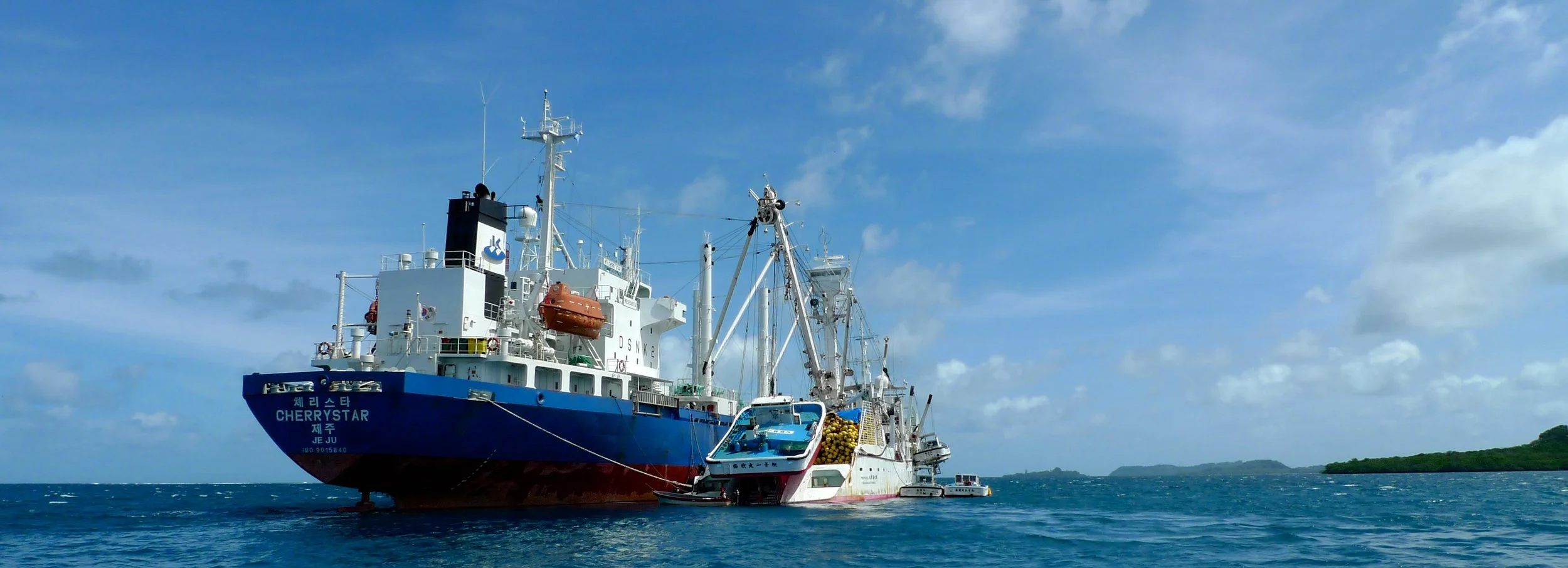
In the past, I wrote about the geopolitics in fisheries, and access agreements are the most basic manifestation of that… and perhaps the most influential (albeit short-lived) and forgotten agreement was the Kiribati - Soviet Union one in 1985 that brought the USA Purse Seiners to accept and respect the Pacific Island Countries’ EEZ. I wrote about it here
But let's get back to the “tension,” of course. I don’t develop much new thinking myself that hasn't been studied and published before by real experts, and some of them are acquaintances, which I'm extremely proud to know: Camille Goodman and Valentin J. Schatz are the first ones to come to mind… so this blog has a lot of bibliography at the end!
Flag and/or Coastal?
The foundational issue is that the EEZ is legally neither territorial sea nor high seas — it is a sui generis zone where two sets of jurisdiction apply simultaneously to the same space. Under UNCLOS, the coastal State has sovereign rights for the purposes of conserving and managing the living resources within its EEZ (Article 56(1)(a)) and is authorised to board, inspect, and arrest vessels engaged in IUU fishing in violation of its laws (Article 73(1)). At the same time, as a general rule, ships on the high seas are subject to the exclusive jurisdiction and authority of the state whose flag they lawfully fly — a principle of exclusivity firmly rooted in the order of freedom of the high seas. When a foreign fishing vessel enters an EEZ under an access agreement, both jurisdictions claim it simultaneously, and UNCLOS does not fully resolve how they interact[1].
The "due regard" asymmetry
The critical mediating concept is Article 58(3), which requires flag states and their vessels to have "due regard" to the rights of the coastal state when operating in its EEZ. The existing discourse on due regard obligations has primarily focused on the conflicting rights or interests between coastal States and flag States in areas within national jurisdiction. Most commentators read this as an asymmetric, subordinating obligation — it falls on the flag state operating in someone else's EEZ, not on the coastal state in its own zone. This gives the coastal state structural legal prevalence, even if the practical picture is messier.[2]
The ITLOS 2015 Advisory Opinion
The most significant recent clarification came from the ITLOS advisory opinion of the Sub-Regional Fisheries Commission. The Tribunal's starting point was the role of the coastal state, which, "in light of its special rights and responsibilities in the EEZ, has the primary responsibility, and even an obligation, to take the necessary measures to prevent, deter and eliminate IUU fishing." With respect to fisheries in the EEZ, Articles 56, 61, 62 and 73 establish the coastal state's primary responsibility, which includes extensive regulatory and enforcement jurisdiction. However, the opinion did not make the coastal-state and flag-state jurisdictions mutually exclusive. Rather, the flag state retains parallel or concurrent jurisdiction over its fishing vessels in the EEZ. [3]
Recognising the sovereign rights of coastal States to manage and conserve fisheries resources in their EEZs, the Tribunal concluded that coastal States have "the primary responsibility for taking the necessary measures to prevent, deter and eliminate IUU fishing." Nonetheless, the Tribunal emphasised that flag States were not relieved of their obligations. The Tribunal acknowledged the obligation under UNCLOS Article 58(3) to give "due regard" to the laws of the coastal State, and under Article 62(4) for nationals of other States to comply with the laws of the coastal State. As such, flag States have the obligation to effectively exercise jurisdiction and control over the vessels they flag when those vessels are in the EEZs of other States..[4]
The practical implication was that, as coastal State regulation and enforcement have, in many cases, proven insufficient, the focus has shifted towards a parallel, complementary responsibility of flag States.[5]
How the literature assesses prevalence
The scholarly consensus is that coastal state rights are legally primary within the EEZ, but that primacy is qualified in three important respects:
First, 40 years after the adoption of the Convention, there remains considerable uncertainty about the nature and extent of these sovereign rights — particularly how far coastal States can go in imposing conditions on access and in exercising enforcement. Goodman's influential work (OUP, 2021) argues that coastal State jurisdiction over living resources in the EEZ is flexible but functional — consisting of broad discretion, exercisable within functional limits determined by reasonableness and by reference to the balance of rights and interests in the EEZ. Crucially, she also identifies a clear trend: coastal States adopt approaches that "thicken" their jurisdiction within the EEZ, "project" their jurisdiction beyond the EEZ, expand the effect of their jurisdiction through cooperation, and enhance the application of their jurisdiction through technology. [6]
Second, international courts and tribunals are likely to adopt a more generous approach to assessing the reasonableness of the coastal State's prescriptive exercises of jurisdiction, and a narrower, more textual approach to assessing the reasonableness of enforcement jurisdiction. Thus, coastal States have wide latitude to legislate access conditions, but less latitude to enforce them extraterritorially.[7]
Third, there is a live political dispute — most visible at WCPFC — over how this legal primacy translates into allocation. Coastal states have advocated that "all historical catches taken within an area under the national jurisdiction of a CPC shall be attributed solely to the CPC with jurisdiction over that area, regardless of the flag of the vessels that took such catches." In contrast, the EU and some distant-water fishing nations have proposed that historical catch from an EEZ should be attributed to the vessel's flag, even if a foreign vessel within an EEZ took it. This is a direct collision between the legal logic of coastal state sovereign rights and the political-economic interests of distant-water fishing nations, and it remains unresolved. [8]
A note on the critics
Not everyone views the current settlement as satisfactory for coastal states. Generally, the ITLOS advisory opinion places emphasis on the responsibilities of flag States and eludes the question of the primary responsibility of coastal States for the management and conservation of resources. This criticism from the Coalition for Fair Fisheries Arrangements reflects a broader concern among developing coastal states that the "primary responsibility" language cuts both ways — conferring rights but also imposing obligations on states with limited enforcement capacity, while distant-water fishing nations retain practical leverage through access negotiations and economic dependence. [9]
In short, the legal literature broadly concludes that coastal state rights are structurally and judicially prior within the EEZ, but that this primacy is (a) constrained by a reasonableness standard on enforcement, (b) supplemented rather than replaced by flag state concurrent obligations, and (c) contested in practice through the political economy of access negotiations where distant water fishing nations retain significant leverage regardless of the formal legal position.
Bibliography
[1] Deirdre M. Warner-Kramer & Krista Canty, Stateless Fishing Vessels: The Current International Regime And A New Approach, 5 Ocean & COASTAL L.J. (2000). Available at: https://digitalcommons.mainelaw.maine.edu/oclj/vol5/iss2/3
[2] Kim, So & Moh, Youngdawng. (2025). Due Regard Obligations in Areas beyond National Jurisdiction. International and Comparative Law Quarterly. 74. 235-254.
[3] Valentin Schatz (2016) Fishing for Interpretation: The ITLOS Advisory Opinion on Flag State Responsibility for Illegal Fishing in the EEZ, Ocean Development & International Law, 47:4, 327-345, DOI: 10.1080/00908320.2016.1229939
[4] Ford, J. H., Wold, C., Currie, D. & Wilcox, C. (2022). Incentivising change to beneficial ownership and open registers—Holding flag states responsible for their fleets and costs of illegal fishing. Fish and Fisheries, 23, 1240–1248. https://doi.org/10.1111/faf.12677
[5] Valentin J. Schatz (2017), The contribution of fisheries access agreements to flag State responsibility, Marine Policy, Volume 84, , Pages 313-319, ISSN 0308-597X, https://doi.org/10.1016/j.marpol.2017.06.022
[6] Camille Goodman (2021). Coastal State Jurisdiction over Living Resources in the Exclusive Economic Zone (Oxford, Oxford University Press) 2021, ISBN: 97801928g6841,
[7] Goodman, C. (2018). Rights, Obligations, Prohibitions: A Practical Guide to Understanding Judicial Decisions on Coastal State Jurisdiction over Living Resources in the Exclusive Economic Zone. The International Journal of Marine and Coastal Law, 33(3), 558-584. https://doi.org/10.1163/15718085-12323082
[8] Andriamahefazafy, M., Haas, B., Campling, L. et al. (2024). Advancing tuna catch allocation negotiations: an analysis of sovereign rights and fisheries access arrangements. npj Ocean Sustain 3, 16. https://doi.org/10.1038/s44183-024-00055-9
[9] Anaïd Panossian, 2015 Rights and responsibilities of flag states and coastal states in West Africa - CFFA comments on ITLOS Advisory opinion about SRFC request. https://www.cffacape.org/publications-blog/2015/06/09/2015-6-9-rights-and-responsibilities-of-flag-states-and-coastal-states-in-west-africa-cffa-comments-on-itlos-advisory-opinion-about-srfc-request