A PhD thesis from 2019 rarely makes it to the top of my ever-growing everyday work reading pile, but it does when pretending to be an academic researcher on UNCLOS (after my conversion at the Rhodes Academy), one of my pet topics: transhipments in the High Seas by Longliners in the WCPFC.
That is why Arron Honniball's PhD thesis on extraterritorial port-state measures deserves not only my attention, but that of anyone who thinks seriously about how we govern fishing on the high seas.
What he maps out — methodically, legally, sometimes painfully — is the architecture of something practitioners like me navigate daily: the uncomfortable gap between what a port state wants to do and what international law allows it to do.
Yet it is not a straight line, as Arron's thesis doesn't focus specifically on high-seas transhipment. I therefore used the extraterritorial PS Jurisdiction framework he builds as the lens through which to examine why transhipment is so legally awkward: carrier vessels arriving at port with catch that changed hands in international waters, outside the reach of any port-state inspection that occurred at source.
The distinction he draws between enforcement jurisdiction (what happens at the port, which is territorial) and prescriptive jurisdiction (the rule being applied, which may target extraterritorial conduct) is the heart of it.
That's what makes denying landing to a reefer carrying transhipped fish legally defensible in some cases but exposed in others.
Let me explain why his work matters overall, but for my interest…. especially for high-seas transhipment.
The basic idea of port state measures (PSMs) is elegant in its simplicity: a vessel has to come to port eventually, and when it does, you have leverage. Deny it entry, deny it landing rights, deny it fuel and ice and the ability to offload its catch — and suddenly the economics of IUU fishing become far less attractive. The Port State Measures Agreement (PSMA), which entered into force in 2016, formalised this leverage into binding international law. So far, so good.
But here is where it gets complicated, and where Arron’s analysis cuts to the bone.
The moment a port state tries to go further than reacting to what happened in its own waters — the moment it tries to use port access as a lever to regulate what a vessel did on the high seas, or in another state's EEZ, or in a fishery it has no direct relationship with — it steps into deeply contested jurisdictional territory. This is what Arron calls "extraterritorial" port state jurisdiction (PSJ): the use of port access conditions to influence conduct that happened elsewhere.
And this is precisely the terrain on which high seas transhipment lives.
The transfer of catch from a fishing vessel to a carrier or reefer vessel on the high seas is one of the original sins of fisheries monitoring. It is the moment when the chain of custody breaks, when IUU catch can launder itself in the legitimate supply chain, when the accountability that port state inspections are supposed to provide simply... evaporates.
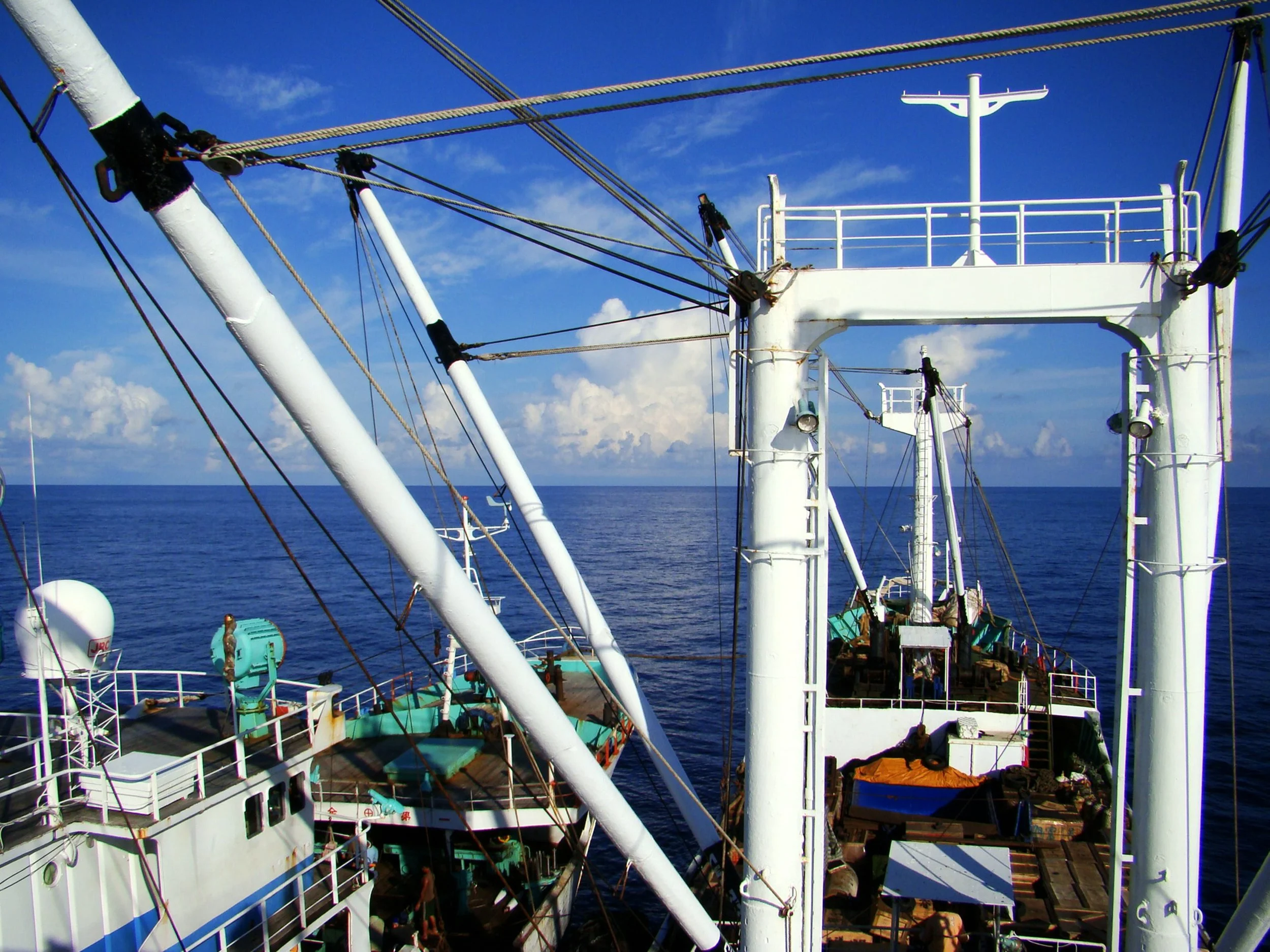
A tuna longliner offloads to a carrier in a High Seas Pocket. That carrier then steams to a port — maybe in one state, maybe another — and presents documentation for fish that no inspector or intelligence analysis has laid eyes on since it was caught. The fishing vessel itself may never enter a port where a PSM-capable authority is waiting for it.
The transhipment problem is not new… anyone working in Pacific tuna knows it. The WCPFC has wrestled with it for years around the “impracticability exemption” but what Arron's work forces us to confront is the legal fragility of the tools we're using — or trying to use — to fix it.
When a port state refuses to allow port use to a carrier vessel (maybe change crew or to land fish that were transhipped at sea from a vessel suspected of IUU activity), it is doing something legally remarkable: it is effectively regulating conduct that took place outside its territory, by a vessel it may have no flag or nationality connection to, in waters governed by flag state exclusivity under UNCLOS. The freedom of fishing on the high seas is not a platitude — it is a foundational norm, and states that breach it face real legal exposure.
Arron walks through this carefully. The basis for extraterritorial PSMs lies in a mix of treaty obligations (UNFSA's Article 23, PSMA provisions, RFMO CMMs) and the more contested terrain of customary international law. The key insight is that a port state denying landing or transhipment is exercising enforcement jurisdiction within its own territory—at the wharf side or in the lagoon—even if the prescriptive basis for that denial (the rule being enforced) targets extraterritorial conduct. The distinction matters legally, even if it looks academic from the operational perspective.
What this means in practice is that the legal ground under PSMs applied to high seas transhipment is real but limited. A port state can deny the landing of fish that were transhipped from a vessel suspected of IUU fishing or a vessel on the vessel of interest list (VoI). It can refuse port services to a carrier whose documentation doesn't meet the CMMs of the relevant RFMO. It can require prior notification and inspection.
What it cannot do — or at least cannot do without legal risk — is unilaterally legislate behaviour on the high seas and enforce that legislation through port access conditions that go beyond what existing treaty frameworks authorise, hence the importance of having information and compliance-sharing agreements, but also reaching out to port states to be part of RFMOs, even if as cooperation non-members.
The Chilean – EU (2000-10) swordfish dispute is the canonical cautionary tale here. Chile sought to use port access conditions to enforce its national licensing requirements for high-seas swordfish fishing. The EU pushed back hard, arguing that this violated the freedom of fishing and constituted an extraterritorial overreach. The case was eventually settled, but the legal ambiguity it exposed never really went away. Port states with strong domestic fisheries interests, good inspection infrastructure, and political will to act — and there are not many of them — have to calibrate carefully.
So, where does this leave the transhipment problem?
Honestly? In a difficult place. The PSMA's provisions around transhipment — requiring parties to inspect vessels seeking to use designated ports for transhipment — are a real step forward. Several RFMOs have moved toward requiring transhipment in port or at designated anchorages rather than on the high seas. These are the right moves. But enforcement remains patchy, the carrier vessel fleet is heavily concentrated under flags of convenience (or open registries to use the polite terminology), and the high seas remain — as they always have — a jurisdiction of last resort where the flag state's exclusive authority is both foundational and yet frequently useless as a compliance tool.
What Arron's work does, at its best, is provide practitioners and policymakers with a map of what can legally be demanded of vessels entering port and where those boundaries lie.
For those of us working on transhipment reform — trying to make the data systems work, trying to get independent observer coverage on carriers, trying to conduct intelligence analysis prior to notification requirements, and actually inspect what comes off carrier vessels — this is not abstract jurisprudence. It is the scaffolding on which operational tools are built.
The future of PSMs as applied to high seas transhipment almost certainly runs through two things: greater multilateralism (so that unilateral measures reflect shared treaty obligations rather than individual state preferences) and better information systems (so that port state inspectors can actually interrogate the catch history of fishing vessels that pass their fish to a carrier vessel before it offloads).
The legal framework, as Aron demonstrates, can accommodate robust action. Whether the political will and the technical capacity exist to use it — that remains the harder question, and one that no PhD thesis can answer for us.
This blog draws on Arron N. Honniball, Extraterritorial Port State Measures: The Basis and Limits of Unilateral Port State Jurisdiction to Combat Illegal, Unreported and Unregulated Fishing (Utrecht University, 2019).