Back in my days when I was fishing, the key input cost was crew, 30 to 40%, and I like to think that at that time, we considered it an investment (as opposite of a cost), as we relied substantially less on technology to find and catch tuna; you needed people that knew their jobs… and they expected to be paid for the money they were making for the vessels owner.
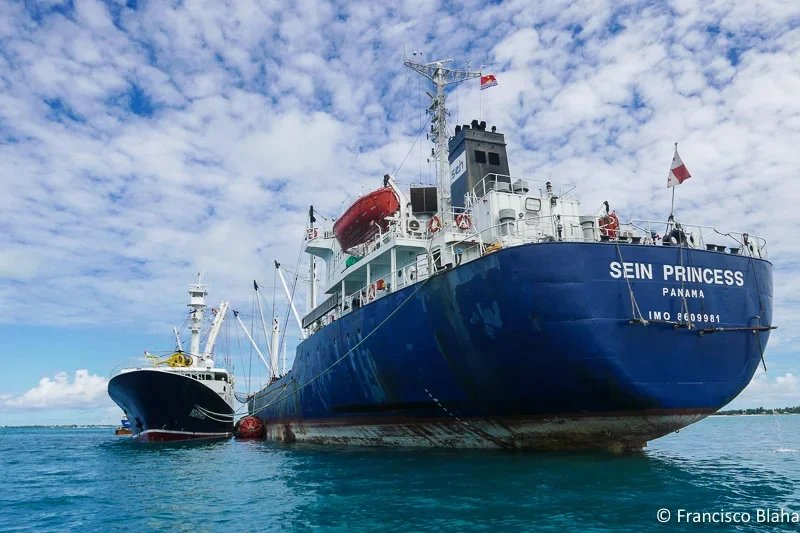
not really fuel bunkering in this case… but you get the idea.
For today’s DWF fleets, fuel accounts for up to half of operational costs until a few weeks ago… it would be more now. Change bunker fuel prices, and you do not merely influence fishing vessels' profitability—you alter dynamics and behaviour.
Vessels will need to fish differently, travel differently, and sometimes not fish at all. In effect, fuel prices become an unacknowledged, market-driven control mechanism, one that operates entirely outside the carefully negotiated commercial frameworks between buyers, traders, and canners and even more so, outside the regional fisheries management measures.
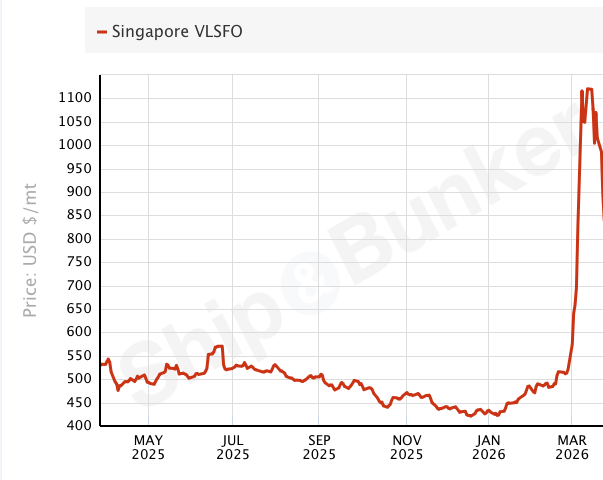
And it is bad... In early 2026, very low sulphur fuel oil (VLSFO) prices in Singapore—arguably the benchmark for the WCPO—rose above $500/mt, with some grades increasing even further, reflecting tightening supply and geopolitical disruptions. More dramatically, spot prices in Asia have reportedly surged to over $1,000/mt during recent market shocks, effectively doubling in some cases in a matter of weeks. This level of volatility is not just noise: it fundamentally alters the economics of fishing operations, especially for fuel-intensive fleets like longliners.
The VDS is the central column of the PS activity in the WCPO and is built on the premise that fishing effort can be quantified, allocated, and traded. But it also relies—quietly—on the expectation that there will be consistent demand for those fishing days. When fuel prices rise sharply, demand generally softens, as consumer price elasticity for canned tuna (a commodity) is very limited. As such, fleets become more selective about how many days they purchase and more aggressive in negotiating their prices.
It also involves distribution. Not all waters are equally productive at different times of the year, and as fuel costs rise, vessels will increasingly concentrate on areas with higher catch rates. Some countries may see their waters fished more intensively, while others—less fortunate in oceanographic terms—find it harder to sell their own allocated days. The scheme remains in place but strained.
At the WCPFC level, the effects are no less complex. Higher fuel costs incentivise efficiency, but not necessarily the kind of efficiency that aligns with ecological objectives. FADs will become even more attractive because they reduce search time and, therefore, fuel consumption. Fishing patterns compress spatially, concentrating effort in predictable, fuel-efficient zones. What emerges is not less fishing, but different fishing—driven by economics rather than management intent.
Free school fish (FAD-free) is, in principle, more sustainable and allegedly commands a higher premium price, yet the gap between that premium and the cost of fishing driven by oil prices diminishes, and people may drop the practice altogether. It would be interesting if the war continues and oil prices get even higher; if we are going to see any PS out during FAD closure.
There is, of course, a more optimistic reading. If fuel costs rise sufficiently, overall fishing effort may decline, at least temporarily. But to rely on fuel prices as a management tool would be a unique abdication of responsibility. The benefits, if they materialise, are likely to be incidental and short-lived.
More concerning, perhaps, is what happens at the margins. As profitability tightens, the incentive to cut corners grows. Compliance becomes more burdensome, not less, and the risk of illegal and unreported fishing increases correspondingly. At the same time, distant water fleets—facing higher costs—may push harder in negotiations, seeking lower access fees or more flexible conditions, and usually cut costs on crew conditions, welfare and vessel maintenance.
And yet, within this disruption lies an opportunity—if one is willing to see it. The energy crisis exposes something that has long been implicit: that fisheries management does not exist in isolation from broader economic systems. Fuel prices, like fuel subsidies or market demand, shape behaviour just as surely as catch limits or effort controls. The difference is that, unlike those other variables, fuel has remained largely invisible in policy design.
Bringing this into view would not be straightforward. It would, at the very least, require recognising that economic indicators—fuel costs and profitability thresholds—belong alongside biological reference points in management discussions. It might even involve confronting the uncomfortable question of fuel subsidies, which continue to distort the true cost of fishing.
Under climate change scenarios, fuel price are no longer a background condition. It is a defining variable. And until it is treated as such, the risk is that the carefully constructed systems of tuna governance—so effective under one set of assumptions—become increasingly brittle under another.
For shore activities: reduced PS fishing impacts, transhipment, port services, and processing sectors.
Now, the LL sector in the WCPO is likely to feel the energy shock more acutely than the PS fleet… LL depends on distance, dispersion, and time. The gear uses far more fuel per kg of fish on board than any other gear, and while it targets higher-value species for higher-value markets, it often operates with thinner operational margins.
When fuel prices rise, this model faces immediate pressure because you must also account for the cost of keeping fish frozen. For temperatures from -30 to -60°C for the sashimi market, it also includes the cost of shipping the fish to those markets and the fact that sashimi fish is almost a luxury item, with fine dinning among the first to be affected during any economic crisis.
At the same time, compliance costs become more burdensome, increasing the constant risk of IUU fishing encroaching at the margins. In a sector already affected by declining catch rates and market fluctuations, the energy crisis not only raises costs but also threatens the viability of the longline model as it currently exists in the WCPO.
And, of course, the most affected are Pacific Island-based industries; for LL, they mainly target the fresh fish market, which is accessed by airfreight, usually with spare cargo capacity on commercial airlines that primarily serve the tourism sector. Their operating costs are directly linked to jet fuel prices, and during crises or when ticket prices rise, demand diminishes as people avoid flying for holidays… a death spiral follows.
Shore processing is very expensive in the Pacific Islands due to economies of scale; electricity costs are high, reflecting that they power production to the levels needed by industry (you aren't going to run cookers, retorts and cool stores off solar panels for now) is based on fuel, and if they want enough to affect their competitiveness, you have the massive increases in the cost of transport… as container ships also run on fuel.
So yeah… if over the next month we don’t return to “normal”, I fear that we will exceed the price elasticity limit, and things will start to shut down… And then they take much longer to start running again.
And if tuna income does not flow into the islands, which are already at the back end of value chains and, because of their economies of scale, they have no capacity to outbid better bidders if fuels become scarce… I really worry about what will happen.
Hope peace prevails again, and the people in charge get their shit together and do the right thing for everyone, not just them.