I read with interest a recent Ocena report, Behind the Fleet: Mapping the Global Network of Service Providers Keeping Distant-Water Fishing Afloat, based on the interesting take they had… For years, the focus has been squarely on vessels—their flags, movements, and compliance or lack thereof.
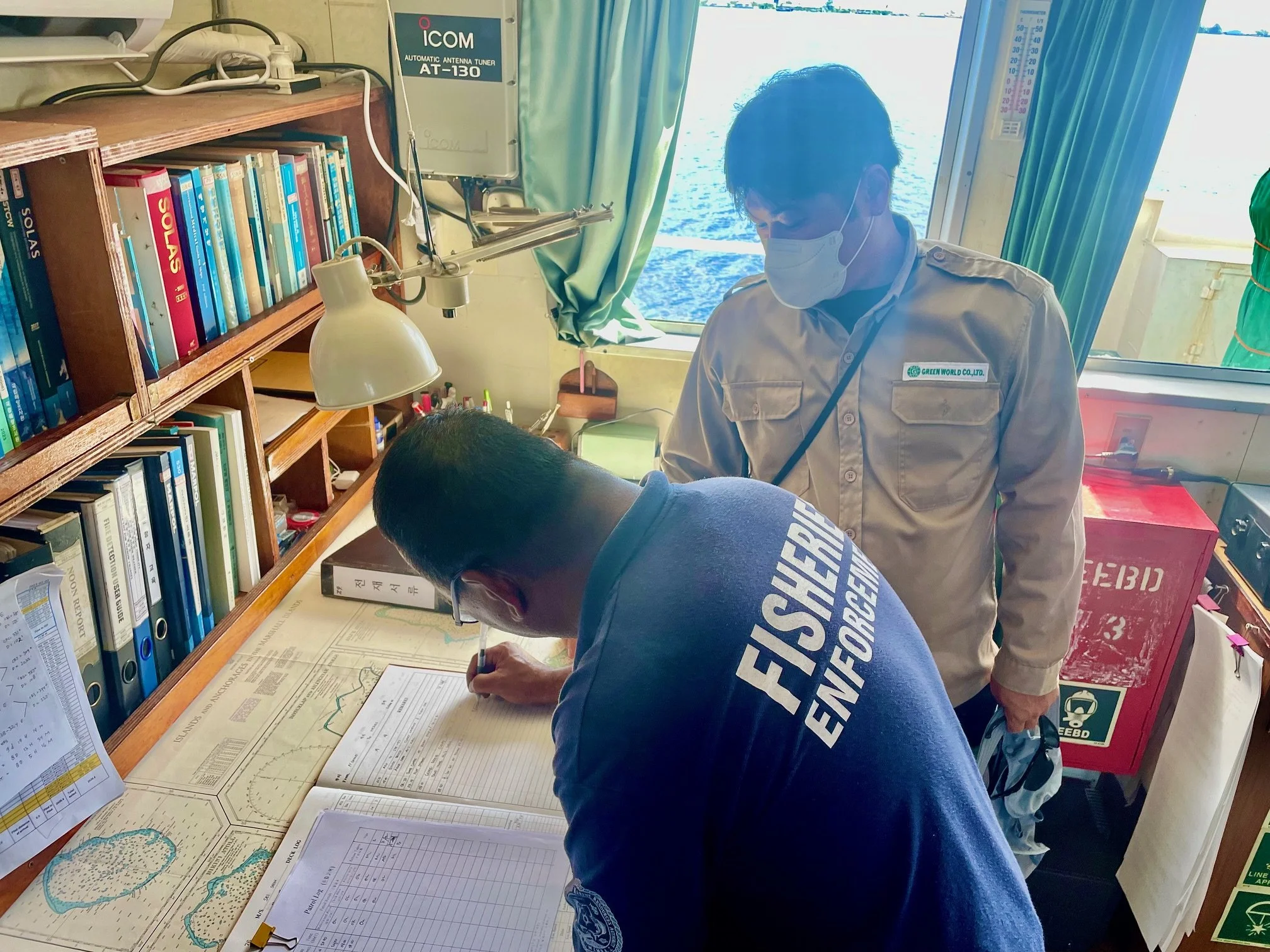
Yet his reports on the network of service providers that support them are a web of ports, insurers, crewing agencies, fuel suppliers, and ports… and, as someone who works a lot in ports here in the Pacific, I thought it might miss a bit of context, so I will try to provide it in this blog.
Of course, I’m no one compared with the academic credentials of the authors… so my take may not be worth the few minutes it will take to read it, but yeah, here it is in any case.
The report is detailed and technically sound. It clearly maps the infrastructure that sustains distant-water fishing (DWF). Yet as one reads through its pages, a pattern emerges: the system is described primarily through its vulnerabilities.
Service providers are framed as leverage points because they are points of failure—places where oversight can break down, where illicit activity can hide, where governance struggles to keep pace with mobility and scale.
What is largely absent from the narrative, particularly when it comes to ports, is the idea that this system persists not simply because of gaps, but because of relationships that work.
There is, in practice, a form of mutualism between DWFN and the ports and services of developing coastal states—a relationship that is neither accidental nor entirely exploitative, but structurally embedded in the region’s fisheries economy.
The report tells us that ports are “gateways for global catch,” essential for resupply, repairs, crew changes, and landings. It correctly explains that without access to ports, most distant-water fleets could not remain at sea for extended periods.
But if you look at this from the port perspective, a different picture is also valid.
Many port states (which are also coastal states) - particularly in the WCPO - are not just gateways for fish, they are engines of the local economies, places where global fisheries intersect with national development in very tangible ways.
Jobs are created not in reports but in supermarkets, vessel services, and workshops; revenue flows not only through licensing agreements but also through MCS activities, provisioning, maintenance, and logistics. Many “port economies” are key to the countries through vessel arrivals and departures.
This is where the report's narrative feels incomplete to me. It recognises that DWF depend on ports, but it does not fully explore the reciprocal truth: that many ports, particularly in developing countries, have a symbiotic relationship with those DWF fleets.
That dependence is not necessarily a weakness. It is, in most cases, a deliberate positioning; most port states I work with have positioned themselves precisely to attract DWFN they have long-standing relationships with, recognising that geography, proximity to productive fishing grounds, and a safe anchorage can translate into economic opportunity.
Others have leveraged foreign investment, sometimes controversially, to modernise facilities and increase capacity. But this is often framed through the lens of risk rather than strategy.
Yet from the perspective of those states, the calculation is often pragmatic. DWFN bring activity, and activity brings revenue. The challenge is not whether to engage, but how.
This is where the idea of mutualism becomes important, as DWFN require access to places to transship, land and maintain vessels close to the fishing grounds; ports provide that access and, in return, capture a share of the economic value generated by those operations.
Yes, it is not always a fair exchange and is certainly not problem-free, but it is a relationship of interdependence rather than a simple one-sided exploitation.
Seen in this light, ports are not merely control points within a governance system. They are interfaces—places where economic and regulatory logics converge.
They offer services, but they also offer something less tangible yet more powerful: jurisdiction. They are among the few places where DWFN can be physically inspected, documents can be checked, and rules can be enforced with immediacy.
The report acknowledges this by highlighting the shift towards port-based control. But it stops short of fully embracing the implication: that oversight itself becomes part of the services ports provide to the regions they serve.
In practice, this is already happening. All ports in the FFA membership use the FFA PSM Frameworks, while many are also implementing the FAO PSMA, effectively using access as leverage to improve compliance.
This is not a story of passive vulnerability. It is a story of evolving agency.
Emphasising uneven implementation, weak coordination, and governance gaps risks flattening that complexity. It is perhaps easier to see developing-state ports as potential weak links in a global chain than as active participants shaping it; oversight does not fail; it adapts and sometimes strengthens under real-world constraints.
None of this is to dismiss the risks the report identifies. They are real, and in many cases, serious. IUU fishing likes to operate in ambiguity; labour abuses persist where oversight is fragmented; transhipment and bunkering can obscure accountability. The service provider lens helps illuminate these issues in ways that vessel-centric approaches often cannot.
But governance built solely on identifying risk will always be partial. To be effective, it must also engage with the incentives that sustain the system.
Distant-water fishing continues not because it escapes governance, but because it is economically rational within the current structure of global fisheries. Service providers—ports above all—are embedded in that rationality. They do not simply enable fishing; they derive value from enabling it. Any attempt to strengthen oversight must therefore work with that reality, not against it.
This is where the report’s insights could go further. If service providers are indeed leverage points, then the question is not only how to restrict services to non-compliant actors, but how to align the provision of services with compliance itself. How to make it economically advantageous for ports to demand transparency. How to ensure that offering oversight is not a burden, but a competitive strength.
There is, however, another layer that sits beneath both the economics and the governance—and it is one that the report touches only indirectly: geopolitics.
Distant-water fishing nations are not present on the high seas and in coastal regions solely because of fish. They are present because presence itself carries weight. In international practice, and often in unspoken doctrine, “if you have presence, you have rights”—whether formal, informal, or anticipatory.
Distant-water fleets are also instruments of statecraft. Port calls, infrastructure investments, long-term access agreements, and even routine vessel visibility all contribute to placing a nation within a generally uneven geopolitical space… where else can small island countries flex influence over giant world powers?
Tuna fisheries, in this sense, are not only about extraction; they are about positioning and diplomacy (as I wrote here)
This has an important implication. If service providers are leverage points, then constraining or tightening those services will certainly affect how DWF fleets operate. But it is naive to assume that doing so will make those fleets simply disappear.
When strategic, economic, or geopolitical interests are at stake, DWF's efforts do not vanish—they adapt.
The DWF system is not only resilient because of market incentives; it is resilient because it is underpinned by state interests. Removing or tightening enablers may raise costs or change behaviours, but it will not, on its own, unwind the deeper drivers of distant-water fishing presence.
Recognising this does not weaken the case for engaging service providers. It strengthens it. Because it suggests that governance must operate not only at the level of compliance tools, but at the level of strategic alignment—acknowledging that coastal states, port authorities, and DWFNs are all operating within a shared, and sometimes competing, geopolitical space.
In that sense, the most powerful idea in the report is also the least fully developed: that many of these service providers are geographically fixed, operating under national jurisdictions that differ from the flag states of the vessels at sea. Ports are not just a governance opportunity; they are an economic anchor that ties DWFN to concrete places—places with their own priorities, constraints, and ambitions. Ports are the places where DWFN become visible, tangible, regulated and economically meaningful.