As I mentioned last week, I have been in Tahiti at the International Workshop on Mitigation of FAD Loss and Abandonment in the Pacific Ocean. It has been a great and impactful experience. Since participating in the climate change in fisheries workshops in 2024, I haven’t been challenged by facts as I was in this workshop.
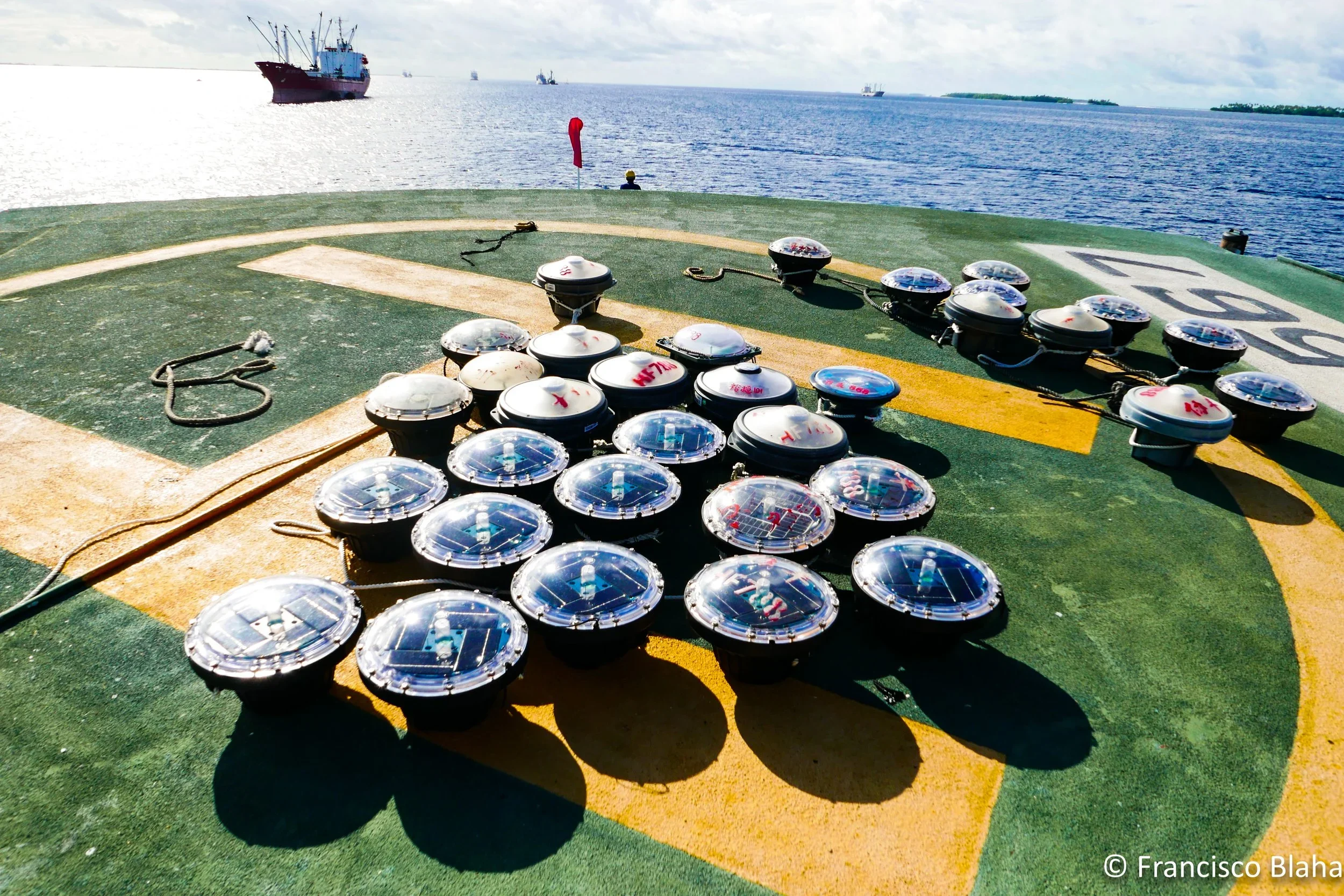
While I’m pleased to see our fishery remains stable and sustainable in terms of stocks, our challenges with IUU fishing being well controlled and among the lowest globally, and with labour issues being addressed progressively, I once again have the feeling of observing a slow-motion train crash.
This is a programme that affects all of us here and many more who are not here. They say there is no free lunch… and it is true… this is the bill for the massive increase in efficiency that FADs brought to the PS fishery.
Beyond their obvious role in modern tuna fisheries, dFADs have a range of unintended environmental and socio-economic consequences that extend well beyond the moment of deployment.
In the WCPO, we estimate there are between 40,000 and 60,000 of these objects drifting east to west along the equator — and yes, we don’t really know the exact number, which is the first part of the problem — and while most are concentrated within 10 degrees of it, we find them all the way down to 25 to 30 degrees south and north.
The enormous year-to-year fluctuations in dFAD numbers mean that even relatively low loss rates result in a significant buildup of floating gear that drifts out of fishing zones and eventually washes up on shores or coral reefs.
When a dFAD makes landfall or tumbles onto a reef, it does more than simply litter the landscape: it can transform into a source of chronic habitat degradation. Still, most of the tails are built with synthetic netting and salt bags designed to extend deep into the water column; when they strand in shallow coastal waters or reef flats, that netting continues to destroy coral and entangle marine life long after the fisheries vessel that deployed the device has left the area.
These additional impacts on nearshore habitats are already compounded by multiple stressors from climate change and local resource use.
Coastal communities in the Pacific bear the brunt of these impacts in tangible ways. Stranded dFADs wash up on beaches, in lagoons, and among coral bommies, where they must be physically removed to protect subsistence fishing grounds, tourism assets, and aesthetic values.
We were presented with numerous examples of their destructive potential: images of dFAD long tails along the reef, with the raft and buoy washed up on the beach, broken buoys with batteries leaking, and so on.
Local authorities and voluntary groups in the islands have limited resources to collect and dispose of these objects; on some islands, ongoing citizen science and reporting initiatives are the only means of documenting and addressing the issue.
The examples we discussed highlight that the “externalities” of industrial tuna fishing extend beyond the offshore environment and also affect the ways of life and economies of island nations.
A dFAD deployed months earlier to improve fishing efficiency often becomes marine debris with ecological consequences. And while we have made advances in design (e.g., biodegradable materials) and in regional cooperation in reporting, retrieval, and accountability… We are still far from meaningfully tackling this problem.
The root cause is that dFADS are now ubiquitous, and intense competition among the three main manufacturers of sonar buoys (Marine Instruments, Zunibal, and Satlink) has made them inexpensive and very effective.
A rough calculation suggests that, if you make the dFAD body from biodegradable materials (best-case scenario) and add a latest-generation sonar buoy, set it up, let it drift, and after a couple of weeks, you catch 3 to 4 tonnes of skipjack (which is a VERY small set), you’ll pay for the whole dFAD. Anything above it is earnings… so the incentive of recovering it, if it drifts beyond a certain distance from the vessel, is gone. Since the cost of fuel and the loss of fishing time are much higher than the cost of the dFAD (particularly once it has been fished, it is not cost-effective to recover it and is easy to let it sink or abandon.
To complicate things, as dropping and recovering FADs is defined as fishing, if they drift into an area where you have no licences (or vessel days), then you are acting “illegally” even if you are trying to do the right thing… thankfully, this could be the easiest issue to fix.
However, once you delve into the legal language, dFADs are difficult to define and may be regarded as MARPOL violations, hazards to navigation, or fishing gear. One of the interesting exercises we undertook was to define 'lost', 'abandoned', and 'discarded' because intentionality is a key issue that is difficult to establish.
But for me, beyond the definitions and legal arguments, the reality is that the life cycle of dFADs is not a “new problem”; it is a waste issue.
My personal view is that we are treating it as a “waste management” issue, centred on disposal and limited recycling, which happens at the end of the problem and shifts the burden onto those who did not cause it… and this is simply not right.
So we need to see it from the perspective of “reverse logistics” that differs from traditional waste management in that it adds a “value” to recovering and repurposing products and routes while respecting the internationally recognised UNCLOS principle that the country to which a fishing vessel belongs is responsible for all the actions of the vessel, including the waste produced by that vessel.
I think we should consider a targeted “waste-bond” system that combines a deposit on new dFAD with a recoverable payment for verified retrievals, creating a market signal that turns abandoned gear into an asset rather than waste.
There are already international experiences in developing a waste bond system payable at the time of permitting activities. In the case of fisheries, this includes licensing, registering FADs, and related activities.
This ‘dFAD bond’ should involve fishing vessels for dFAD bodies and sonar buoy producers for their units, as they are directly involved in the issue.
Sure, it would be great to have the canners and traders involved… yet there is very little leverage to get them in… and in principle, cost can be added to the price sold to them as one option, or they can choose to buy dFAD-free (non-associated) fish in the same way that vessels can choose to do that as well.
Of course, this will increase fish prices, as a premium would need to be involved, yet I know premiums are volatile… Currently, most canned tuna buyers prefer MSC-certified tuna over FAD-free tuna. However, some traders encounter specific customers who request FAD-free options. In such cases, a premium is usually paid to the fishing vessel for implementing onboard catch separation. The FAD-free premium typically ranges from USD 50-100 per tonne.
However, as I will discuss later … MSC may also have a role, their Principle 2 – Ecosystems considerations, which dFADs are very much part of it, they could have the requirement to be part of the dFAD waste bond fund (after all, until a decade ago, dFAD fish wasn’t certifiable) is not something they couldn’t do again if they want to
Yet these days, MSC premiums are negligible because they have lobbied distributors and retailers in rich countries to make it a standard market requirement, and almost all purse seiners in the WCPO are covered under an MSC certification. If an MSC premium is being offered, it would be around USD 20-50.
(My views on the neocolonial nature of private certification are more than well documented… rich countries’ consumers should not trust the sustainability claims of Pacific Islands governments or their bodies, so certification bodies from rich countries need to provide that certification)
But as I said before, the price for dFADs is now borne by the environment and the communities in the Pacific islands… which are the ones that are less involved in PS fishing.
While I’m aware this is a theoretical exercise for now, and we need to test legal, logistical, and financial mechanisms for
incentivising responsible design and deployment,
enabling community-based collection and reimbursement, and
establishing an accountable chain of custody for reused or recycled materials…
I’m old enough to remember when PNA’s VDS was also an “idea”… and look at it now
Based on the vessels' operational and size characteristics, a reasonable estimate of loss expectancy can be used to calculate the required dFAD bond. Many factors must be considered when setting the bond amount, including practical, economic, and political considerations.
The FAD bond would be held in escrow, possibly using a standard commercial mechanism, and renewed annually for each licence period or as needed. Vessels that repeatedly fail to manage their FAD may lose their bond, and that money could be allocated to a different FAD recovery programme.
The initial numbers in SPC’s analysis talked of around 1000 to 2000 USD per recovery, with the variability based on the different types of systems and scenarios
So, we could imagine a system where we have a deposit + recovery payment (waste-bond)
Deposit: Per-dFAD fee applied at point of registration (collected in equal parts from buoy/fleet owners, vessel operators and manufacturers) and the bond is held in a managed pilot fund.
Recovery payment: Verified retrievals (stranded or drifting but recovered) are eligible for a payment drawn from the fund. Payment should exceed local collection costs to ensure participation (e.g., cover transport + a margin). The payment scale could be tiered: higher payments for reef/nearshore retrievals (harder and greater ecological benefit), lower payments for open-water recovery.
Bond mechanics: If an owner demonstrates recovery (proof of retrieval), part or all of their deposit is returned; if the dFAD is not recovered within a defined period, or if the dFAD is abandoned, the deposit funds are allocated to support local recovery/processing and community incentives.
Then a Verification and chain of custody
ID & registration: All participating dFAD buoys must carry unique, tamper-resistant IDs and be registered in a central registry.
Proof of retrieval: EM or Photographic evidence (geotagged), GPS buoy transfer logs, observer records, handing in to authorised collection points, or verified collection by trained community teams.
Processing points: Designated collection hubs receive material, separate buoy electronics (for reuse), and route netting/components to designated recycling or repurposing partners.
So the reverse-logistics flow could be:
Deployment → buoy registered → deposit paid.
If lost/stranded, the community or the retrieval team collects it and transports it to the collection hub.
Hub verifies, logs, and issues a recovery payment to the collector, and, if appropriate, returns a deposit (or a partial refund) to the registered owner.
Reusable components repurposed or sent to a recycler; non-reusable waste to be transported back to the flag state to be disposed of per environmental standards.
And fundamentally, we need to agree on Governance, roles and responsibilities, so here are some ideas
Regional coordination: WCPFC/SPC or a regional body to provide a regulatory framework, technical guidance, harmonise reporting, and provide legal templates.
National governments: Host pilots, manage local permits, approve collection hubs, administer funds or appoint fund manager.
Industry partners (fishing companies, buoy manufacturers): Participate in deposit payment, register buoys, and engage in co-funding and design improvements.
Local communities/NGOs: Collection teams, verification, awareness campaigns, and hub operations.
Ecolabels: having as part of their standards (for example, in MSC Principle 2 – Ecosystems considerations) the requirement to be part of the dFAD fund. (after all, until a decade ago, dFAD fish wasn’t certifiable) so is not something new they could do.
Third-party administrator/trustee: Financial management of deposits, payments, and audit functions (could be a regional organisation, financial advisor or trust).
Donors/development partners: Seed funding for deposits, capacity building, and initial hub setup.
As if all the above were not complicated enough. This all has to fit under a Legal & policy framework that incorporates
Compatibility with national laws: Ensure deposit collection and fund use align with customs, tax and fisheries regulations.
Ownership & liability: Clarify ownership of recovered gear and liabilities.
Incentives versus perverse outcomes: Avoid incentives that encourage deliberate recoveries to claim payments (strong verification is required).
Data/privacy: Buoy registration and tracking data protocols must maintain the present confidentiality and proprietary tracking arrangements.
Yet, given that the key buoy manufacturers are all Spain-based, they may need to comply with the EU’s Waste from Electrical and Electronic Equipment (WEEE) regulations and other Extended Producer Responsibility (EPR) laws that hold producers financially or physically responsible for the entire lifecycle of their products, particularly those that require separate collection and recycling targets, and mobilising reverse logistics across entire product categories.
Compliance with these principles could also be required, as market conditions are today, in the same way that catch and health certificates are today (see my publication for FFA on this). Particularly, the Directive (EU) 2024/1760 of the European Parliament and of the Council of 13 June 2024 on corporate sustainability due diligence (CSDDD) is worth mentioning here, as this legislation will be implemented gradually over the next few years, imposing mandatory human rights and environmental due diligence requirements on large EU and non-EU corporations operating in the EU.
These companies must take steps to manage actual and potential adverse impacts of their activities on human rights and environmental matters arising from :
their own operations,
the operations of their subsidiaries, and
the operations of their business partners in their chain of activities.
The "chain of activities" does not encompass the disposal of products or the activities of a company's downstream business partners related to the company's services. However, it does cover:
The activities of the company's upstream business partners related to the production of goods or the provision of services by the company (including the design, extraction, sourcing, manufacture, transport, storage, and supply of raw materials, products, or product components, and the development of products or services).
The activities of a company's downstream business partners related to the distribution, transport, and storage of the product, in which the partners perform those activities for the company or on its behalf.
The primary due diligence obligations under the CSDDD are "obligations of means", not "obligations of result".
Companies are not expected to guarantee that adverse impacts will not occur, nor will they always be prevented. However, they are expected to take "appropriate measures": measures capable of achieving due diligence objectives.
Finally, I’m the 1st one that is VERY aware that this is all easier said than done and will require coordination, time, effort and money, but we have precedents in solid waste (MARPOL) and the Basel Convention on the Transboundary Movement of Hazardous Wastes, so we don’t need to reinvent the wheel. Yet we need to find a solution for these problems, if we wish to maintain any legitimacy as a responsible industry
Additionally, we could also consider this from an insurance perspective and the obligations under UNCLOS…. But I’ll leave these for another day.