There is a quiet pride in reading a report that lists your name in the acknowledgements. You recognise the arguments, the framing, even some of the technical suggestions. Yet when you read the final published report, what emerges is less a story of progress than one of persistence—of problems that have been known for years and worked on, described in a much better, more sophisticated language than my own, yet still largely unresolved in the WCPO.
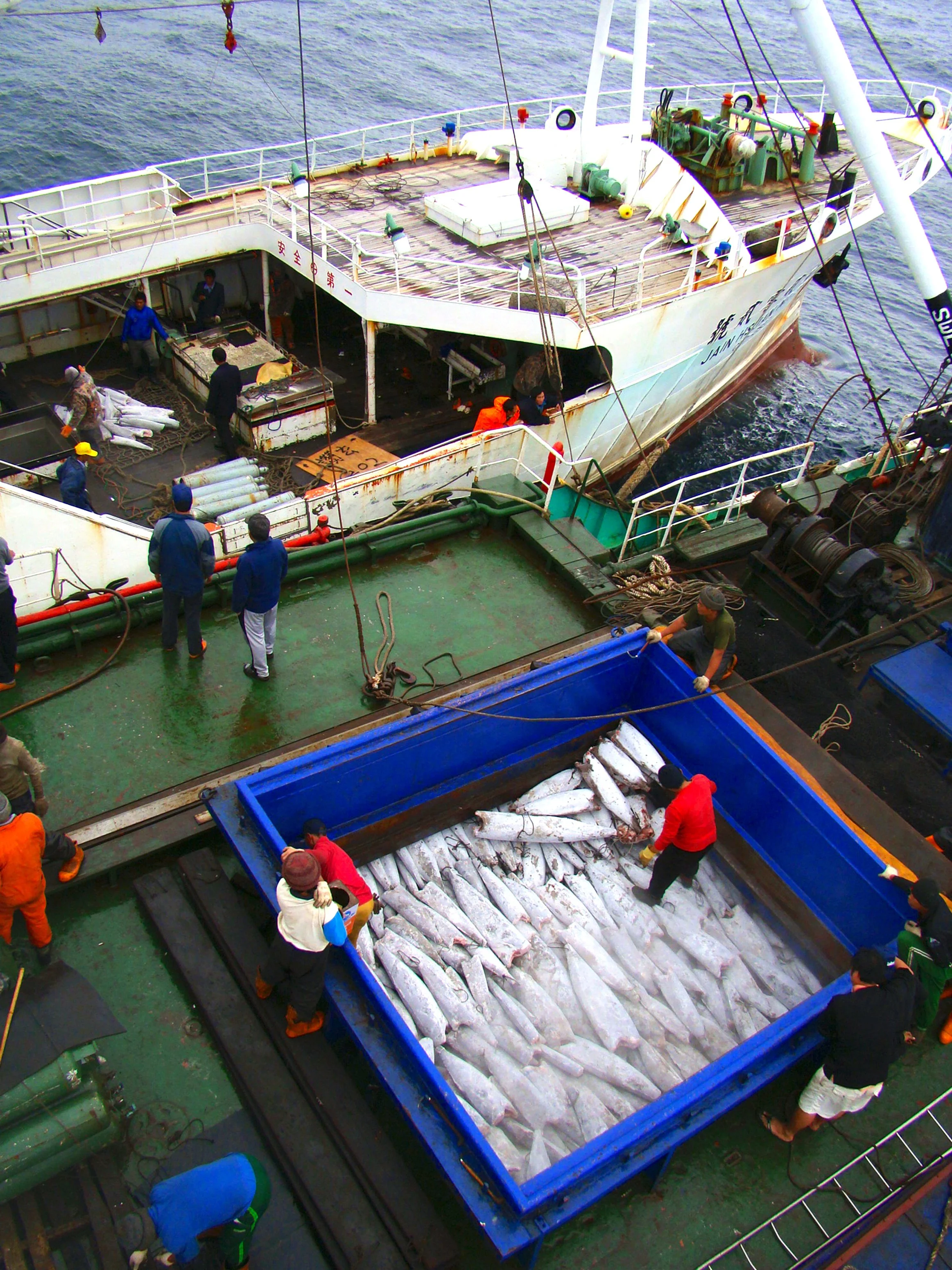
ilustrative image only
This ISSF report I’m talking about is the result of the excellent work of Kerrie Robertson & Holly Koehler, and benchmarks the different tuna Regional Fisheries Management Organisations (RFMOs) against the FAO’s 2022 Voluntary Guidelines on transhipment , in which I worked a few years ago.
It is a thorough piece of work; it compares five RFMOs, assesses their performance against dozens of criteria, and reaches a conclusion that is both unsurprising and troubling: none of their regulatory frameworks around high seas transhipments is fully aligned with the guidelines.
That, in itself, is not the most concerning aspect. Voluntary guidelines are, after all, voluntary. They are also relatively “new”, and the RFMO CMM making and review process is notoriously slow.
The more telling story for me lies in how the gaps are distributed—and nowhere are they deeper or more consequential than in the Western and Central Pacific Fisheries Commission, wich is worth remebering does in pronciple prohibits teanshipmenbts at sea!
As someone who has been working on High-Seas (HS) transhipment reform efforts within the WCPFC. Through research, analysis, extensions and writing quite a lot about the problems we have (in particular the abuse of the impracticability exception), I knew we didn’t align…. But had a limited idea of how bad we were in comparison with the other tRFMOs
The WCPFC manages the world’s largest tuna fishery. It sits at the centre of global tuna supply chains, where volumes are high, distances vast, and oversight inherently difficult. If there is one place where HS transhipment controls need to be robust, coherent, and enforceable, this is it. And yet, what the report reveals is a system that is structurally incomplete.
On the surface, the WCPFC system based on CMM 2009-06 appears functional. It has authorisation frameworks, reporting requirements, vessel lists, and, increasingly, access to data. In fact, the report identifies transparency and data sharing as one of its strongest areas.
But transparency is not the same as control. It never has been.
The system is better at documenting what has already occurred than at preventing what should not occur in the first place. HS transhipment events are largely validated after the fact, through declarations and reports that arrive days or even weeks later. Observer reports may take months. By the time the information reaches those who might act on it, the fish has already moved through the supply chain, blended into the system, and lost its traceability.
And those of us working on the reform know it is not a technical limitation, but rather an incomplete design choice by those fishing nations that do not want changes to occur, albeit agreeing to stronger measures in the other tRFMOs
The FAO Guidelines place considerable emphasis on risk-based approaches, pre-event verification, and real-time monitoring… which are not abstract concepts but rather elements in the basic architecture of any HS transhipment control system that aims to manage risk rather than simply record it. Yet this is precisely where the WCPFC system shows its greatest weakness.
Verification and risk management remain underdeveloped. There is no systematic process for assessing risk before HS transhipment. There is no consistent mechanism to cross-check what is declared at sea with what is eventually landed. In effect, there is no reliable way to ensure that what is reported corresponds to reality. Instead, the system relies on a combination of declarations, partial observer coverage, and delayed reporting. It functions, but it does not provide control.
Perhaps the most striking gap is the lack of an independent regional observer programme (RoP) for transhipment. Among all tuna RFMOs, WCPFC is the only one without a specifically designed ROP to cover HS transhipments, which is cost-recovered from participants…I wrote extensively about it here.
Observers are present, but the lack of flag-state independence raises questions about consistency, credibility, and, ultimately, the potential for enforcement. In a context where the observer is often the only direct witness to a covered HS transhipment, this matters more than the programme's formal presence. Independence is not a procedural detail; it is the difference between observation and potential verification.
Without independence, data is fragile… and fragile data, even when abundant, fails to support effective monitoring.
The report notes that the data collected—through declarations, observer reports, and logbooks—often lacks the quality and structure needed for meaningful analysis. Key fields are missing, formats are inconsistent, and reporting timelines do not align with operational realities. Information is available, but not necessarily usable.
There is a tendency in fisheries governance to equate more data with better management. I like that this report’s comparative findings could suggest otherwise: data, without timeliness, standardisation, or verification, is not a solution… at best, it offers only a partial description of the problem.
HS transhipment, by its nature, sits at the weakest point of the fisheries MCS world. It occurs far from shore, across jurisdictions, and often involves vessels that can operate in more than one RFMO area and that receive fish from a handful of DWFN-flagged vessels. And if weaknesses in one RFMO are not contained, they propagate across the system, as the same carriers can operate under different regulatory regimes, each with its own gaps and inconsistencies. In this context, the absence of harmonised standards, shared data systems, and coordinated enforcement creates opportunities—not for compliance, but for avoidance.
Reading through the report’s recommendations, one is struck by their familiarity. Improve pre-event notifications. Standardise data fields. Shorten reporting timelines. Introduce independent observer programmes. Strengthen cross-referencing of data. These are not new ideas. They have been discussed, proposed, and, in some cases, partially implemented for many years.
That brings me to the uncomfortable part of the analysis.
The gaps identified are not primarily technical. They are not the result of insufficient knowledge or a lack of available tools. They persist because of the way decisions are made, priorities are set, and trade-offs are accepted.
In that sense, the system is not failing in the conventional sense. It is functioning within the limits that have been collectively agreed—or at least collectively tolerated.
My modest contributions to the report sit within that reality… they do not, in themselves, change the underlying condition.
I’m absolutely guilty of believing that better analysis leads to better outcomes… Sometimes it does… but more often, it simply leads to better descriptions of the same outcomes.
This report is a excellent piece of work. It is careful, balanced, and evidence-based. It acknowledges progress where it exists and identifies gaps where they remain. It does very well what it sets out to do.
What it also does, for me, is to highlight the distance between knowing and doing.
My personal take is that the WCPFC HS transhipment system does not lack information, frameworks, or recommendations… what it lacks is the collective willingness to create a system that consistently prioritises control over convenience, and prevention over description.
As usual, on one side are Pacific islands and a few DWFN allies, and on the other, the DWFN that benefit from the status quo
Until that balance shifts, HS transhipment in the WCPC will remain as it has long been: a space where the system works just well enough to function, but not well enough to fully control what matters most.