I always get a reassuring feeling about initiatives like the Ethical Tuna Collaboration (ETC). They signal intent and create a sense of responsibility.
They bring companies, NGOs, and well-meaning actors, many of whom I have known for years and respect, together through the Conservation Alliance for Seafood Solutions, an organisation I served on its board, into a shared space where problems are acknowledged, and solutions are discussed.
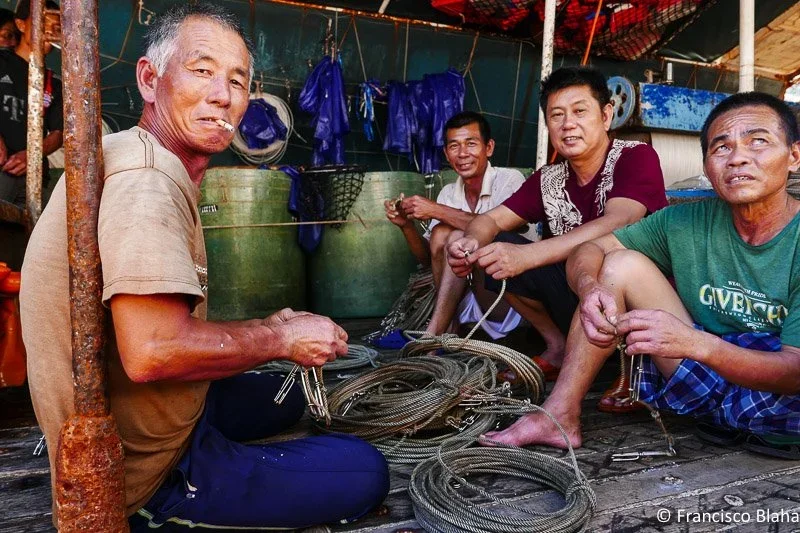
My years as a migrant fisherman, albeit a couple of decades ago, my work in fisheries compliance today, and my present research on the labour rights of fishers make me painfully aware that abuses in fisheries are real, persistent, and, thankfully, increasingly visible.
And yet, surely because I come from a compliance angle. I always feel a bit anguished about these initiatives. Not because they are wrong—but because I feel they are incomplete in ways that, in my (surely wrong) opinion, are fundamental.
In response to pressure from consumers and retailers, the private sector and the NGO Ecosystem have stepped in, developing voluntary frameworks, standards, private certifications, and collaborations to improve working conditions at sea. These initiatives foster progress through transparency, dialogue, and incremental improvement.
But they also share a defining characteristic: they largely operate outside the structures of state authority. Governments are the very entities responsible for regulating vessels, enforcing labour standards, and ensuring compliance, yet they are absent or peripheral in these initiatives, surely because they are coming from a different angle, one that is built on goodwill, market incentives, and reputational risk, and not from hard enforcement.
To me, the issues these initiatives aim to address are not aspirational. They are not “nice-to-have” conditions that distinguish responsible operators from less responsible ones. They are, in fact, basic legal obligations.
For example, timely payment of wages in accordance with contract terms is not an ethical aspiration—it is a minimum standard, and anyone employed by an organisation could take their employer to court for failing to meet it.
The prohibition on fisher-paid recruitment fees is not a corporate commitment—it is a well-established safeguard against debt bondage… which is illegal under international labour law (ILO Convention) since 1930, recognised as a form of slavery since 1956, and reinforced repeatedly since then (last time in the 2014 Protocol to the Forced Labour Convention), which has already 62 signatories (albeit none of the Asian DWFN).
Access to contracts and documentation, freedom of movement, are not innovations—they are embedded in international instruments and most national legislations when you bring foreign workers to work in a country.
If these basics are not met, the question is not whether a company should participate in a voluntary initiative, but for me is far more fundamental:
How is that vessel allowed to go fishing and to sell the catch in the first place?
This is where the distinction between outcomes and causes becomes critical for me.
If I were contracted by a company in Vanuatu to work anywhere in the country, I’d be required, in addition to completing a lot of paperwork, to pay $1,670 USD to obtain the right to work legally there and to receive protections equivalent to those of a Vanuatuan citizen in the workplace.
Similarly, for China, your cost will be around $800, with all costs accounted for, and again, have protections like those for nationals working with you.
So it angers me that we take it for granted that people in fishing boats should not have those rights, and that this should not be challenged as the basis for buying fish!
For example, the only reason I’m in NZ is that Sanford, the fishing company I was working for, provided me with a work visa, which is required to work on a NZ-flagged vessel, whether in the EEZ or the high seas. This then allowed me to apply based on my qualifications, work experience and employment to gain residency and citizenship.
So it is possible and can be done… yes, it is expensive, but the cost of not doing it is paid in abuses and forced labour for those less fortunate
Voluntary initiatives may improve outcomes at the margins. They can raise awareness, harmonise expectations, and create incentives for companies to improve. However, for me, they do not address the root causes of labour abuse in fisheries, which stem from structural governance failures.
As the literature increasingly points out, the proliferation of voluntary social responsibility tools in the seafood industry reflects not just innovation but also displacement. Rather than strengthening state regulation, responsibility is diffused across a growing ecosystem of standards, certifications, and collaborations.
The result is what some have described as a “hydra” of initiatives—each well-intentioned and addressing part of the problem, yet collectively failing to transform the conditions that enable abuse in the first place.
At the heart of this problem is a simple asymmetry. Fishing vessels operate under flag states. These states have clear obligations: to regulate working conditions, to enforce labour standards, and to ensure compliance before and during fishing operations. When these obligations are weakly implemented—or not implemented at all—space opens for exploitation.
Voluntary initiatives, as well-intended as they are, do not close that space… they operate within it.
They rely on audits, reporting, and certification processes that, across sectors, have repeatedly proved effective at detecting or preventing labour abuses for a few committed players, but not for the sector as a whole, where the rest lack meaningful worker participation, robust grievance mechanisms, or enforceable remedies.
And crucially, they do not alter the underlying incentives.
A flag state that allows a vessel to reduce costs by underpaying crew, charging recruitment fees, or extending working hours beyond legal limits can still compete—sometimes more effectively—than one that fully complies with labour standards. In such a context, voluntary compliance becomes a competitive disadvantage unless universally enforced.
This is why framing basic labour rights as elements of “ethical” trade is problematic for me. It subtly reframes obligations as choices.
It suggests to me that paying wages on time or eliminating recruitment fees are markers of leadership rather than mere legal requirements. It shifts the conversation from enforcement to excellence by a few…
If the baseline is not clearly defined and enforced by states, then the best outcome—no matter how well articulated by voluntary initiatives—remains “optional”
Close your market, don’t buy fish from vessels flagged to countries that treat foreign workers on fishing boats differently from workers on their territory in terms of immigration and labour rights, and things would change. Require states to accede to the basic ILO conventions as a condition of doing business, and so on….
Yes, this will have implications and costs, yes, it would alter standards, business practices, and so on… but we’ve been here before… no one today would argue not to have official health certification for traded seafood products, the EU has a list of authorised countries and approved vessels and establishments in each country/flag state that is allowed to export. Both the USA and the EU require different forms of non-IUU catch certification (albeit fundamentally different and arguably incomplete). I was working with industry and regulators when these obligations came, and they were argued as “impossible”, and here we still are.
Now, let me be clear: all this rant is not to dismiss the value of collaborations, not at all. There is space for industry-and NGO-led initiatives to complement regulation, pilot new approaches, and accelerate improvements where governments are slow to act.
The experience from other sectors is instructive. Decades of voluntary social governance tools in industries such as garments and agriculture have shown that, while they can improve transparency and mitigate reputational risk, they rarely deliver sustained improvements in working conditions without strong public regulation and worker-driven mechanisms.
Fisheries are unlikely to differ, and in fact, they may be more challenging. The remoteness of operations, the transnational nature of supply chains, and the vulnerability of migrant crews all amplify the risks and complicate oversight.
In such a context, reliance on voluntary mechanisms alone is not just insufficient—it may be counterproductive if it diverts attention from the need for binding enforcement.
I have no issues with voluntary commitments, as long as an equal level of effort is put on governance, compliance, enforcement and government-driven initiatives, such as market access
This should be enforced by flag states before vessels depart; if not, by market states through import controls and due diligence requirements
Which brings me back to first principles. Labour rights at sea are not a matter of corporate ethics. They are a matter of equal human rights, including those of the citizens of the flag state and of immigrants working in their territory and on their vessels, regardless of where they fish.
If a vessel is operating with unpaid wages, debt-bonded crew, or confiscated documents, the failure is not primarily a matter of corporate responsibility. It is a failure of governance.
Voluntary initiatives help illuminate that failure. They can even, at times, mitigate its consequences. But they cannot resolve it.
To ensure that fishermen are treated fairly, it is necessary to fill in the many legal loopholes, ensure that flag nations comply with regulations, strengthen international collaboration, and close markets to those that don’t provide official guarantees.
The protection of fishers' rights and the improvement of working conditions are both dependent on networked multilateralism. Approaches that stem from the bottom up, such as those that involve unions and fishermen, are also fundamental.
The fishers I have worked with for over 40 years are some of the most resourceful, resilient, generous, and positive people I've met… chances are that they wouldn’t be alive otherwise. We owe them the same right we enjoy at land.