The idea of electrifying a hook is almost poetic. Not in a dramatic or cinema-like way, but in a quiet, almost bureaucratic manner. A small piece of zinc, pressed against graphite and clipped just above the bait, generated a weak electric field in the water. Not visible. Not outrageous or costly. And yet, it could change some things.
This paper, "Efficacy of a novel galvanic shark deterrent to reduce catch of elasmobranchs in longline fisheries," looks like a technical addition to the growing list of tools that help reduce bycatch. Another study, another gadget, and another percentage drop.
But if you read it carefully, it turns into something else… a story about incentives, selectivity, and maybe even how we keep looking for technological fixes for problems that are really structural at their core.
Let's start with what works, and there is a lot that does.
The concept is quite straightforward: sharks can detect electricity, which most bony fish cannot. The ampullae of Lorenzini help them locate tiny electric fields, so instead of altering the bait, hooks, or depth, which might affect the target species, the idea is to leverage a biological difference.
Create an electrical field and let the sharks get annoyed… and hopefully the annoyance is stronger than the willingness to prey.
The concept of electropositive deterrents isn't new; they have been tested previously. The innovation here is the material — graphite and zinc. Cheap, easy to source, and already recognised by fishers as sacrificial anodes. No rare metals, no magnets that get stuck in gear, no complicated electronics. Just chemistry doing its thing in salt water.
And the results, at least in part, are very interesting. It works very well… when it does.
The figures from the Florida demersal trials are hard to overlook; compared to controls, shark catch rates decreased by 62% to nearly 70%.
That is not insignificant. That is not a gradual process. If such a reduction were implemented widely, it would significantly alter a fishery's bycatch profile.
Most importantly, the deterrent did not reduce the target catch, which is almost provocative. In a few tests conducted in the open ocean, treated hooks caught more target teleosts, such as tuna and swordfish.
That's the holy grail of bycatch reduction: get rid of the unwanted without affecting the wanted.
For once, the trade-off seems to get easier, but nothing in fisheries is ever that easy.
And this is where the paper gets more interesting. In Massachusetts, the deterrent did not deter spiny dogfish, no matter what. Why?
The authors put forward a few ideas:
Sensitivity that is specific to a species (some sharks have fewer electroreceptors)
Behaviour when there is competition (when food is scarce, punishment is less important)
Effects of density (too many sharks, not enough time to choose)
Which is very logical and sensible, but together they point to something more important: there is never a one-size-fits-all answer; always, one answer depends on something else. So yeah, it works, but only in certain ecological contexts, with specific species, and under particular behavioural conditions.
This is, of course, how fisheries work.
Then there is the question that always comes up with promising trials: Is it possible to use this?
It appears that the deterrent effect only functions at close range; the electric field diminishes rapidly—possibly within half a metre—and is not very strong with sharks, which are not generally patient predators. I smell/taste first, then decide whether to bite… they generally go for it.
Hence, the deterrent needs to be in each hook, not one for a basket or a set… One for each hook…. And that in today’s pelagic longlining practices… is a LOT of hooks… let’s say above 3000 per set!
And each of them will need checking, replacing the zinc if needed, and time to do it… all by hand, and considering that we are inferring these days that most longliners are working above 18 hrs… either they put more crew on, or they ask the crew to work more hours… And we know they'll choose the 2nd option!
And this is where many good and promising ideas quietly fail. It's not that they don't work; it's that they don't fit well into the way fishing works.
And then the key question is: what is the big problem we are trying to solve?
Of course, it is presented as a conservation tool, on the one hand, because it reduces shark bycatch, supports sustainability, and addresses declining populations.
On the other hand, it is clearly stated that it will help reduce fishing costs: less gear damage (assuming metal tracers are not used), less time spent handling… But it is not that the crew get paid by the work effort they do… They are on board and work as commanded… not by the hour.
Today's longline is a numbers game. I have written about it in the past, in 1993/4 when I was fishing these waters, it was the heyday of LL in the WCPO, peaking at 5000 vessels. Today, as you can see here, only 1/3 of that fleet (1600) remains, yet they are soaking almost twice as many hooks. How can that be possible? Deck and gear setting technology is almost the same… response: overworking the crew, duplicating the workload, and obviously having as many hooks in the water as humanly possible (literally).
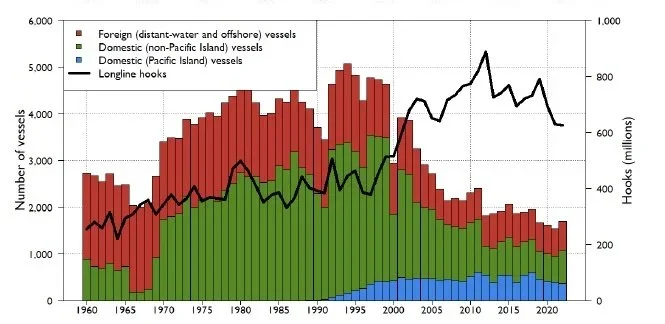
The more hooks are available for the species you want to catch, the more you will catch… thanks to the mess that the squid fishery in the SE Atlantic is…. Squid (the main bait is cheap chips)
This is where things get interesting: generally, conservation won't be the main reason people adopt bycatch minimisation strategies (e.g., for sharks or seabirds).
It will be efficient, which is at once the issue and the answer… efficiency is what caused the bycatch problem in the first place.
Longline fisheries are already highly efficient. They have been refined over decades to maximise fish catch, minimise costs, and operate on a large scale across vast ocean areas... and have been pushing the economic limit for some time now... personally, I believe subsidies and geopolitics are what are keeping the current figures in place.
If we develop technology that promises to make longline more selective, that's really good, but it is not neutral.
Because efficiency doesn't happen on its own. It works with effort, incentives, and market demand. If you catch fewer sharks per hook, one of two things happens:
The same amount of work has fewer negative effects (the best-case scenario)
Or effort and catch increase as the fishery becomes more efficient, as crew costs are fix (the less discussed scenario)
The paper, as one would expect, does not go there.
In any case, this study doesn't just give you a tool; it also shows you where to go.
It says that:
A better understanding of biology can help with selectivity.
Simple, cheap solutions might work better than complicated ones.
Behavioural ecology can be used in real-life fisheries.
And maybe most importantly:
Regulation doesn't need to be the only solution to address bycatch issues. Some solutions can arise from incentives that work together. If vessels can catch more tuna and fewer sharks at lower cost, adoption makes sense and isn't burdensome.
As in other aspects of fisheries, the problem is not with technology; it's with the system.
Every year, unless they are specifically targeted, sharks are accidentally caught… a shark caught on a hook means one less tuna on board, and if we didn’t have a grey zone due to regional demand and the fact that crew is now a commodity on board for almost 24 hours, the solution would lie in the benefits of selectivity… but we are not there yet… no matter how smart a piece of zinc and graphite is, that doesn't change.
Yet it can reduce harm at the edges, and sometimes that's all it takes to make a difference... In my experience, apart from a few exceptions, that's how fisheries change: not through big moves, but by making small, beneficial adjustments that accumulate over time and transform the system from the inside out.