I have insisted for the last couple of decades that the biggest shift I’ve seen in my 40 years of fishing is that it used to be about catching fish to be eaten by people… while now a whole parallel dynamic is at play: geopolitics.
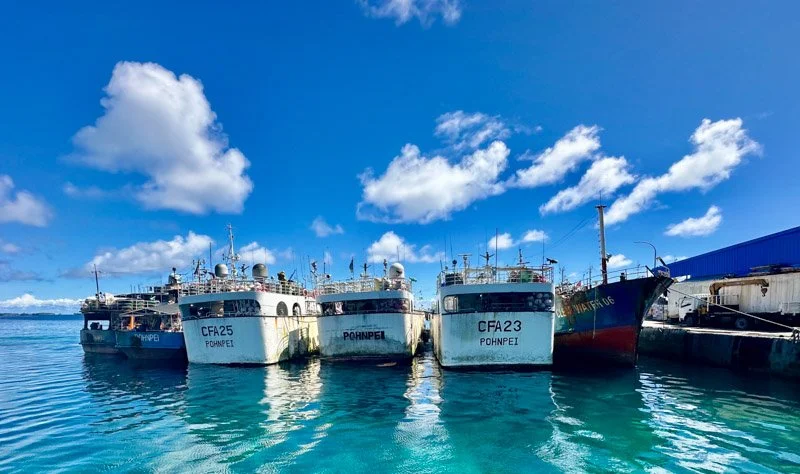
The main issue I have with Distant Water Fishing Nations (and their subsidies) is that they blur the boundary between commercial activity and geopolitics…. and generally the consequences are paid by others.
The principle that “presence equals rights” is fundamental to how nations establish, maintain, and defend their interests in disputed areas. It embodies the idea that ongoing activity in a specific region grants a state or other actor "rights" in that territory or activity, often overriding legal claims or international standards.
Therefore, fishing is no longer solely about catching fish.
Here is an example from FFA’s excellent “Trade and Industry News,” which is worth subscribing to, and, in addition, it relates to a country very close to my work (and heart), the Marshall Islands.
In late October 2025, the USA suddenly reclassified tuna caught in the Marshall Islands EEZ and exported to the US as Chinese origin. The practical effect is severe: a sudden 45–55% import tariff on tuna, which had long been considered a Marshallese product.
What makes this move especially upsetting is that it directly undermines established fisheries governance, since, for over a decade, the WCPFC has been clear in terms of the reporting of those catches:
In the Conservation and Management Measure for Bigeye, Yellowfin, and Skipjack Tuna (CMM 2023-01, para. 8), it is stated that, ‘...attribution of catch and effort shall be to the flag state, except that catches and effort of vessels notified as chartered under CMM 2021-04 or its replacement shall be attributed to the chartering member….’,
The new US position simply disregards that consensus—at least for trade purposes—raising uncomfortable questions about how fisheries management, trade policy, and geopolitics are now conflicting.
The government of the Marshall Islands has strongly pushed back. Its Foreign Minister formally lodged an objection to US Customs, reportedly without response, while MIMRA publicly recognised the serious economic risks to jobs, revenue, and domestic industry. The impact is real.
The issue directly affects Marshall Islands Fishing Venture (MIFV), a long-established Majuro-based operation that anchors a regional longline supply chain exporting high-value bigeye and yellowfin to the US and Japan.
At the time of writing, the issue remains unresolved. However, what is clear is that this involves far more than tariffs. It reveals how fragile small island economies can be when dominant trading partners unilaterally alter the rules—and how swiftly decades of carefully negotiated fisheries governance can be sidelined by trade politics.
For the Marshall Islands, the stakes are existential: market access, livelihoods, and the credibility of the rules-based system they have adhered to for years.
Now…MIFV is a wholly-owned subsidiary of Luen Thai International Group in China. MIFV has been in continuous operation in RMI for 25 years and currently operates a processing facility adjacent to MIMRA that processes longline-caught fish in the RMI EEZ, with a fleet of approximately 30 vessels, mostly flagged in China, with a few flagged in FSM. The vessels are owned by Liancheng Overseas Fishery Group (Shenzen) Co. Ltd. or one of its subsidiaries, all of which are part of the parent company, Luen Thai.
The fleet based in Majuro targets yellowfin and bigeye tuna in RMI’s EEZ for export to the US, Japan, and other markets. In 2024, RMI’s longline tuna catch was 4,049 mt, consisting of 51% bigeye, 42% yellowfin and 7% albacore.6 Exported products include whole tuna and fresh/frozen loins, including loins treated with carbon monoxide. The Majuro operation forms an integral part of the company’s supply chain that links RMI with other unloading and supply bases in Samoa, Pohnpei and occasionally Kosrae in FSM
Crucial here is that Shenzhen-based Liancheng Overseas Fishery (Shenzhen) Group (LCFG) a massive fisheries conglomerate, is the umbrella company under which its three subsidiaries, Liancheng Overseas Fishery (Shenzen) Co. Ltd, Liancheng Overseas Fishery (FSM) Co. Ltd (FMLC) and China Southern Fishery Shenzhen Co. Ltd operate tuna longline vessels in the WCPO.
Luen Thai’s Asia Pacific Airlines (APA), owner of MIFV, plays a vital role in LCFG’s fresh fish operations in the western Pacific through its air cargo services. Operating up to four 757 air freighters, APA facilitates the transportation of LCFG’s fish across Micronesia to markets in Japan, Hawaii, the US mainland, and beyond.
Reflagging those vessels to the Marshall Islands would resolve the issue, as the “customs” origin would then be fully RMI; however, geopolitical considerations enter.
RMi is a strong ally of Taiwan, and its foreign policy aligns with the compact agreement (a kind of US commonwealth) with the USA. Although RMI and China have no official relations, up to 30 Chinese-flagged vessels operate in the RMI EEZ, which is a sore point for TW and a strong card for China (remember, if you have presence, you have rights).
Furthermore, having those vessels flagged to RMI will entail upgrading many of their safety requirements and classification certificates, thus imposing costs on the operators.
Yet fundamentally, they will lose the generous fuel subsidies they currently receive, which are disguised as tax exemptions at headquarters in China.
Trade rules are quite fickle, as many variables from both the receiving and the originating countries influence trade agreements and development status. Yet, as a gross generalisation, a product is considered to originate in a country (like RMI) if it has been wholly obtained or sufficiently worked or processed with wholly or partly imported materials.
So here the details can be argued, not only through the chartering of vessels by an RMI company – MIFV (independent of the ownership), yet fishing only in the RMI EEZ (wholly obtained), but also to what extent fresh loins by plane to the USA constitute sufficiently worked or processed.
And while the fish have been passing through the USA for decades without issues, providing jobs for locals and Filipino immigrants alike, the current hostility between the US government and China directly affects a Pacific Island nation that does not cause the problems and merely seeks to benefit from the only gifts nature has bestowed — a well-managed ocean and a good port.
So again… It’s not just about fishing, it's also geopolitics.