As you all may know, I spend a lot of my work time and personal time working on transhipment issues in the WCPO… I was involved in transshipments as a fisherman, as a compliance officer, as an observer training standards developer, as an algorithm developer with Starboard.nz, as a researcher (IUU quantification and Impracticability assessment), and as a policy operator both with the FAO Transhipment Guidelines and with the now-defunct WCPFC Transhipment Interseasonal Working Group, and so on… I think I know my stuff on this fishing reality.
Yet it is always interesting to read about it from a different perspective, so I was interested to read a recent paper, "An Expanded Evaluation of Global Fisheries Management Organisations on the High Seas," authored by Gabrielle Carmine et al., which provides a comprehensive review of how Regional Fisheries Management Organisations (RFMOs) perform in managing high seas fisheries. And also talks about a topic I also worked on recently, MPAs in ABNJ
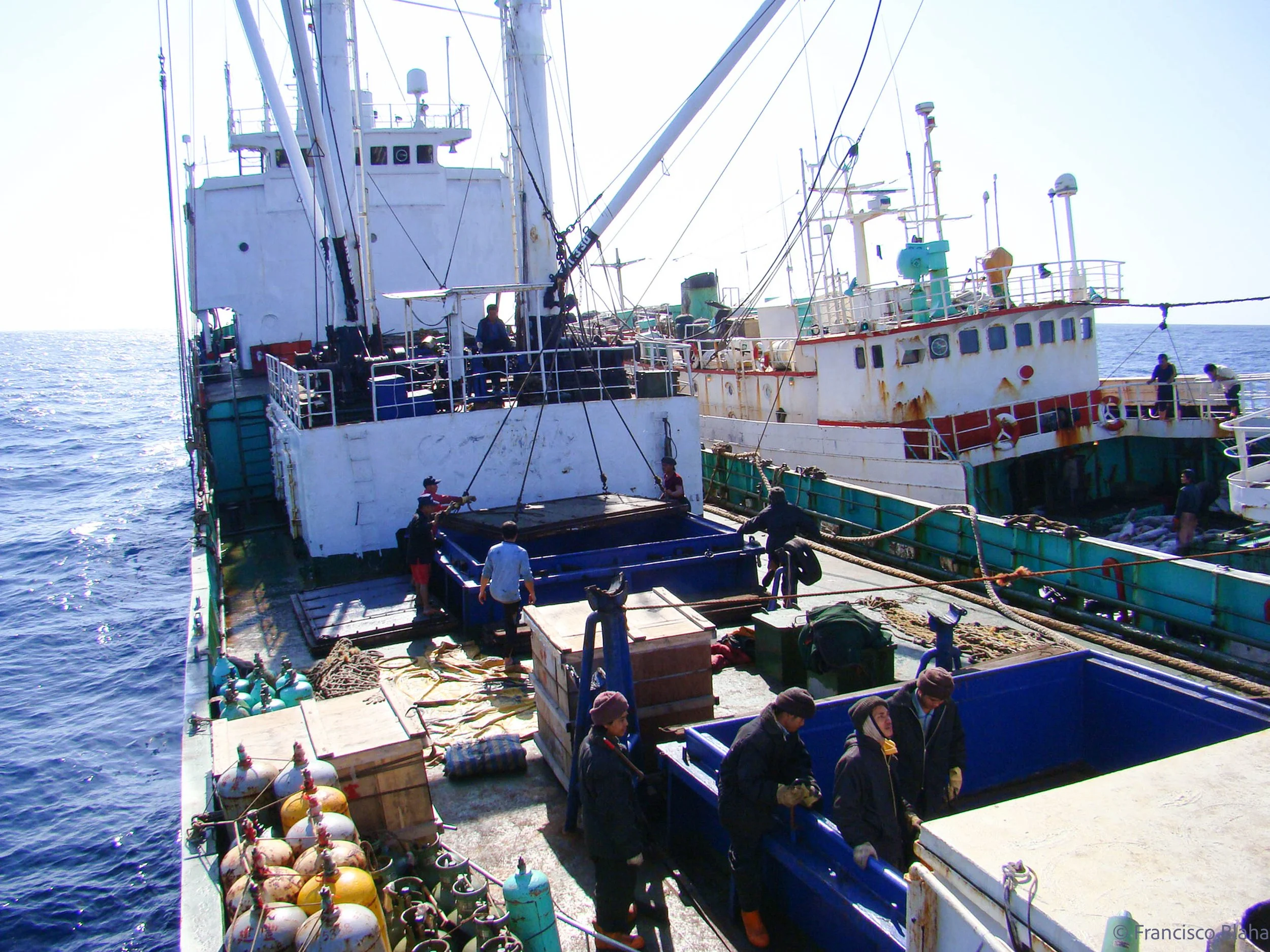
While not its primary objective, the paper focuses on transhipment at sea, which has been linked to higher risks of IUU fishing and other illegal activities. Interestingly, the WCPFC scores well on overall sustainable management of the fishery, yet we still have the loosest HS Transhipment scheme among tRFMOs.
So yeah… below is a summary, but as always, read the original!
The high seas, which constitute nearly half of the Earth's surface, are crucial for global biodiversity and fisheries. Yet, industrial fishing activities have led to significant biodiversity loss, overfishing, and bycatch, posing challenges to the sustainability of marine ecosystems. RFMOs carry a dual mandate under the United Nations Fish Stocks Agreement (UNFSA) of 1995: to ensure the long-term conservation of fish stocks and their ecosystems, and to manage the sustainable use of high seas fisheries.
The study evaluates 16 active RFMOs using 100 performance questions across ten categories, including access and equity, bycatch reduction, illegal, unreported, and unregulated (IUU) fishing prevention, integration of scientific knowledge, spatial management, and stakeholder participation. The authors assign scores (0, 0.5, or 1) based on publicly available information such as meeting documents, conservation and management measures (CMMs), and convention texts.
The average score across all RFMOs was 45.5 out of 100, with the highest being 61.5 for the Western and Central Pacific Fisheries Commission (WCPFC) and the lowest at 29.5 for the North Atlantic Salmon Conservation Organisation (NASCO). Notably, no RFMO achieved a perfect score in any category, highlighting significant performance gaps.
The study found that only one RFMO, the South-East Atlantic Fisheries Organisation (SEAFO), has implemented a complete ban on transhipment at sea. Five other RFMOs—GFCM, IATTC, ICCAT, IOTC, and WCPFC—maintain partial prohibitions, which were rated at 0.5 points in the evaluation. The remaining RFMOs have no restrictions on transhipment at sea, leaving this practice largely unregulated in many high-seas areas. The authors argue that a complete moratorium on transhipment at sea could bring substantial ecological and social benefits, including reducing IUU fishing, safeguarding high seas biodiversity, and addressing human rights issues.
The paper also stresses the importance of RFMOs adopting more rigorous measures to tackle the challenges of transhipment. These include enhancing monitoring and enforcement mechanisms, increasing transparency in transhipment activities, and applying policies that follow the precautionary principle. The authors recommend that RFMOs work together with the United Nations Biodiversity Beyond National Jurisdiction (BBNJ) treaty, which will come into force in 2026, to establish marine protected areas (MPAs) and improve governance frameworks.
The study's findings suggest that RFMOs are not meeting their mandates to manage high-seas fisheries sustainably and to conserve marine biodiversity. Despite having policies and best practices in place, there is little correlation between RFMO management performance and positive outcomes, such as reduced overexploitation of target stocks or lower fishing intensity. Reactionary policymaking, external environmental factors, and ineffective enforcement of RFMO measures may cause this disconnect.
The authors recommend several measures to enhance RFMO effectiveness, including the establishment of permanent no-take MPAs covering at least 1% of RFMO convention areas, immediate reductions in allowable catches to combat overfishing, and a complete ban on transhipment at sea. They contend that no-take MPAs are more successful than multi-use protected areas in achieving conservation objectives, as they support considerably higher fish biodiversity and can provide spillover benefits to nearby exclusive economic zones (EEZs). Furthermore, banning transhipment at sea would mitigate the risks of IUU fishing and improve transparency and accountability in high seas fisheries.
The paper also highlights the importance of good governance in RFMOs to prevent regulatory capture and ensure fair decision-making. The authors note that some RFMOs have allowed industry representatives to participate in decision-making processes, raising concerns about conflicts of interest and the risk of regulatory capture. They advise RFMOs to adopt robust governance measures, such as those used by the International Pacific Halibut Commission (IPHC), including comprehensive rules to manage conflicts of interest.
In conclusion, the paper highlights the urgent need for RFMOs to improve their performance in managing high-seas fisheries and conserving marine biodiversity. The authors advocate for stronger collaboration between RFMOs and the BBNJ treaty to address existing governance gaps and implement effective conservation measures. By prioritising long-term conservation and adopting a precautionary approach, RFMOs can better fulfil their mandates and support the sustainable use of high seas resources.