As usual at this time of the year, SPC’s flagship tuna publication, “The Western and Central Pacific Tuna Fishery: 2024 Overview and Status of Stocks,” is out.
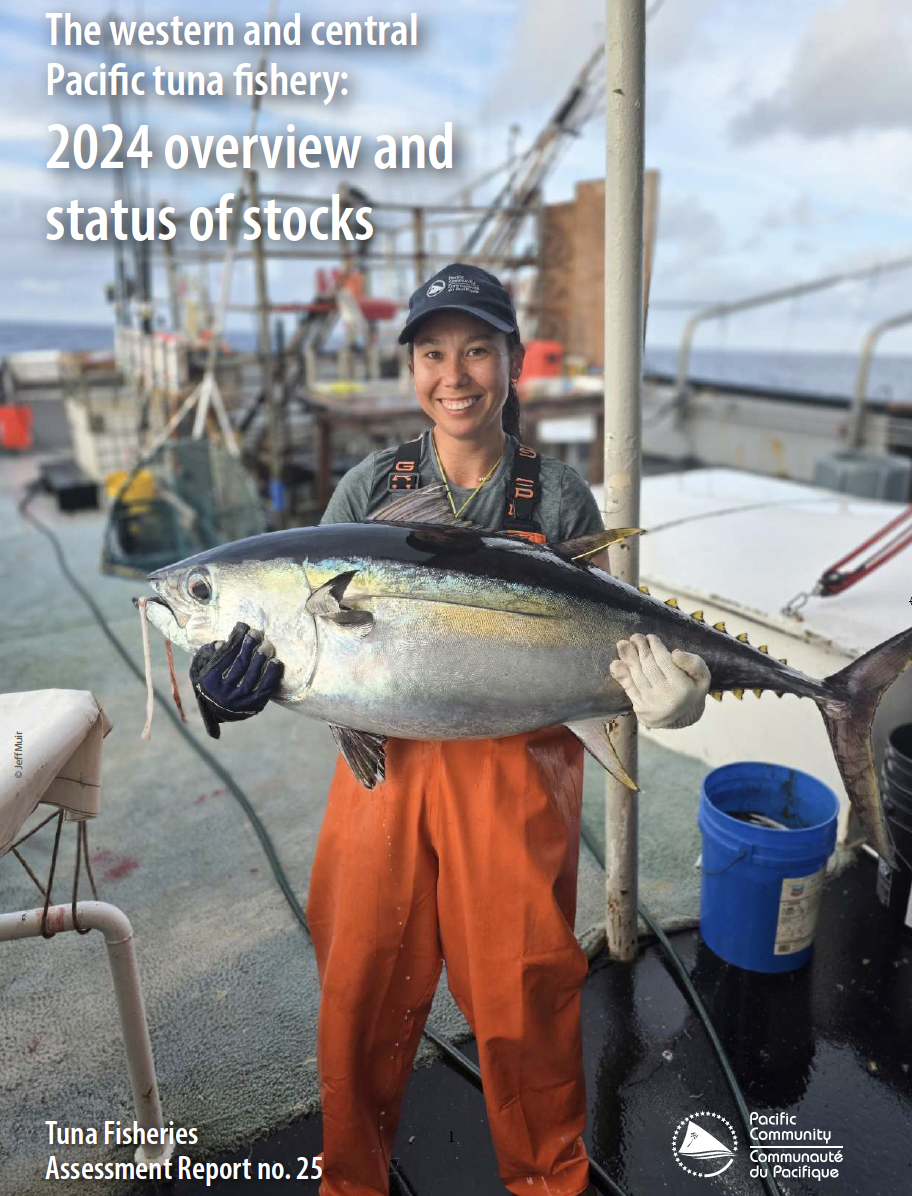
The publication always has well-crafted graphs and tables (Plus now pictures, some of them mine). It has a few changes from the draft version prepared in time for the WCPFC Annual Meeting, and this final version, which got more thoroughly scrutinised, has some changes immediately apparent and others requiring closer reading. But the overall story is consistent, tuna stocks are doing well, and measures taken are improving some of the bycatch problems we have.
The news still talks about the collapse of tuna fisheries in the Pacific, that the (name your geopolitical nemesis, i.e., China, the US, Korea, Japan, EU, etc.) are taking all the fish, that the regional management organisations are secret, that we need eco-labels to know if fisheries are sustainable, and so on.
This document includes analyses of the fishery by species and fleet type, the impact of climate change, and much more. Like most things in life, there is good and bad news. Some things are going well, while others are not. However, if you look closely, you can see beyond the surface.
If you're reading this blog, it's probably because you're interested in tuna fisheries in the region. SPC is the data and science provider to the WCPFC and has some of the world's top stock assessment scientists. Therefore, this publication is essential reading for any informed discussion.
Overview of the Western and Central Pacific Tuna Fishery
The 2024 report provides a comprehensive assessment of the tuna fishery in the western and central Pacific Ocean, highlighting record catches and stock statuses.
Overview of Tuna Fishery Developments
The 2024 catch reached 3,059,005 metric tonnes, a 15% increase from 2023.
This catch represents 56% of the global tuna catch, which is estimated at 5,498,369 t for 2024.
The fishery includes small-scale artisanal operations and large-scale industrial fisheries.
Tuna Catch by Gear Type in 2024
Purse-seine accounted for 70% of the total catch at 2,146,139 t, marking the highest catch ever.
Longline fishery contributed 8% with 247,350 t, a 6% increase from 2023.
Pole-and-line fishery landed 139,405 t, 34% of its peak in 1984.
Artisanal gear accounted for 17% of the total catch, reaching a record 518,840 t.
Tuna Catch by Species in 2024
Skipjack tuna catch was 2,045,720 t, the highest ever, representing 67% of total catch.
Yellowfin tuna catch was 741,473 t, 3% below the highest value recorded in 2021.
Bigeye tuna catch was 151,611 t, 22% below its peak in 2004.
Albacore tuna catch was 120,201 t, a 19% increase from 2023 but below its historical high.
Fishing Effort and Fleet Dynamics
The number of active purse-seine vessels peaked at 313 in 2014-2015, with 59% flagged to Pacific Island countries in 2024.
Longline fleet size decreased to 2,158 vessels, with a 12% increase in hooks fished to 666 million.
Pole-and-line fleet continued to decline, with only 63 vessels remaining in 2024.
Status of Tuna Stocks Overview
The report summarises the status of key tuna stocks, including skipjack, yellowfin, bigeye, and albacore.
Assessments indicate that overfishing is not occurring for these stocks, although fishing pressure varies across regions.
Skipjack Tuna Stock Assessment
The 2025 assessment indicates that recent fishing mortality is 0.35 times the level associated with maximum sustainable yield (MSY).
Spawning biomass is estimated at 51% of the level predicted without fishing, well above the limit reference point (LRP).
The stock is stable, with zero probability of dropping below the LRP under current fishing conditions.
Yellowfin Tuna Stock Assessment
The 2023 assessment shows yellowfin catch at 741,473 t, with fishing mortality below MSY.
Spawning biomass has levelled off since 2010, with no risk of breaching the LRP under average fishing conditions.
Recent fishing mortality rates for both juvenile and adult fish have increased, but overfishing is not occurring.
Albacore Tuna Stock Assessment
The South Pacific albacore catch in 2024 was 74,591 t, 21% below the 2017 record.
The assessment indicates that fishing mortality is below MSY, and the stock is not overfished.
Ongoing assessments are crucial for understanding stock dynamics and ensuring sustainable management.
Fishing Mortality and Stock Status of Tuna
Fishing mortality rates and stock status of key tuna species in the Western and Central Pacific Ocean (WCPO) indicate varying levels of sustainability and differing management needs.
Fishing mortality and depletion levels differ by region, with the highest impact in tropical areas due to purse-seine fisheries.
WCPFC is advised to reduce fishing mortality on yellowfin tuna, particularly from fisheries targeting juveniles, to enhance yields and protect spawning biomass.
Structural uncertainties in stock assessments necessitate cautious interpretation of data for management decisions.
SC19 recommends maintaining yellowfin tuna fishing mortality at levels that sustain spawning biomass at 2012-2015 levels until a target reference point (TRP) is established.
Bigeye Tuna Stock Assessment
The 2024 catch of bigeye tuna in the WCPFC-CA was significantly lower than historical highs, with a diverse catch distribution across fishing methods.
Total bigeye catch in 2024 was 151,611 t, with 36% from longline and 33% from purse-seine fisheries.
The majority of catches occur in equatorial areas, with significant juvenile catches from domestic fisheries in the Philippines and Indonesia.
Recent assessments indicate that fishing mortality has increased since 1970 but is currently below maximum sustainable yield (MSY) levels.
Spawning biomass is above the limit reference point (LRP), and the stock is not overfished or experiencing overfishing.
South Pacific Albacore Tuna Overview
The South Pacific albacore tuna catch in 2024 increased slightly but remains below historical highs, with longline fisheries accounting for the majority of the catch.
Total catch in 2024 was 74,591 t, an 8% increase from 2023 but below the 2017 high of 94,499 t.
Longline fishing accounts for 95% of the catch in recent years, primarily targeting larger adult albacore.
The 2024 stock assessment indicates that the albacore stock is not overfished, with a median spawning biomass depletion of 0.48.
Fishing mortality has been increasing, particularly for adults, but remains below MSY levels.
Summary of Target Tuna Stocks
All four target tuna stocks in the WCPO are currently assessed as healthy and sustainable, with no signs of overfishing.
The stocks include skipjack, yellowfin, bigeye, and South Pacific albacore, all showing a 0% probability of overfishing.
A Majuro plot illustrates the stock status, indicating that all stocks are above their respective MSY reference points.
Uncertainty in stock status estimates is acknowledged, emphasising the need for ongoing monitoring and assessment.
Progress in Harvest Strategy Development
The WCPFC is making strides in developing harvest strategies for key tuna stocks, with varying levels of progress across species.
CMM 2022-03 mandates the establishment of harvest strategies for key fisheries and stocks.
Significant progress has been made for skipjack, with a management procedure adopted and implemented.
South Pacific albacore and bigeye are still in the development phase for management procedures, with candidate TRPs identified for evaluation.
The mixed fishery approach aims to align management objectives for yellowfin and bigeye tuna.
Tuna Tagging Initiatives
Large-scale tuna tagging efforts are crucial for enhancing stock assessment data and understanding fishery dynamics in the WCPO.
Over 497,051 tunas have been tagged and released since 2006, with 69,667 reported recaptures.
Tagging data is integrated into stock assessment models to improve estimates of fishery exploitation rates and population sizes.
Ecosystem Considerations in Fisheries
Observer coverage and bycatch data are essential for understanding the ecological impacts of tuna fisheries in the WCPO.
Observer coverage for purse-seine fisheries is mandated at 100%, but actual coverage has fluctuated, peaking at nearly 65% in 2023.
Bycatch rates differ between associated and unassociated purse-seine sets, with associated sets having a higher bycatch rate.
Interactions with protected species, such as marine turtles and seabirds, are low, but increased observer coverage in longline fisheries is needed to improve data quality.
Climate and Ecosystem Indices
Climate change and ecosystem indicators are being monitored to assess their impacts on tuna fisheries and broader marine ecosystems.
The El Niño Southern Oscillation (ENSO) significantly influences climate variability and tuna distribution in the Pacific.
Sea surface temperatures (SSTs) in the WCPO have shown long-term warming, with 2024 an anomalously warm year.
Marine heatwaves have increased in frequency and duration, potentially affecting marine ecosystems and tuna populations.
Projected Impacts of Climate Change
Climate change is expected to alter the distribution and abundance of key tuna species, with significant implications for fisheries management.
Projections indicate a shift in tuna stocks towards the central and eastern Pacific Ocean due to climate change.
Historical fishing pressure has reduced adult stocks by 30-55%, with climate change effects becoming more pronounced in the long term.
The SEAPODYM modeling framework is being used to assess the impacts of climate change on tuna populations under different greenhouse gas emission scenarios.
Fishing Effort Indices for Tuna Gears
The data presents various indices of fishing effort for tuna in the western and central Pacific region from 1960 to 2024.
Fishing effort is categorised by gear type: purse-seine, longline, and pole-and-line.
Effort totals exclude specific domestic vessels from Japan, Indonesia, the Philippines, and Vietnam.
Longline effort data prior to 1970 is considered unreliable and removed; pole-and-line data prior to 1972 is also excluded.
The table shows a gradual increase in fishing effort over the years, with notable spikes in the 1970s and 1980s.
Skipjack Tuna Catch by Gear Type
The catch data for skipjack tuna by gear type in the WCPFC-CA from 1960 to 2024 indicate trends and changes in fishing practices.
The total catch in 2024 is projected at 2,045,720 metric tonnes, with longline, pole-and-line, and purse-seine the main contributors.
The highest catch recorded was in 1991 at 1,025,148 metric tonnes.
The pole-and-line catch peaked in 1983 at 278,721 metric tonnes.
The data shows fluctuations in catch over the years, with a general upward trend in recent decades.
Yellowfin Tuna Catch by Gear Type
The yellowfin tuna catch data from 1960 to 2024 highlights the distribution and trends in fishing practices.
The total catch in 2024 is projected at 741,473 metric tonnes, with longline, pole-and-line, and purse-seine as the primary methods.
The highest recorded catch was in 1991 at 465,436 metric tonnes.
The longline catch peaked in 1996 at 91,887 metric tonnes.
The data indicate a decline in catch in recent years compared to historical peaks.
Bigeye Tuna Catch by Gear Type
The bigeye tuna catch data from 1960 to 2024 illustrates the trends and changes in fishing practices for this species.
The total catch in 2024 is projected at 151,611 metric tonnes, with longline as the dominant gear type.
The highest recorded catch was in 1998 at 161,641 metric tonnes.
The longline catch peaked in 1996 at 58,054 metric tonnes.
The data shows variability in catch over the years, with a notable increase in the early 2000s.
Albacore Tuna Catch by Gear Type
Albacore tuna catch data from 1960 to 2024 provides insights into the species' fishing practices and trends.
The total catch in 2024 is projected at 74,591 metric tonnes, with longline as the primary method.
The highest recorded catch was in 1997 at 76,780 metric tonnes.
The longline catch peaked in 2017 at 91,868 metric tonnes.
The data indicate fluctuations in catch, with a general decline in recent years.
Biological Reference Points and Stock Status
The biological reference points and stock status for various tuna species provide insights into their sustainability and management.
Recent spawning biomass for albacore is 341,308 metric tonnes, while for bigeye it is 672,600 metric tonnes.
The maximum sustainable yield (MSY) for albacore is 101,100 metric tonnes, indicating that biomass is currently below MSY.
The number of models used for assessments varies: albacore has 100 models, and skipjack has 300.
The data highlights the need for effective management strategies to ensure sustainable tuna populations.
Tuna Tagging Projects Overview
The total number of tuna tagged during major projects provides insights into the research and monitoring efforts in the Pacific.
The Pacific Tuna Tagging Programme (PTTP) has released 501,497 tags, while the Regional Tuna Tagging Programme (RTTP) released 69,650 tags.
The Skipjack Survey and Assessment Programme (SSAP) released 151,667 tags.
Tagging efforts are crucial for understanding tuna migration patterns and stock assessments.
Climate and Ecosystem Indices
The climate and ecosystem indices provide context for the environmental factors affecting tuna populations.
The Oceanic Niño Index (ONI) indicates the strength and duration of ENSO events, which impact tuna habitats.
Sea surface temperature anomalies are monitored to assess changes in ocean conditions affecting tuna stocks.
The data highlights the relationship between climate change and tuna biomass projections, emphasising the need for adaptive management strategies.