I'm in Argentina at the moment, visiting my 90-year-old dad, so I've been following the coverage of the ITLOS order in the local papers. There hasn't been much depth to the analysis. To be fair, this one is hard to explain in a news story: the reasoning is technical, and the result is not the clean win or loss a headline needs.
So here is my quick take, as promised, following my first read of Argentina's request in October.
What happened
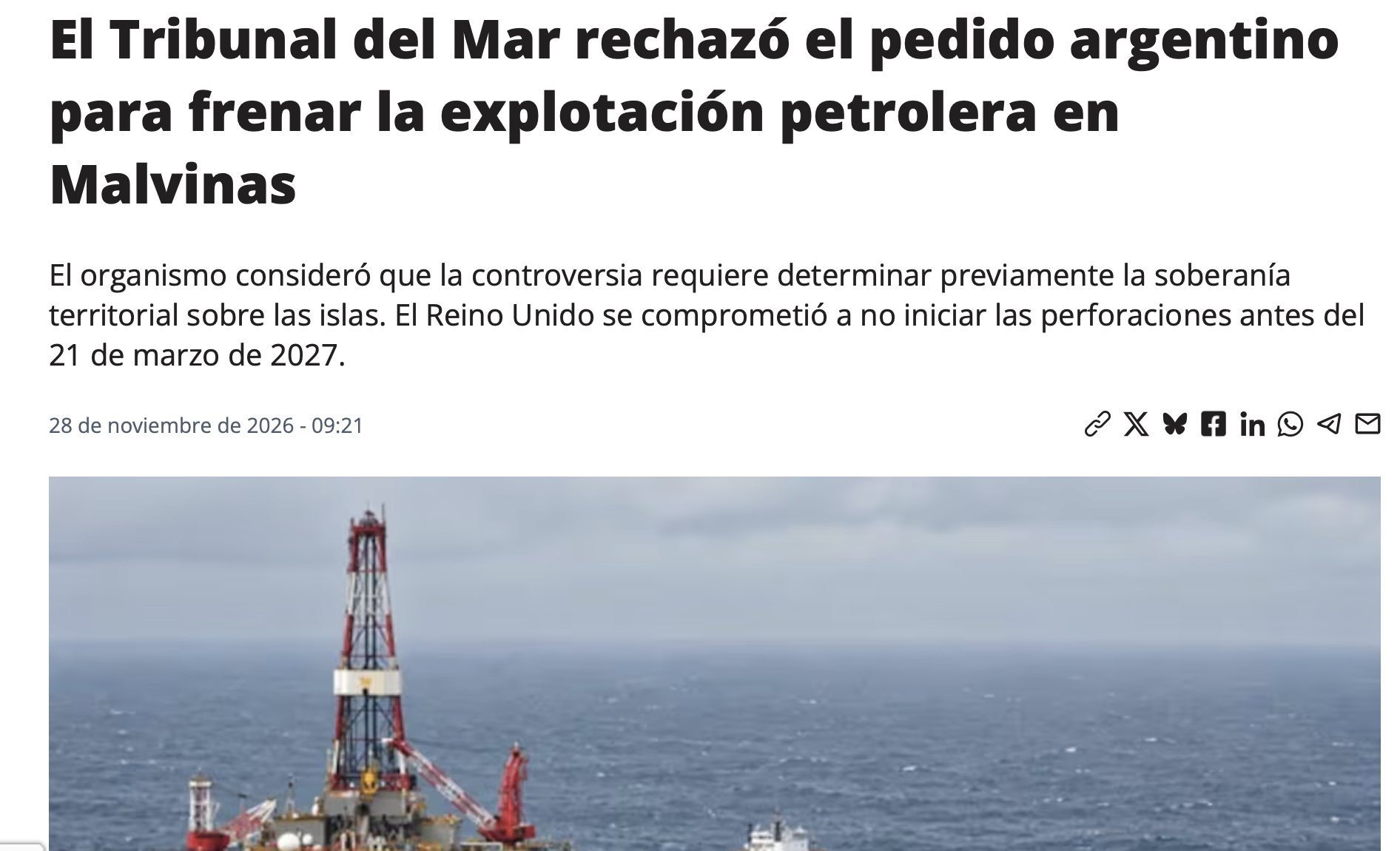
On 28 November the Tribunal rejected Argentina's request by 18 votes to 3. As per my earlier post, I called the main battleground right but got the outcome wrong. I expected the low prima facie threshold to be cleared, as it usually is. Instead the Tribunal found no prima facie jurisdiction at all.
The reasoning is simple to state. Every one of Argentina's claims depends on first deciding who the coastal State is. That is a question of sovereignty over land, not a question of interpreting or applying UNCLOS. The Tribunal also held that Articles 279 and 300 cannot stand on their own as a basis for jurisdiction. Having found no jurisdiction, it never looked at irreparable harm or urgency.
Why Ghana/Côte d'Ivoire didn't fit
I had pointed to Ghana/Côte d'Ivoire as the likely template. That was a delimitation dispute: both states' coastlines were undisputed, and their maritime entitlements overlapped. That puts it squarely inside UNCLOS, so the Special Chamber had prima facie jurisdiction without difficulty. It then weighed the harm and ruled against new drilling, allowing existing operations to continue.
ITLOS makes the distinction itself in paragraph 100. Articles 74(3) and 83(3) deal with conduct pending delimitation where entitlements overlap, and the Tribunal says that is not the situation here. Ghana/Côte d'Ivoire asked where the line falls between two coasts. This case asks whose coast it is.
What Argentina still got
Argentina did not walk away empty-handed. The UK's assurances from the hearing are now on the record: no drilling before 21 March 2027, no extraction before March 2028, and no new licences while the licensing regime is suspended. In practice, that looks a lot like the pause on new activity I expected, but it rests on a UK undertaking rather than an order.
The Tribunal also said the Convention applies in the disputed areas and expects both parties to act accordingly. The Annex VII tribunal should be set up by January, and this order doesn't prejudge its jurisdiction. So filing before drilling started did buy Argentina something, just not what it asked for.
The fisheries angle
Argentina's statement of claim asks for information on how fish resources in the disputed areas are being exploited. On this reasoning, any fisheries claim would run into the same wall as the oil claim, because rights over fish also come back to who the coastal State is. The dispute stays where it has always been, outside UNCLOS dispute settlement, and fisheries management around the islands continues as before.
Still to read
Judges Horinouchi and Patel and Judge ad hoc Vinuesa dissented, and several judges wrote separate opinions. I haven't read them yet. If any of them take on the "who is the coastal State" question, they could be worth a deeper dive.